April 1945. The pine forest of Bavaria was a cathedral of mist and silence—until the screams of dying women shattered it. Three German grandmothers lay on beds of frozen mud, their lungs drowning in pneumonia, their bodies skeletal from starvation. They had been left behind by their own retreating army, discarded like broken tools. And now, an American patrol had stumbled upon them. What happened next would defy every rule of war and every expectation of hatred.
Corporal James Sullivan, a medic from Iowa who had seen the worst of Europe, froze. “They were just… grandmothers,” he later wrote. “Like my own, waiting back home.” But these women were the enemy. And the orders were clear: leave them.
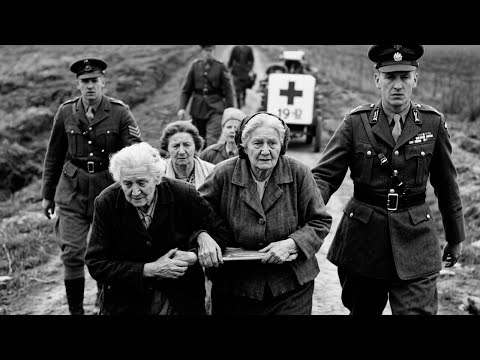
Sergeant Marcus Washington knelt beside the eldest, her breath a wet rattle. Pneumonia. Advanced. Untreated. “They’ve been here three days,” he muttered. “Maybe four. No food. No medicine.” Private Danny Chun, the unit’s translator, spoke gently to the only conscious woman. Her name was Frau Bergman. “We were told Americans would come,” she whispered. “We were told you might help—or at least not harm.” The words hung in the cold air, a desperate hope from a woman abandoned by her own people.
Lieutenant Morrison, just 24, faced a choice that would define him. The nearest aid station was 12 miles back—through rugged, shell-torn terrain. His orders were to advance, not to rescue enemy civilians. “We can’t just leave them,” he said, his voice barely a whisper. “No, sir,” Washington agreed. “We can’t.” The decision was made.
Private Tommy Walsh, a carpenter from Iowa, fashioned stretchers from pine branches and salvaged canvas. His hands worked with frantic precision as the women’s conditions worsened. Frau Keller’s fever spiked. Frau Schmidt slipped into unconsciousness. Only Frau Bergman remained alert, her eyes wide with disbelief as the Americans prepared to carry them. “Why?” she asked Chun. “We are Germans. You are Americans.” Chun paused. “Because you’re sick. Because leaving you to die would be wrong.”
Morrison radioed command. The response was ice: “Negative on route deviation. Civilian casualties are secondary priority. Do not deviate.” He keyed the radio again. “Respectfully, we cannot leave critical patients to die. We are proceeding with evacuation. Morrison out.” He switched off the radio. The men stared at him. He had just defied a direct order. For three old women he had never met.
The journey began. The first hour was agony—muscles screaming, shoulders burning, the weight of the stretchers grinding into bone. Sullivan and Morrison carried Frau Keller, her breath shallow and labored. Behind them, Washington and Walsh bore Frau Schmidt. Chun and Rodriguez followed with Frau Bergman. The forest path was a minefield of roots, rocks, and mud. Every step was a battle.
At the second hour, they reached the jeep—but the road ahead was impassable. They pressed on. Frau Keller’s fever raged. Frau Schmidt stopped responding. Even Frau Bergman’s consciousness flickered. “They’re dying,” Sullivan muttered. “We have to move faster.” But the terrain fought them. The fourth hour brought disaster: Frau Keller stopped breathing. Sullivan dropped the stretcher and ran to her head. “She’s not breathing!” He tilted her head back and breathed for her—one, two, three, four. Washington began chest compressions. “Come on, come on!” he growled. For four agonizing minutes, they fought death. Then—a gasp. Weak, but there. She was alive.
They gave her morphine and lifted the stretcher again. The fifth hour was pure will. Sullivan’s shoulders were raw, bleeding. Morrison’s back spasmed with every step. But they kept walking. “She’s breathing,” Sullivan told himself. “That’s all that matters.”
The sixth hour brought them within sight of Forward Aid Station Baker—a cluster of canvas tents and idling vehicles around a farmhouse that had been converted into a field hospital. Smoke rose from medical incinerators. The organized chaos of military medicine was visible even from a distance. Morrison keyed the radio. “Three critical civilian patients, advanced pneumonia, require immediate intensive care. ETA fifteen minutes.” The response crackled back: “We’re ready. Bring them straight to the main tent.”
The final mile was the longest. Sullivan’s vision narrowed to the path ahead, the pole on his shoulder, and the woman whose life depended on him for fifteen more minutes. His legs moved automatically, muscle memory overriding conscious thought. They reached the aid station as the sun touched the western horizon. Twelve miles in eight hours. Three elderly German women delivered alive.
Doctors and nurses swarmed the stretchers, assessing patients rapidly, calling for antibiotics and oxygen and IV fluids. Morrison collapsed against a tent pole, his shoulders seizing in cramps that made him cry out. Sullivan sat on the ground, unable to stand, his body shaking with exhaustion and delayed stress. Washington pulled off his jacket and found his shoulders bleeding, fabric stuck to torn skin.
Major Hawkins, the aid station’s commanding physician, examined the arrivals, then sought out Morrison. “Who authorized this evacuation?” he asked, not hostile, but curious. “I did,” Morrison replied. “Against orders. Command wanted us to leave them.” Hawkins nodded slowly. “Their own forces abandoned them?” “Yes, sir. Left them to die in a forest with no food, no medicine, no help.” “And you decided that wasn’t acceptable.” “It wasn’t acceptable, sir. They’re human beings. Sick, elderly, helpless human beings. We had the capability to help. Leaving them would have made us no better than the forces that abandoned them.”
Hawkins smiled slightly. “You’re going to face consequences. Colonel Henderson is furious about the deviation from assigned route. But you did the right thing. These women would have died without intervention. Now they have a fighting chance.” He paused. “Off the record, I’d have done the same thing. On the record, I have to report that you defied direct orders to aid enemy civilians, and command will have to decide what that merits.” “I understand, sir.”
Frau Keller survived. Not easily, not quickly, but she survived. The antibiotics available at the aid station—penicillin, just starting to be widely distributed to forward medical units—attacked the pneumonia that had nearly taken her life. Oxygen therapy helped her damaged lungs recover function. IV fluids rehydrated tissue that had been depleting for days. Within forty-eight hours, her fever broke. Within a week, she was conscious and able to speak.
Frau Schmidt recovered faster. Her case was less advanced, her body responding quickly to treatment. Within three days, she was sitting up, eating solid food, asking Chun to translate questions to the American medical staff who had saved her life. Frau Bergman needed the least intensive care but took the longest to recover emotionally. She kept asking why the Americans had helped. Couldn’t reconcile enemy soldiers carrying her twelve miles with the propaganda that had promised American forces would show no mercy to German civilians.
Chun sat with her, explained through translation, and gradually she began to understand that ideology and reality were different things. That humans could choose mercy even toward enemies. That the Americans who had carried her were not monsters, but young men who had seen suffering and decided they could not add to it by abandoning helpless women.
Morrison faced court-martial charges—not formal trial, but administrative discipline for disobeying direct orders during combat operations. He was called to headquarters, required to explain his decisions to officers who valued military discipline and following command structure regardless of humanitarian considerations. Colonel Henderson was blunt in his assessment. “Lieutenant, you violated direct orders. You took your unit off assigned route, potentially compromising operational security to aid enemy civilians. This is unacceptable insubordination.”
Morrison stood at attention, accepted the criticism, and offered no defense except the truth. “Sir, I believe that leaving three dying women in the forest was morally wrong. I accept full responsibility for my decision and any consequences you deem appropriate.” Henderson studied him for a long moment. “If I had been in your position, Lieutenant, I probably would have made the same choice. But I’m not in your position. I’m in a command position, which means I have to maintain discipline and ensure orders are followed. You’re officially reprimanded for insubordination. This will go in your record. But unofficially—between us—you did something decent in a war that hasn’t had enough decent moments. Dismissed.”
The men faced no official consequences. But the story spread through the division. How an American medical detachment had spent eight hours carrying elderly German women through mountain terrain, had defied orders to provide care to enemies, had chosen humanity over efficiency. Some soldiers thought it was foolish sentimentality. Others saw it as evidence that Americans could maintain moral standards even during total war.
Two weeks later, Frau Keller was well enough to be transferred to a displaced persons camp where German civilians were being processed. Before leaving, she asked Chun to meet the men who had saved her life. Morrison, Sullivan, Washington, Walsh, Chun, and Rodriguez stood in the hospital tent while the three elderly women thanked them in German that did require translation to convey meaning. Frau Keller spoke for all three.
“You carried us when your own people would not. You showed mercy when we deserved only justice for what our nation did. We cannot repay what you have given us. We have nothing to offer except our gratitude and our prayers that God will bless you for your kindness. We will remember. We will tell our families—if we find them—that American soldiers saved our lives when German soldiers abandoned us. We will tell the truth about what happened here so that people understand war does not eliminate all decency, that enemies can choose mercy, that humanity persists even in the darkest times.”
Sullivan felt tears on his face and didn’t bother wiping them away. Washington nodded, unable to speak. Morrison managed a response in German he had learned from Chun. “We did what was right. That’s all.”
The women were transferred the next day. Morrison’s unit resumed normal duties—treating casualties, processing prisoners, moving forward as German resistance collapsed. The war ended three weeks later, and the men returned to civilian lives carrying memories of firefights, of friends lost, and of the particular weight of stretchers bearing elderly women through twelve miles of Bavarian forest.
Forty years later, in 1985, James Sullivan received a letter from Germany. It had followed connections across four decades to find the medic who had helped carry an old woman to safety. The letter was from Frau Keller’s granddaughter. Her grandmother had survived the war, returned to her village, and lived another thirty years before passing peacefully in her bed, surrounded by family.
“My grandmother never forgot,” the granddaughter wrote in careful English. “She taught us that hatred is a choice, that enemies can become saviors, that the Americans who won the war also showed humanity in their victory. We owe you our existence, and we wanted you to know that your mercy multiplied across generations.”
Sullivan sat in his Iowa living room, the letter in hands that were now old themselves, and wept—for the woman he had helped carry, for the war that had required such choices, and for the unexpected grace of knowing his decision had rippled forward through decades to touch lives he would never meet.
He wrote back. The correspondence continued for years, letters crossing the Atlantic, building a connection between families that had once been enemies but were united by one moment of mercy in a Bavarian forest. Washington framed the photograph and told his grandchildren not about battles or victory, but about carrying elderly enemies to safety. Morrison, whenever asked about the reprimand on his record, always said the same thing: he had disobeyed orders to save dying women, and he would make the same choice again.
Twelve miles through Bavarian forest. Eight hours of carrying. Three elderly German women delivered alive. It was a small moment in an enormous war, barely noteworthy in the grand scope of history. But it mattered—to those women, to their families, to the men who chose to help, and to everyone who hears the story and understands that mercy given to enemies who cannot repay it is perhaps the truest measure of human worth.
So here is the question that remains, decades later, as wars still rage and refugees still flee and armies still abandon the weak: if six young soldiers could defy orders to carry three dying strangers twelve miles through a forest—what excuse do the rest of us have for choosing indifference over compassion when the moment comes?
Report this article
Select a reason for reporting:






