When the first German prisoners of war stepped off transport ships onto Canadian soil in 1940, they were prepared for torture, starvation, and execution. Nazi propaganda had painted the Allies as savage beasts, and these young men—many of them U-boat sailors whose vessels had been sunk in the Atlantic—braced for the worst. But what they encountered instead would shatter their worldview and change thousands of lives forever.
Over 35,000 German POWs were held in Canada during World War II, and the treatment they received was so unexpectedly humane that many later described their captivity as the most transformative period of their lives. This is the story of how a nation at war chose compassion over cruelty, and how that choice cracked the ideological armor of the Third Reich.
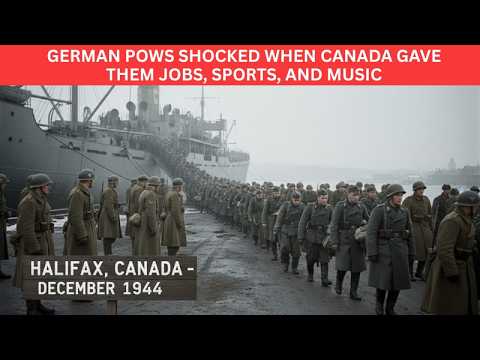
The first shock came the moment they arrived at camps like Lethbridge, Alberta, or Camp 30 in Bowmanville, Ontario. Heated barracks. Three nutritious meals a day. Conditions that many prisoners privately admitted were better than what they’d endured in the German military. One POW wrote to his wife in 1943 that he had gained weight since his capture—a surreal statement to recipients in a Germany growing increasingly desperate.
But physical comforts were only the beginning. Canadian authorities made a controversial decision: they would put prisoners to work, but they would pay them for their labor. This wasn’t the brutal forced labor of Nazi concentration camps—it was structured employment with wages, rest periods, and safety standards. German POWs found themselves in lumber camps across British Columbia, on farms throughout the prairie provinces, and in various projects supporting Canada’s war effort.
Initially, Canadian farmers resisted the idea of German prisoners working their fields. But necessity and proximity changed minds. A prisoner named Helmut Her, documented by historians at the University of Waterloo, described being transported to a farm in southern Ontario in the summer of 1944. He expected slave labor and minimal sustenance. Instead, he found himself invited to eat lunch with the farming family—sitting at the same table, sharing the same food. He recalled his confusion when the farmer’s wife asked if he wanted more potatoes, treating him as a guest rather than an enemy.
This kind of interaction repeated across thousands of farms began to erode the ideological foundations Nazi propaganda had built. These prisoners had been taught that Canadians were mongrel races corrupted by Jewish influence and democratic weakness. But here they were, face to face with families who worked hard, showed Christian charity, and treated them with a dignity supposedly reserved for the Aryan master race.
Sports became another unexpected avenue for breaking down walls. Soccer fields were constructed within camp perimeters, and prisoners organized fiercely competitive leagues. Boxing matches, track and field competitions, even ice hockey games in winter months gave prisoners something to focus on beyond their captivity. What made this truly remarkable was that Canadian guards sometimes participated—playing soccer against prisoner teams or teaching hockey to Germans who’d never seen the sport. These sporting events became significant social occasions, with prisoners crafting makeshift trophies and organizing tournaments involving multiple camps.
Music proved even more transformative. The Canadian government allowed and even encouraged musical activity, and the results were extraordinary. Prisoners formed orchestras, jazz bands, and choir groups that performed regularly. Instruments arrived through Red Cross packages and Canadian donations. The orchestra at Camp 30 in Bowmanville included trained musicians who had performed professionally in Germany, and some Canadian civilians actually requested permission to attend their concerts—curious about the musical talents of men they’d been taught to hate.
For men stripped of freedom, identity, and dignity by capture, the ability to create beauty through music offered a way to reconnect with their humanity. But not all prisoners were alike. The camp at Angler, Ontario—positioned on the remote northern shores of Lake Superior—was designated for hardened Nazis, men who maintained rigid adherence to Nazi ideology and attempted to enforce it among fellow prisoners. This separation of ideological extremists was a Canadian innovation not widely practiced in other Allied POW systems. By isolating the most committed Nazis, Canadian authorities hoped to create space for other prisoners to question the ideology they’d been fed.
Education programs emerged as another unexpected feature. Partnering with organizations like the YMCA, Canadian authorities provided language courses, vocational training, and correspondence courses from Canadian universities. One prisoner, Wolfgang Schmidt, described taking English lessons from a Canadian teacher—an elderly woman whose own son was fighting in Europe. She brought books, corrected grammar with patience, and once told Schmidt she hoped someone was showing similar kindness to her son if he’d been captured. This moral clarity ran counter to everything Schmidt had been taught about racial hierarchies and total war.
The psychological journey of these prisoners can be traced through letters, diaries, and postwar interviews. Men arrived as soldiers of the Third Reich, many still believing in German superiority. But daily exposure to a society that contradicted everything they’d been told began to create cracks in their ideological certainty. When letters from home described Allied bombing campaigns destroying German cities, food shortages, and the collapse of the Eastern and Western fronts, prisoners had to reconcile these reports with their treatment in Canada. They were warm, fed, paid for their work, and allowed to maintain dignity—while their families back home suffered increasing privation and danger. This cognitive dissonance proved impossible for many to ignore.
The relationship between guards and prisoners evolved in unexpected ways. Guards were often Canadian soldiers deemed unfit for overseas combat due to age or medical conditions—men who took their duty seriously but weren’t consumed by combat hatred. Documented accounts show that guards and prisoners sometimes developed cautious friendships, sharing cigarettes, discussing sports, or simply exchanging greetings that acknowledged their shared humanity. This wasn’t universal—some guards maintained hostility throughout the war—but the overall atmosphere in most Canadian camps was characterized more by pragmatic coexistence than by brutality.
Camp newspapers, written in German and submitted to Canadian censors, provide fascinating insights into how prisoners processed their experience. These newsletters contained camp news, sports scores, announcements about concerts, and carefully worded articles that hinted at the surreal nature of their captivity. One prisoner, whose correspondence is preserved in Library and Archives Canada, wrote to his wife that he had gained weight since his capture—a statement that must have seemed impossible to recipients in a Germany growing increasingly desperate.
The story of German POWs in Canada is not one of softness or naivety. It is a story of moral clarity in the midst of total war—a decision to treat enemy soldiers as human beings, to uphold the Geneva Convention not as a burden but as a principle. And it is a story that would have profound consequences, not just for the prisoners themselves, but for the world they would return to after the war.
The camp newspapers reveal something subtler than mere news reporting. In their pages, prisoners debated the war’s progress, reviewed books, and even published poetry—carefully sanitized, of course, but unmistakably human. One 1943 issue from Camp 132 in Medicine Hat ran a column titled “Was Werden Wir Tun?”—”What Will We Do?”—in which prisoners speculated, in cautious language, about life after the war. The very act of imagining a future beyond the Reich was, for many, a quiet act of rebellion.
Canadian authorities walked a delicate line. They could not appear to be re-educating prisoners—that would violate the Geneva Convention—but they also understood that rigid Nazi discipline within camps bred violence and unrest. The solution was subtle: they simply let Canada speak for itself. The warm barracks, the paid labor, the shared meals, the soccer matches—these were the arguments, and they proved more persuasive than any pamphlet.
Not every prisoner was transformed. Some remained committed Nazis to the end, and the camp at Angler recorded bitter ideological disputes, fistfights, and even a few murders among prisoners who enforced loyalty through fear. The camp’s isolation on Lake Superior’s remote north shore was no accident—it was designed to remove the most dangerous ideologues from the influence they craved. Yet even there, the cracks appeared. Letters from home grew more desperate. The promised victory never came.
Perhaps the most telling evidence of change came in the final months of the war. As Germany collapsed, Canadian camp administrators noticed a shift in the mood of the prisoners. Men who had once sung Nazi songs fell silent. Some requested permission to listen to BBC broadcasts. Others asked their guards, hesitantly, what life in Canada was really like—the wages, the farms, the schools.
When the war in Europe ended in May 1945, thousands of German POWs in Canada faced a question they had never anticipated: did they want to go home? Repatriation was mandatory under international agreements, but the process dragged on for months, and during that time, prisoners wrote letters to Canadian officials asking about immigration procedures, job prospects, and whether a former enemy soldier might one day be welcome.
Some of those requests were granted. A small number of former POWs eventually returned to Canada as immigrants, bringing their families and settling in the very prairie towns and Ontario farmlands where they had once labored as captives. One former prisoner, who had worked on a Manitoba farm, wrote to the farmer’s family in 1952 asking whether they remembered him—and received a warm reply inviting him to visit.
Historians who interviewed these men decades later found a recurring theme in their testimony. They had arrived in Canada expecting monsters and found ordinary people. They had been taught to hate and were met with patience. And in the end, many of them carried a quiet conviction for the rest of their lives: that the country they had been sent to as enemies had, in some strange way, given them back their humanity.
Yet the story does not end with gratitude. It ends with a harder question—one that historians still debate. Was Canada’s humane treatment of POWs a genuine expression of principle, or a calculated strategy to weaken Nazi ideology and win the peace that would follow? The answer, preserved in the archives, is almost certainly both. And that ambiguity is precisely what makes the story so remarkable.
Decades later, when the last of these men were old, interviewers asked them what they remembered most. Not the food, not the wages, not even the music. They remembered being seen as men when they had been taught they were only soldiers.
Some returned to Germany and never spoke of Canada. Others kept photographs of farm families, exchanged Christmas cards for years, and told their children that the enemy had taught them what humanity meant. A few came back to stay.
The camps are gone now—bulldozed, overgrown, remembered only in archives and the memories of men who are themselves fading. But the question they left behind still waits for an answer from every generation that inherits it.
If you were handed an enemy tomorrow—someone raised to hate you, taught that you are less than human—what would you do with him? Would you have the courage to treat him as Canada once did? Tell us in the comments.
Report this article
Select a reason for reporting:






