Dr. Sarah Chen’s hands trembled as she stared at the photograph. It was a formal portrait, beautifully composed, of two Black women in an elegant parlor. The older woman sat with dignified posture, her eyes serene but penetrating. Beside her stood a younger woman, perhaps twenty-three, her hand resting gently on the older woman’s shoulder. On the back, in elegant script: “Mrs. Josephine Carter and her daughter, Dr. Elizabeth Carter, Atlanta, Georgia, November 1895.”
Dr. Elizabeth Carter. A Black female physician in 1895—just thirty years after slavery, during the brutal rise of Jim Crow. Sarah’s heart raced. This was the kind of discovery she’d dreamed of for her book on African-American women in medicine. But something about the portrait felt off. The intimacy of that hand on the shoulder, the way they stood as equals, not mother and daughter. It was too deliberate. Too guarded.
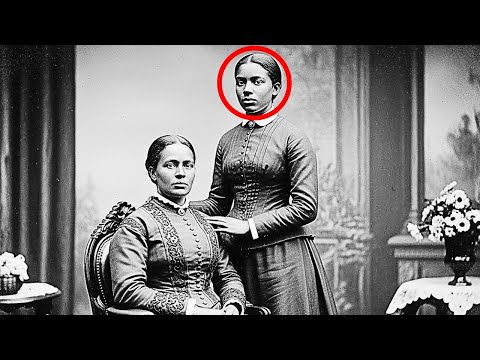
She searched every archive she could think of. Census records confirmed Elizabeth’s occupation as “physician” in 1900, living with Josephine at 847 Auburn Avenue. But beyond that, nothing. No hospital affiliations, no medical society records, no practice listings. Elizabeth Carter had graduated from the Women’s Medical College of Pennsylvania in 1894—one of only two Black women in her class—and then vanished from official history.
Sarah dug deeper. She found a letter Elizabeth wrote to her professor in March 1895: “No hospital will grant me privileges. The medical society refuses my membership. My race and sex present insurmountable barriers. However, I am not deterred. There are women in my community who desperately need medical care… My mother has secured us a suitable location.”
My mother. The phrase nagged at Sarah. Formal, almost distant. And Josephine had purchased the property herself in 1893—as a single woman, with $800 cash. A boarding house, known for its discretion, housing only women. Newspaper mentions spoke of a “safe haven” and “charitable work done quietly.”
Then Sarah found the death notices. Women dying from childbirth complications, their burials arranged by Josephine Carter, their names unrecorded. A pattern emerged. Someone was providing clandestine medical care to Black women who had nowhere else to turn.
Sarah called her colleague Dr. Patricia Moore, an expert in African-American LGBTQ history. After reviewing the evidence, Patricia looked up with knowing eyes. “They were a couple,” she said quietly. “Josephine and Elizabeth. Not mother and daughter—partners.”
The truth clicked into place. Two women, unrelated by blood, living together as mother and daughter to hide their love—and to run a secret medical practice. The boarding house was a front, providing cover for women coming and going at all hours. The community protected them through silence, because they saved lives.
Sarah drove to Oakland Cemetery, where a simple headstone marked their shared grave. The inscription read: “Devoted to each other and to serving their community.” The code was hidden in plain sight.
But the full story was still buried—in a dusty trunk, in a diary, in the margins of history. Sarah had only just begun to uncover the extraordinary courage of Josephine and Elizabeth. What she would find next would change everything.
Sarah sat in her car outside the cemetery for a long time, the engine off, the afternoon light fading. The headstone’s inscription kept repeating in her mind: “Devoted to each other and to serving their community.” It was a public declaration hiding in plain sight—a love letter carved in stone that no one had thought to read.
Back at the archive the next morning, she pulled Ruth Washington’s diary scans again. The name had surfaced twice now—a nurse, a neighbor, a witness. If anyone had documented the daily reality of the Carter household, it was Ruth. Sarah searched the 1900 census for Washington and found her: Ruth Washington, age thirty-two, nurse, living two blocks from the boarding house, widowed, no children listed.
But the diary itself—the original—was what Sarah needed. Evelyn Price had shown her only excerpts. Sarah called her that afternoon and asked the question she’d been circling for days. “Would you trust me with the whole journal? I think there’s more in there than either of us has seen.”
Evelyn hesitated. “My grandmother kept that diary private for a reason. Some of what’s in there isn’t just about the Carters. It’s about her own choices.” She paused. “But you’ve honored them so far. Come by Saturday.”
Saturday arrived gray and drizzling. Evelyn set the leather journal on the kitchen table between them and did not open it. “I want you to understand something first,” she said. “My great-grandmother was not just an assistant. She was part of it. She loved them both, in her way. And she made a choice to stay invisible so they could work.”
Sarah opened the journal to a page she hadn’t seen, dated August 1897. Ruth’s handwriting was small and careful: “Dr. C performed a surgery today that would have been done in any hospital in the North. Mrs. C stood at the door with a lamp. I held the instruments. Three hours. The woman lived. We buried no one this week. God is good.”
Sarah read on. The entries were not just medical notes—they were a ledger of a hidden world. Women arrived at night. Some paid in coins, some in bread, some in nothing at all. Elizabeth never turned anyone away. Josephine kept the books and the cover story and the calm.
Then Sarah reached an entry from February 1901, the week of the arrest. Ruth had written: “They came for Mrs. C on Thursday. A neighbor woman, jealous or frightened, told the police there were strange women at all hours. Dr. C was not home—thank God. She was at the Infirmary delivering a child. I stayed with Mrs. C through the night. She was calm as still water. She said, ‘They can take the house, but they cannot take what we know.’”
Sarah set the journal down. “She was protecting Elizabeth even then.”
Evelyn nodded. “That’s what the diary shows. Mrs. Carter took the risk onto herself, again and again, so the doctor could keep working.”
Sarah turned more pages. An entry from 1910 stopped her cold. Ruth had written: “Dr. C asked me today what I would do if I could live my life again. I said I would do the same. She laughed and said, ‘I would too. Even the hiding. Because the hiding was how we loved.’”
Sarah closed the journal gently. The rain had stopped outside. “There’s something I haven’t told you,” she said. “I found a reference to a trunk. Josephine’s trunk, sent to her sister after she died. It’s in Seattle. I’m going next week.”
Evelyn looked at her for a long moment. “Then you’ll finally see what they were protecting.”
The flight to Seattle gave Sarah too much time to think. She had spent three years reconstructing Josephine and Elizabeth from fragments—a census line, a church ledger, a diary entry written by a woman who loved them enough to keep their secret. Now she was about to open a trunk that had been sealed for over a century, and she was afraid. Not of what she might find, but of what she might not.
Jordan Matthews met her at the airport. He was tall, soft-spoken, a software engineer in his thirties who had spent his whole life believing his great-great-aunt had died childless and alone. “My grandmother always said Josephine was a saint,” he told Sarah as they drove. “But she never said why. Just that she was a saint.”
The trunk sat in his garage beneath a canvas tarp, its brass corners green with age. When Jordan lifted the lid, the smell of cedar and old paper rose up like a breath held too long. Sarah knelt on the concrete floor, her hands shaking as she lifted out the first bundle of letters tied with faded ribbon.
The first letter was dated October 1893, written in Josephine’s hand. “My dearest Elizabeth, I am back in Atlanta and the house is ours. I have counted the money three times and it is enough. There is a room at the back with its own door to the alley, perfect for your work. I have told the neighbors my daughter is coming from school in the North. No one will question a widow wanting her child near her.”
Sarah read aloud, her voice catching. “She planned everything. The house, the cover story, the room with its own door. She built a life for them before Elizabeth even arrived.”
Jordan sat down heavily on an old lawn chair. “She was a strategist. Nobody in my family ever told me that.”
The next bundle held Elizabeth’s medical notes—pages and pages of them, written in a precise, tiny hand. Patient records, but not the kind taught in medical school. No names, only initials. “L.M., age 22, second pregnancy, hemorrhage at four months. Treated with ergot and bed rest. Recovered. Paid in eggs.” Beside it, in Josephine’s handwriting: “L.M.’s husband beats her. Told her to come back if it happens again.”
Sarah looked up. “They were documenting everything. The medicine and the danger. They knew what they were doing was illegal and they wrote it down anyway.”
Jordan picked up a small leather case from the trunk. Inside were three glass syringes, a set of steel surgical instruments wrapped in oilcloth, and a brass pocket watch engraved with the letters E.C. “She carried these,” he said quietly. “She carried them through the streets of Atlanta at night.”
Sarah found the journals at the bottom, wrapped in a quilt. Four volumes, spanning 1893 to 1918. She opened the last one first, unable to stop herself. The final entry, dated May 2, 1918, was barely legible.
“I have not written in weeks. The house is so quiet. I still set two cups at breakfast. I still listen for her step on the stairs. Ruth comes every day and makes me eat. She says Elizabeth would want me to live. But I do not know how to live in a world that no longer contains her. I have asked the church to bury us together. It is the only thing I have left to ask.”
Sarah closed the journal and wept. Jordan put a hand on her shoulder and did not speak.
Sarah stayed in Seattle two more days, reading every page aloud to Jordan while he recorded it all on his phone. By the final volume, they had pieced together what no archive had ever held: a full ledger of the women Elizabeth treated, the children she delivered, the lives she pulled back from the edge of death. “Two hundred and fourteen patients,” Sarah said, her voice raw. “That we can count. Probably twice that we can’t.”
Jordan stared at the open trunk. “My family hid this for a hundred years because they thought it was shameful. It’s the most extraordinary thing I’ve ever read.”
On the plane home, Sarah drafted the article in her head, then stopped. An academic paper wasn’t enough. This needed to be a book, a monument, a living thing. She thought of the house on Auburn Avenue, still standing, still waiting.
Six months later, the Carter-Carter Foundation held its first fundraiser in that restored parlor. The 1895 portrait hung on the wall where it had been taken. Dr. Tamara Brooks announced the clinic had served over a thousand women in its first year. Maya Johnson, now a resident at Grady, stood at the podium and read Josephine’s final journal entry aloud. There wasn’t a dry eye in the room.
Sarah stepped outside afterward, into the warm Atlanta evening. The oak trees whispered. Somewhere behind her, a young woman laughed with her partner, unafraid, unhidden. Josephine and Elizabeth had paid for that laughter in ways no one would ever fully measure.
So here is the question I leave with you: if your love and your life’s work had to be hidden to survive, would you still build them—and who would you trust to remember?
Report this article
Select a reason for reporting:






