Marcus Bennett had restored hundreds of 19th-century photographs, but the moment he slid the fragile portrait from its envelope, something felt different. Two young boys—one white, one black—sat shoulder-to-shoulder on an ornate bench, dressed in identical velvet-collared suits, their hands resting so close their smallest fingers seemed to touch. In 1890 Charleston, South Carolina, this was not just unusual. It was dangerous.
As Marcus enhanced the image on his screen, his breath caught. Behind the painted backdrop, a shadowy figure watched—a woman, her hand raised to her face as if weeping. And on the back of the photograph, a faded inscription read: “Thomas and Samuel, March 1890. Before everything changed.” Marcus had no idea that this single image would lead him into a story of forbidden friendship, a mother’s impossible choice, and a chilling revelation that had nothing to do with ghosts—and everything to do with the cruelty of racism.
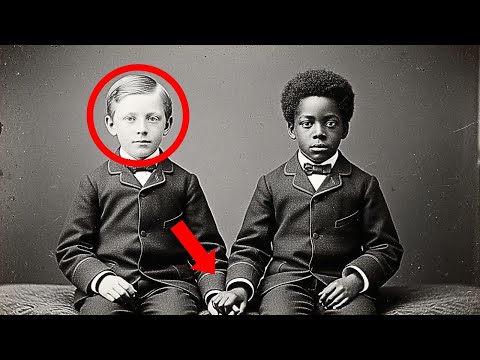
He called the collector who’d sent it, Richard Hartwell, who’d bought it at an estate sale in Columbia. “There’s something about those boys’ faces,” Richard said. “Something sad or frightened. I can’t quite put my finger on it.” Marcus felt it too. He spent the next two days digging through archives, searching for the photographer—Arthur Ellsworth, a man who’d dared to photograph black and white children as equals. A newspaper article from April 1890 revealed that Ellsworth had faced outrage from prominent families. “A child is a child and all deserve to be remembered,” he’d reportedly said. By 1893, his studio had closed.
Then Marcus found a diary entry from Adelaide Whitmore, a friend of the Harrison family. She wrote of a boy named Thomas who insisted his friend Samuel be included in the portrait, dressed identically. “Mrs. H could not refuse him, though she knows the danger of such a display.” Adelaide stood behind the backdrop during the sitting, her heart breaking. “They do not yet understand what the world will demand of them.”
Marcus traced the boys: Thomas Harrison, son of a plantation owner, and Samuel Evans, son of the black housekeeper, Ruth. Born the same year, raised on the same land, they’d formed a friendship in the fluid years after the Civil War. But by 1890, Reconstruction was over, Jim Crow was rising, and the social climate had turned hostile. More diary entries painted a grim picture. “The colonel has forbidden Thomas from playing with Samuel,” Adelaide wrote in April. “The boy is heartbroken and does not understand.” In May, men from town—some associated with white supremacist groups—came to the plantation, warning the colonel to control his household. “They spoke of making examples.”
June 1890: “It is done. Ruth and Samuel are gone.” The colonel had sent them away in the night, giving Ruth money and telling her to leave South Carolina entirely. Thomas locked himself in his room and refused to eat. Margaret, his mother, wept over the photograph. “It is all they have left of their son’s innocence. The last moment before the world’s cruelty reached him.”
Marcus sat back, his hands shaking. The chilling revelation wasn’t supernatural. It was the mundane horror of racism—two boys torn apart, not by death, but by a system built on white supremacy. He traced Samuel to Philadelphia, where Ruth had found work with a Quaker family. Samuel became a teacher and civil rights activist, married, had children. But his journals revealed a lifelong grief. “I dreamed of Thomas again last night,” he wrote in 1920. “We were children playing by the river… I woke with tears on my face. 30 years have passed, and I still miss him.”
In 1918, Samuel wrote to Thomas, but the letter was returned unopened: “Correspondence from colored individuals will not be accepted.” Thomas never married. A 1915 letter from Margaret revealed: “He told me once… that he gave his heart to a friend when he was 8 years old, and that friend was taken from him, and he could never give it to anyone else.” Thomas kept the photograph hidden in a drawer, writing on the back: “The only true friend I ever had. The world stole his capacity for love.”
Marcus restored the photograph, and it now hangs in the Avery Research Center in Charleston, a testament to a friendship that defied Jim Crow—and to the work of building a world where love matters more than skin color. But the story wasn’t over. Samuel’s descendants and Thomas’s great-grandson met for the first time at the exhibition, standing together before the image of their ancestors. “This is what Thomas and Samuel would have wanted,” William Harrison said, tears streaming. “Not just to be remembered, but for us to finish what they started.”
Months after the exhibition opened, Marcus received a call from Patricia, Samuel’s great-granddaughter. Her voice was urgent, almost breathless. “There’s something I need to show you,” she said. “Something we found in my grandmother’s attic. It was in a box that hadn’t been opened since the 1970s.” She wouldn’t say more over the phone. She wanted Marcus to see it in person.
Two weeks later, Marcus stood in Patricia’s living room in Philadelphia, staring at a small wooden box on her coffee table. It was unremarkable—scratched, faded, its hinges rusted. But when Patricia lifted the lid, Marcus felt the air leave his lungs.
Inside lay a second photograph. Same studio stamp, same ornate bench, same painted columns. But this image was different. Thomas and Samuel were not seated side by side. They were standing, facing each other, their hands clasped between them. And they were laughing—genuinely, openly laughing, their faces bright with a joy that the formal portrait had suppressed.
“There’s writing on the back,” Patricia said softly, handing him the photograph. Marcus turned it over. The handwriting was Samuel’s—neat, careful, unmistakable.
“Mr. Ellsworth took two photographs that day. The first was for Mrs. Harrison, to remember us as we were supposed to be. This one was for us. He said every child deserves a picture of themselves happy. Thomas hid this in his coat. I kept it all my life. When I was old, I gave it to my daughter and told her the story. She kept it safe. Now it belongs to the family—both families.”
Marcus’s hands trembled as he examined the image more closely. In the background, barely visible, Adelaide Whitmore stood behind the backdrop—but in this photograph, she wasn’t weeping. She was smiling. And beside her, a man Marcus hadn’t noticed before: Arthur Ellsworth himself, the photographer, watching the boys with quiet pride.
“There’s more,” Patricia said. She pulled out a small envelope from the box, yellowed and brittle. “This was inside. It’s addressed to Thomas. It was never sent.”
Marcus opened it carefully. The letter was dated August 1890—two months after Samuel and Ruth had fled Charleston.
“Dear Thomas, Mother says I shouldn’t write to you, that it isn’t safe. But I have to tell you something. I don’t know if you’ll ever read this. I don’t know if I’ll ever see you again. But I want you to know that I’m not angry. I’m not even sad, not really. Because I have this picture of us laughing, and whenever I look at it, I remember that we were happy. Really, truly happy. And no one can take that away. Not the colonel, not the men who came to the plantation, not the whole world. We were friends, Thomas. Real friends. And that was real, even if everything else was a lie. I hope you’re okay. I hope you’re safe. I hope you find someone to laugh with again. But if you don’t, that’s okay too. Because we had this. And this was enough. Your friend always, Samuel.”
Marcus looked up at Patricia, his eyes wet. “Thomas never knew,” he whispered. “He never knew Samuel wrote this.”
Patricia nodded. “My grandmother said Samuel carried this letter with him for years. He never sent it because he was afraid it would put Thomas in danger. But he never threw it away either.” She paused. “We think Thomas should have it. Or at least, his family should.”
Marcus called William Harrison that evening. The old man listened in silence as Marcus described the second photograph, the letter, the laughter frozen in time. When Marcus finished, there was a long pause on the line.
“I’m coming to Philadelphia,” William said finally, his voice thick. “I want to see it. I want to hold it.”
Three days later, William Harrison stood in Patricia’s living room, holding the photograph of his great-grandfather laughing with his best friend. He traced the image with trembling fingers. “He was happy,” William whispered. “All my life, I heard stories about Thomas Harrison—the stern planter, the lonely man, the one who never smiled. But look at him. Look at him.” He broke down then, sobbing openly, and Patricia crossed the room to hold him.
When he recovered, William opened the letter and read it aloud. His voice cracked on the final line: “Because we had this. And this was enough.” He folded the letter carefully and placed it back in the envelope. “I want this displayed,” he said. “Both photographs. The letter. Everything. People need to know that this wasn’t just a tragedy. It was also a love story. A friendship that survived everything the world threw at it.”
Marcus agreed. He spent the next month working with the Avery Research Center to expand the exhibition. The second photograph—the one of the boys laughing—became the centerpiece. Beside it hung Samuel’s unsent letter, and beneath it, a simple plaque that read: “They were happy. That was real. No one could take it away.”
But the story still had one more chapter. A week before the expanded exhibition opened, Marcus received an email from a historian at the South Carolina Historical Society. She’d been researching the Harrison plantation and had found something unexpected: a small, leather-bound journal buried in a box of unlabeled family papers. It had belonged to Thomas Harrison.
The journal’s final entry was dated June 1890—the day Samuel and Ruth left. Marcus opened the attachment with shaking hands.
“They took him away today. Mother says it’s for the best, that it’s dangerous for us to be friends. But I don’t care about danger. I care about Samuel. He’s my brother, even if we don’t share blood. He’s my brother, and they took him away. I don’t know if I’ll ever see him again. I don’t know if I’ll ever be happy again. But I know this: I will never forget him. I will never stop loving him. And someday, somehow, I will find him. I will find him, and I will tell him that he was right. That we were happy. That it was real. And that no one—not my father, not the men who came to the plantation, not the whole world—could ever take that away.”
Thomas never found Samuel. But 130 years later, their families found each other. And in a small exhibition hall in Charleston, two photographs hung side by side: one of two boys sitting formally, hands touching, their faces serious; the other of two boys laughing, their hands clasped, their joy undeniable.
Marcus stood before them on the opening night of the expanded exhibition, surrounded by the descendants of both families. Patricia and William stood together, their arms linked, tears streaming down their faces. “They would have wanted this,” Patricia said. “Not just to be remembered, but to be understood. They were just two boys who loved each other. And that love was real.”
William nodded. “And it’s still real. It’s here, in this room, in all of us. They started something. And we’re finishing it.”
Marcus looked at the photographs one last time. The boys stared back at him—serious in one, laughing in the other. Two children, frozen in time, their friendship preserved in silver and paper. He thought of Samuel’s words: “We had this. And this was enough.” It wasn’t enough. It should have been more. They should have had their whole lives. But it was something. It was a testament. It was a promise.
And as the exhibition doors opened to the public, Marcus knew the story wasn’t over. It was just beginning.
Marcus stepped back as the first visitors entered, their footsteps hushed against the polished floor. A young girl paused before the laughing photograph, tugging her father’s sleeve. “Daddy, they look so happy,” she said. He knelt beside her, reading the plaque aloud, and she grew quiet, her small hand finding his.
Later, Patricia found Marcus by the window, watching the sun set over the Ashley River. “You know what haunts me?” she asked. “That letter. Samuel never knew if Thomas ever got to be happy. And Thomas never knew Samuel forgave him for not writing back.”
Marcus nodded slowly. “Maybe that’s what this exhibit is for,” he said. “Not to answer the questions they never got to ask—but to make sure we keep asking them.”
Outside, the river carried its old, patient current toward the sea, indifferent to the century it had crossed. And somewhere in the quiet gallery, two boys kept laughing, refusing to be forgotten.
What would you have done—if a friendship like Thomas and Samuel’s had been yours to protect?
Report this article
Select a reason for reporting:






