For nearly two thousand years, they lay in absolute darkness—sealed inside clay jars, tucked into the crevices of limestone caves, baking in the relentless heat of the Judean desert. Nobody knew they were there. Nobody was looking for them. And when a teenage shepherd finally stumbled into that cave in 1947, tossing a rock after a lost goat and hearing the unmistakable crack of ancient pottery, he had no idea he had just triggered one of the most important archaeological discoveries in human history.
The Dead Sea Scrolls—more than 900 manuscripts, over 25,000 fragments—were the oldest surviving copies of the Hebrew Bible, predating anything scholars had ever seen by roughly a thousand years. For decades, the story seemed clean: a reclusive Jewish sect called the Essenes wrote them at a remote settlement called Qumran, then hid them from the Romans in 68 CE. Case closed. Except it was never really closed.
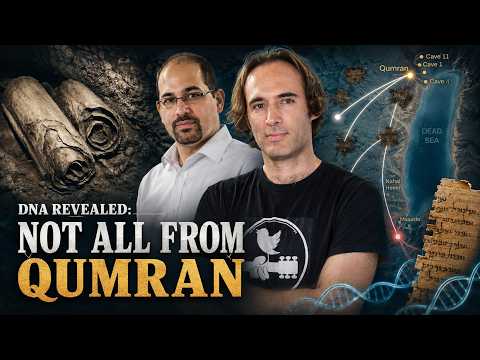
In 2020, a team of scientists did something no one had ever done before. They extracted ancient DNA from the animal skins on which the scrolls were written. And what they found shattered the tidy story that scholars had been telling for over 70 years. The scrolls did not all come from Qumran. Some of them came from far away.
This is the story of how molecular biology cracked open the greatest archaeological puzzle of the 20th century—and what it revealed about a period of history that shaped the foundations of the Western world.
Let me take you back to the very beginning. The year is 1947. The British Mandate over Palestine is collapsing. Tensions between Arab and Jewish communities are escalating toward open conflict. And somewhere in the barren, sun-scorched wilderness east of Jerusalem, a Bedouin shepherd named Muhammad ed-Deeb is searching the limestone cliffs along the northwestern shore of the Dead Sea for a stray goat.
The landscape here is brutal. The air is thick with dust. The temperature regularly pushes past 40 degrees Celsius. The terrain is a labyrinth of eroded ravines and jagged rock formations pocked with hundreds of small caves carved by millennia of wind and water. It is not a place where you would expect to find anything of value.
But Muhammad, a teenager from the Ta’amira Bedouin tribe, was not looking for treasure. He was looking for a goat.
As the story goes—and there are several competing versions of exactly how it happened—Muhammad tossed a stone into the dark mouth of a cave high on the cliff face. He expected to hear the bleat of an animal or the dull thud of rock against rock. Instead, he heard something else entirely: the sharp, brittle crack of breaking pottery.
Curiosity pulled him inside. What he found in that cave would change the course of biblical scholarship forever.
Inside the narrow, musty chamber, Muhammad discovered several tall, cylindrical clay jars. Most were empty, but a few still contained their cargo: bundles of ancient parchment wrapped in linen cloth, darkened by age, but remarkably intact. Seven scrolls in total, written in Hebrew and Aramaic—texts that had not been read by human eyes in roughly two thousand years.
Muhammad did not understand what he had found. Neither did his companions. The scrolls were taken back to the Bedouin camp, handled casually, passed around. Eventually, they were brought to a cobbler and antiquities dealer in Bethlehem named Khalil Iskander Shahin, known locally as Kando. Kando recognized that these were old, possibly valuable.
The scrolls began making their way through a chain of dealers, middlemen, and religious figures. Some ended up with Athanasius Samuel, the Archbishop of the Syrian Orthodox Monastery of St. Mark in Jerusalem, who purchased four of them for a sum equivalent to roughly $28. Others were acquired by Eleazar Sukenik, a professor of archaeology at the Hebrew University of Jerusalem, who—in one of the great dramatic ironies of the 20th century—purchased three scrolls on November 29th, 1947. The very same day that the United Nations voted to partition Palestine.
Sukenik immediately recognized what he was holding. These were ancient Jewish manuscripts of extraordinary age and significance. The Great Isaiah Scroll—a nearly complete copy of the biblical book of Isaiah, stretched over seven meters long and dated to roughly the second century BCE—was the oldest known copy of any complete book of the Hebrew Bible, predating the next oldest manuscript by more than a millennium.
The implications were staggering. Here was physical proof that the text of the Hebrew Bible had been transmitted with remarkable fidelity over an almost incomprehensible span of time. But the scrolls also contained differences—variations in wording, alternative phrasings, entire passages that diverged from what later became the standardized text. The picture was suddenly far more complicated than anyone had imagined.
And the discoveries were only beginning.
Between 1949 and 1956, a frantic race unfolded between Bedouin treasure hunters and professional archaeologists. The Bedouin had realized that these scraps of ancient leather could be sold for significant sums, and they scoured the cliffs with extraordinary determination. Archaeologists, led initially by the French Dominican scholar Roland de Vaux, launched systematic excavations of the caves and the nearby ruins of Qumran.
In total, eleven caves were discovered in the vicinity of Qumran, each yielding manuscript fragments. Cave 4, arguably the most important, was found in 1952 by Bedouin searchers who spotted bats flying out of a cliff face and correctly deduced that there must be a large cavity behind the rock. Inside, they found the remains of roughly 600 manuscripts—most of them in fragments, many of them buried hastily in the cave floor rather than stored carefully in jars. It looked as though someone had hidden these texts in a desperate hurry.
By the time the dust settled, the collection encompassed more than 900 individual manuscripts represented by over 25,000 fragments. The texts included every book of the Hebrew Bible except Esther. They included previously unknown religious writings, apocalyptic prophecies, community rules, hymns of thanksgiving, commentaries on biblical texts, and mysterious documents describing cosmic battles between the forces of light and the forces of darkness.
And at the center of the scholarly interpretation was Qumran itself.
De Vaux excavated the ruins throughout the 1950s and developed a theory that quickly became the dominant paradigm. The settlement, he argued, was a kind of religious commune—a monastic community of Jewish sectarians who had withdrawn from the corruption of Jerusalem and its Temple. He identified what he believed was a scriptorium, a room dedicated to the copying of texts, complete with tables and inkwells. And he connected the community to the Essenes, a Jewish sect described by ancient writers like Josephus, Pliny the Elder, and Philo of Alexandria.
The Essenes, according to these sources, were an ascetic group who lived in communal settings, practiced ritual immersion, held property in common, and devoted themselves to the study and copying of sacred texts. Pliny the Elder specifically placed a community of Essenes near the western shore of the Dead Sea, north of the fortress of Engedi—a description that matched the location of Qumran almost perfectly.
The theory was elegant. The Essenes lived at Qumran. They wrote and copied the scrolls. When the Roman legions advanced during the First Jewish-Roman War, the Essenes hid their library in the surrounding caves to protect it from destruction. Then the community was overrun, and the scrolls were sealed in darkness for two millennia.
For decades, this was the story. It appeared in textbooks, museum exhibits, documentaries, and popular histories. The Dead Sea Scrolls were the library of the Essenes of Qumran. Case closed.
Except it was never really closed.
Almost from the beginning, there were dissenting voices—scholars who looked at the same evidence and saw something very different. One of the most persistent and vocal critics was Norman Golb, a historian at the University of Chicago, who argued for decades that the scrolls could not have been the product of a single isolated sect. Golb pointed out that the scrolls represented an enormous diversity of literary styles, theological perspectives, scribal traditions, and even languages. Hebrew, Aramaic, Greek, and Nabataean texts were all represented. Some manuscripts reflected strict sectarian rules with references to a mysterious Teacher of Righteousness and a Wicked Priest, but others were straightforward copies of biblical books or popular literary works or legal documents with no obvious connection to any particular sect.
How could one small community in the desert produce such a varied library?
Golb’s alternative theory was provocative. He suggested that the scrolls were not written at Qumran at all. Instead, they had been brought there from Jerusalem, carried by refugees fleeing the Roman advance. The scrolls, in this reading, represented not the narrow worldview of a single sect, but the broad literary and religious culture of Second Temple Judaism as a whole.
Other scholars pushed back from different angles. Israeli archaeologists Yizhar Hirschfeld and Yitzhak Magen, who excavated Qumran for over a decade, argued that the site was nothing more than a pottery factory, with no evidence of the kind of religious communal living de Vaux had described. Rachel Elior of Hebrew University went even further, arguing that the Essenes as described by Josephus may never have existed at all—that the ancient accounts were literary constructions rather than historical descriptions.
The debate grew heated. Some scholars described the pro-Essene and anti-Essene camps as being on the verge of physical confrontation at academic conferences. Magen called the proponents of the Qumran-sect theory a guild with money and conferences. Golb accused his opponents of trying to silence him. The argument over the origins of the Dead Sea Scrolls became one of the most contentious disputes in all of biblical scholarship.
And for decades, the debate was stuck. The physical evidence—the pottery, the architecture, the paleography, the carbon dating—could be interpreted in multiple ways. What scholars needed was a completely new kind of evidence, something that could cut through the interpretive fog and provide concrete empirical answers about where these scrolls actually came from.
That new evidence arrived in 2020, and it came from a source no one had expected: the DNA of sheep. The scrolls were written on parchment made from animal skin, and skin contains DNA. If you could sequence it, you could determine the species—and, more importantly, whether two fragments came from the same flock, the same region, the same ancient world.
The man who led the effort was Oded Rechavi, a molecular biologist at Tel Aviv University, whose usual research focused on tiny worms. His collaborator was Noam Mizrahi, a philologist of ancient Hebrew. The two met in 2012 on a bus during a faculty orientation and bonded over a shared, if unusual, interest in worms. Rechavi worked on microscopic worms; Mizrahi worked on what worms had left behind—ancient manuscripts ravaged by time and decay.
The technical challenges were enormous. The scrolls are among the most precious artifacts in existence, and every touch risks damage. So the team worked with microscopic samples—tiny specks, sometimes literally scroll dust. They had to filter out millennia of human contamination and isolate only the ancient animal DNA. After seven years, they published their results as the cover story of the journal Cell.
The first finding was simple but important: nearly all fragments tested—24 of 26—were made from sheepskin, not goat, overturning a long-standing assumption. The real breakthrough came from comparing the genetic relationships between individual sheep. Fragments from closely related animals likely came from the same place. Fragments from genetically distinct animals almost certainly came from different locations.
Eight fragments showed genetic signatures from closely related sheep—and seven of those eight had independently been classified by handwriting and spelling as products of Qumran scribal practice. The DNA and the philology pointed in the same direction. These scrolls were local.
But others told a very different story. One fragment of Jeremiah was made from cowhide; another from sheepskin. Cows could not be raised in the arid desert around Qumran. The cowhide scroll had to have been produced elsewhere—in the agricultural heartland of Judea, or beyond. It was an import.
And the two Jeremiah fragments contained different versions of the text—one shorter, closer to the Greek Septuagint; one longer, closer to the traditional Hebrew. Both circulated at the same time. The idea of a single, fixed, authoritative Bible simply did not exist in this era. The holiness of the text, as Mizrahi put it, did not extend to its precise wording.
Another revelation involved the Songs of the Sabbath Sacrifice, a mystical text describing angelic worship in the heavenly temple. Ten copies were found at Qumran, plus one at Masada. Scholars assumed the Masada copy had been carried there by refugees from Qumran. The DNA said otherwise: the Masada parchment came from a genetically distinct sheep, a different breeding population entirely. The Songs had not traveled from Qumran to Masada. They were widely circulated—something of a bestseller in the ancient world.
And one Isaiah fragment matched no known Qumran population at all. It hinted at undiscovered caches still waiting somewhere in the Judean desert.
This mattered because the world of scroll scholarship was also grappling with a modern crisis: forgery. In 2020, an investigation concluded that all sixteen fragments in the Museum of the Bible’s collection were fakes—ancient leather inscribed with modern ink. DNA offered something no forger could replicate: the genetic fingerprint of the animal was fixed at the moment the parchment was made.
So what does it all mean? The scrolls were not the library of one isolated sect. They were a cross-section of Jewish thought during one of the most creative and contested periods in Western religion—the world that gave birth to both rabbinic Judaism and Christianity. A Judaism that was not monolithic but pluralistic, not rigid but dynamic, not confined to one place but spread across an entire region.
And the research is far from over. Only 26 fragments have been sampled out of more than 25,000. As techniques improve, the picture will sharpen. Somewhere in those cliffs, sealed in darkness, there may be more.
The scrolls are still speaking. We are only now learning how to listen.
So here’s my question for you: if you could send one team of scientists back into the Judean desert tomorrow, which mystery would you want them to chase first—the lost caches hinted at by that anomalous Isaiah fragment, or the full genetic map of the 25,000 fragments we already have? Tell me in the comments—I read every single one.
Report this article
Select a reason for reporting:






