Unteroffizier Hans Müller stepped off the train in Medicine Hat, Alberta, in the summer of 1943, bracing for the worst. He expected snarling guards, barbed wire, and the cold brutality of a prison camp. Instead, a Royal Canadian Mounted Police officer offered him a cigarette and asked, in broken German, whether his journey from the port had been pleasant. Müller, a 24-year-old Wehrmacht soldier captured after months of desert fighting under Rommel in North Africa, was certain this courtesy was a psychological trick—a prelude to the real cruelty.
He could not have been more wrong. Over the following weeks, Müller and thousands of other German POWs would confront a truth that shattered their assumptions: Canada’s treatment of enemy prisoners was no deception. It was a genuine commitment to the Geneva Conventions, often exceeding the minimum requirements. They received food rations better than many Canadian civilians had during wartime rationing, and housing that seemed luxurious compared to the front lines.
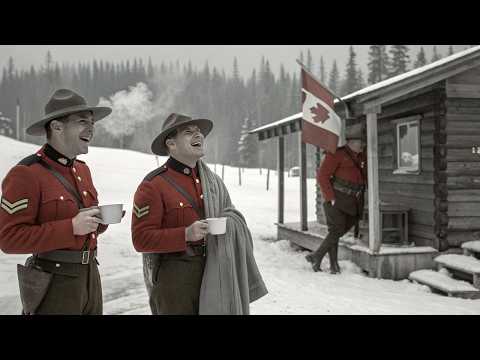
The scale of German POW detention in Canada was staggering. By 1945, roughly 34,000 German prisoners were held in camps across the country, making Canada one of the largest detention centers for Axis POWs outside Europe. The decision to house them there rather than in Britain was practical: Britain, facing invasion fears and overcrowded prisons, had asked Canada to take thousands of prisoners. Canada’s remote location made escape nearly impossible, and its vast landscape offered isolated sites for camps like Lethbridge and Medicine Hat—each designed for up to 12,500 prisoners.
These were not mere stockades. The camps boasted barracks for 350 men, recreation halls for 3,000, educational huts, workshops, and dining facilities. The RCMP and veteran guards—many from World War I—maintained order with a light touch, reflecting a belief that fair treatment would reduce escape attempts.
Food became the most visible and controversial aspect of camp life. Local Canadians complained that German prisoners ate better than they did—and they were largely right. POWs received the same rations as their Canadian guards, though prisoners often had better cooks and more time to prepare meals. For soldiers like Müller, arriving from North Africa where food was scarce, the three full meals a day—with meat, fresh vegetables, bread, and dairy—seemed almost unbelievable. In letters home, he described his astonishment at portions that were “extravagant” compared to what German soldiers had at the front.
The cognitive dissonance was profound. Nazi propaganda had claimed that the Allies starved their prisoners. Yet here was proof to the contrary, forcing many POWs to question everything they had been told about their enemies. “We were taught to hate them,” one prisoner later recalled. “But they treated us like guests.”
The respect shown by RCMP officers and guards was not an isolated phenomenon. Former Luftwaffe pilot Horst Liebeck, shot down over England and held at Camp Heron Bay on Lake Superior, returned to Canada after the war, became a citizen in 1958, and built a successful business—a path unimaginable had his captivity been brutal. Numerous German POWs chose to emigrate to Canada after the war, a testament to the impression the country left on them.
Work programs further surprised the prisoners. By 1945, about 11,000 German POWs were employed in forestry and agriculture, earning a symbolic wage. Unlike forced labor systems, Canadian programs followed Geneva guidelines, forbidding work directly supporting the war effort and requiring reasonable conditions. Rudolf Reese, a POW who worked on the Case family farm near Lethbridge, was treated like family, had his own small house on the property, and ate with the family. When the war ended, farmer Joe Case called it a sad farewell—a bond that transcended prisoner and guard.
Recreation and education rounded out the surreal experience. Camp 133 in Lethbridge hosted regular soccer tournaments, while camps across Canada offered theater performances, music, classes, and hobby activities. Prisoners published camp newspapers, organized language lessons, and created art. Canadian authorities encouraged these pursuits, believing that long-term detention required mental stimulation to prevent psychological decline. For men who had spent months in combat where survival was the only priority, the chance to study, play sports, or paint seemed almost otherworldly.
But the humane treatment did not erase deep ideological divisions. The shackling crisis of 1942 brought political tensions to the fore. After the Dieppe raid, Germany ordered British POWs shackled in retaliation for alleged British orders to shackle German prisoners. Britain responded by ordering German POWs in their custody—including those in Canada—to be shackled. In Camp Bowmanville, Ontario, German prisoners barricaded themselves in buildings, leading to a violent confrontation in which one prisoner was shot and over a dozen guards were injured.
Canada’s response was telling. Rather than escalate, Canadian authorities decided to ignore the British orders and run their camps according to their own interpretation of the Geneva Conventions, asserting sovereignty over detention policy and refusing to implement measures they saw as violations of international law. This decision reflected Canada’s determination to uphold treatment standards it deemed appropriate, regardless of British pressure.
The psychological impact on German prisoners was lasting. Many had believed Canada was nothing but forests and Indians, and knew only that Canadians were good fighters. Discovering a developed nation with beauty, opportunity, and people who treated them with basic decency forced a reckoning with Nazi propaganda. Some prisoners clung to Nazi ideology, isolating themselves and refusing to participate in activities they saw as fraternization. Others gradually adjusted their worldview, acknowledging that their treatment suggested not everything they had been told was true. A few underwent profound ideological transformations, rejecting Nazi beliefs entirely.
The internal dynamics sometimes turned violent. In 1943 and 1944, two POWs were murdered by fellow prisoners on orders from the camp’s Nazi leadership. The RCMP investigated, and several Germans were arrested and transferred to lumber camps in Northern Ontario. These incidents revealed shadow power structures within the camps, where dedicated Nazis tried to enforce loyalty through intimidation and violence. Canadian authorities responded by segregating hardcore Nazis—Camp Medicine Hat was designated for the most devoted—to reduce their influence on others.
As the war ended, the question of what would happen to the German prisoners stirred both anxiety and hope. Canadian public opinion was divided: some argued that prisoners who had proven themselves on farms and in factories should be allowed to stay, while others, including the Canadian Legion, passed resolutions opposing their remaining. For prisoners who had experienced Canadian hospitality and come to appreciate the country, returning to a devastated Germany was unappealing. Harry Pool, a 19-year-old merchant sailor captured and put to work on a farm near Brooks, Alberta, told his new wife after returning to Hamburg that he would go back to Canada—and she agreed.
The Canadian government eventually established immigration programs allowing some former POWs to return as immigrants, provided they demonstrated they were not committed Nazis and could contribute to Canadian society. The legacy of Canada’s treatment of German POWs extends beyond individual stories, illuminating broader questions about how nations treat captured enemies and what such treatment reveals about national character. Canada’s decision to uphold Geneva Convention standards, even when politically controversial or practically inconvenient, reflected values that would become central to Canada’s international identity in the postwar period.
The treatment succeeded in its immediate practical goal: maintaining order in the camps and preventing escape attempts that would have diverted resources from the war effort. More importantly, it left positive impressions of Canada on thousands of German prisoners, some of whom became Canadian citizens, and all of whom carried memories that contradicted Nazi tales of Allied cruelty. The shock that Hans Müller and countless other German prisoners experienced upon discovering that Canadian Mounties treated them as guests rather than hated enemies revealed the power of propaganda to shape expectations—and the equal power of humane treatment to refute them, cigarette by cigarette and train ride by train ride.
Yet the story of German POWs in Canada is not solely one of comfort and enlightenment. For every prisoner who embraced the opportunity to study or play soccer, there were others who seethed with resentment, viewing Canadian kindness as weakness or as a subtle form of humiliation. The camp at Medicine Hat, while designated for the most hardened Nazis, became a tinderbox of ideological fervor. Here, prisoners who remained loyal to Hitler organized secret ceremonies, sang banned songs, and enforced a brutal code of silence against anyone who dared speak well of their captors.
Hans Müller, who had arrived expecting cruelty and found instead a strange, disorienting benevolence, soon discovered that the greatest threat did not come from the Canadian guards but from his own comrades. “They called me a traitor because I wrote home that the food was good,” he later recalled. “They said I was helping the enemy.” Such accusations were not idle; the shadow courts of the camp had already sentenced two men to death for alleged collaboration, and the RCMP’s investigations had only scratched the surface of a deeply entrenched network of Nazi enforcers.
The Canadian authorities, aware of these internal dangers, faced a delicate balancing act. They could not simply punish all Nazi sympathizers—that would have meant imprisoning thousands and undermining the very principles of fair treatment they sought to uphold. Instead, they relied on a combination of segregation, surveillance, and psychological pressure. Camp Medicine Hat’s isolation allowed the most fanatical elements to be contained, but it also created a hothouse where their beliefs grew more extreme. Guards reported hearing late-night rallies and finding crude swastikas carved into barracks walls, reminders that the war of ideas continued even in captivity.
For Müller and others like him, the camp became a microcosm of the larger conflict—a battle for the soul of Germany played out in barrack huts and dining halls. Some prisoners, worn down by months of indoctrination, found the courage to resist the Nazi enforcers, forming small circles of dissent that met in secret to discuss the news from Europe and to question the propaganda they had been fed. Others, terrified of retribution, simply kept their heads down, neither embracing nor rejecting the Canadian hospitality that surrounded them.
The work programs, which had initially seemed like a welcome distraction, became another arena of ideological struggle. Prisoners assigned to farms often found themselves forming genuine bonds with Canadian families, bonds that the Nazi leadership viewed as dangerous fraternization. When Rudolf Reese returned to camp after his time with the Case family, he was interrogated by the camp’s internal tribunal and warned to sever all ties with the enemy. He refused, and from that moment on, he was treated as an outcast by the loyalists—a fate that many others shared.
Yet the Canadian experiment in humane detention continued to yield unexpected results. Letters intercepted by camp censors revealed that even some of the most hardened Nazis had begun to express doubts about the war and about Hitler’s leadership. “We were told the Canadians were savages,” one prisoner wrote to his wife. “But I have seen them weep for their own dead and share their bread with us. How can such people be our enemies?” Such sentiments, though rare, were a crack in the ideological armor that the Nazi leadership had worked so hard to maintain.
As the war in Europe entered its final year, the tension inside the camps reached a fever pitch. News of German defeats on the Eastern Front and the Allied advance toward the Rhine filtered in through newspapers and radio broadcasts that the Canadians permitted. For the loyalists, each report was a fresh wound; for the doubters, a confirmation that the world they had known was crumbling. Müller, who had once believed in the inevitability of German victory, found himself increasingly drawn to the quiet defiance of the dissenters. He began attending their secret meetings, listening to their debates, and slowly, painfully, allowing himself to consider that everything he had been taught might be a lie.
The Canadian guards, observing these developments with a mixture of professional detachment and private sympathy, did what they could to encourage the moderates without appearing to interfere. They turned a blind eye to the secret discussion groups, provided extra food to prisoners who showed signs of ideological flexibility, and even arranged for German-speaking officers to engage in informal conversations that gently challenged Nazi dogma. It was a subtle campaign, waged with cigarettes and kind words rather than rifles and batons, and its effects would not be fully known until long after the war had ended.
But the ideological battle was not the only challenge facing the Canadian authorities. As the end of the war approached, the question of what to do with the prisoners became increasingly urgent. The Canadian public, weary of rationing and sacrifice, had little patience for the idea of coddling enemy soldiers. Letters to newspapers demanded that the prisoners be sent back to Germany immediately, and some politicians called for them to be put to work rebuilding the devastated countries they had helped destroy. The government, caught between its commitment to international law and the pressures of domestic politics, began to plan for a gradual repatriation—a process that would take years and that would leave many prisoners wondering if they would ever see Canada again.
For Hans Müller, the end of the war brought a strange mixture of relief and sorrow. He had survived, but the Germany he had known was in ruins. The country he had been taught to hate had treated him with a humanity he had never expected, and now he faced a choice: return to a homeland that might never recover, or seek a new life in the land that had held him captive. It was a decision that thousands of German POWs would face in the months and years to come, and their choices would leave an indelible mark on both Canada and Germany.
Müller chose Canada. In 1947, after two years of paperwork and interviews designed to weed out committed Nazis, he boarded a ship from Bremerhaven with a single suitcase and a letter of recommendation from a Lethbridge farmer. He worked the sugar-beet fields of southern Alberta, learned English from a radio, and by 1955 owned a small hardware store in Medicine Hat—the very town where a Mountie had once offered him a cigarette.
“They asked me if I hated them,” he wrote to his sister in 1948. “I told them I could not hate a people who fed me when my own country starved me.”
Horst Liebeck built his business. Harry Pool returned with his Hamburg bride. Rudolf Reese visited the Case farm every Christmas until Joe died. And in the camp at Medicine Hat, where swastikas had once been carved into barrack walls, a small plaque was later mounted by former prisoners—a quiet thank-you in two languages.
The legacy was never simple. Some prisoners went home hardened, convinced the kindness was a trick. But thousands carried Canada in their bones, and their children grew up hearing that the enemy had once been the most decent people their fathers ever met.
So here is the question, dear reader: if a single cigarette and a full plate can undo years of hatred, what might we still be able to change today—and who will be brave enough to offer it first?
Report this article
Select a reason for reporting:






