The snow fell in relentless sheets, blanketing the Texas hills in a silence so deep it seemed to swallow the world. It was December 1864, and fourteen-year-old Alice Todd was riding behind her father, her fingers numb from the cold, when the first war cry shattered the stillness. In an instant, her life—and the lives of everyone who loved her—would be torn apart.
Alice was a sweet-natured girl with a kind disposition, beloved by her schoolmates at the small school in San Saba. Among them was Molly Winn, a girl who would carry the memory of that fateful day for nearly eighty years. “I loved her dearly,” Molly would later recall, her voice trembling with the weight of decades. But love could not protect Alice from the storm that was coming.
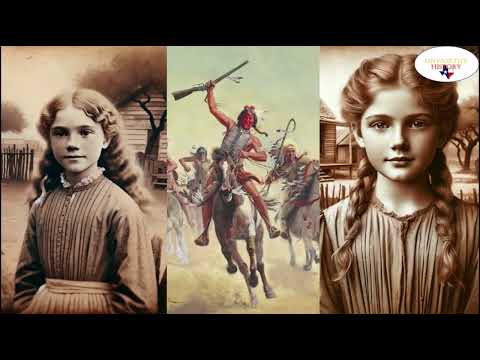
The attack was swift and brutal. The Indians charged upon the Todd family as they traveled back to school after the Christmas holidays. Alice’s mother, Disenia, was wounded so severely that she died five days later. The black slave girl riding behind her was killed instantly. In the chaos, Alice’s horse bolted, and she fell—straight into the hands of her captors. Her father, George Todd, could only watch in horror as his daughter was carried away into the blinding snow.
That night, a blizzard descended upon the frontier, the snow measuring fourteen inches on the level. It was as if the heavens themselves mourned Alice’s fate. “No trace was ever found of Alice following her capture,” Molly Winn would say, her words a haunting echo across the years.
But the story of Alice Todd did not end with her disappearance—it only began. Her father would spend years searching, begging the state and federal government for help, following every rumor, every whisper of a white girl seen among the Comanche. Her half-brother, Jim Smith, would die in a tragic accident while gathering wild honey, a venture undertaken solely to fund the endless search. And Molly Winn, the schoolmate who stayed behind, would grow old with the memory of a friend who vanished into the snow, her fate forever sealed in mystery.
As the years passed, the frontier changed, but the question remained: What became of Alice Todd? Was she adopted into the tribe, or did she meet a darker fate? The answers lie buried in the past, waiting to be uncovered.
Molly Winn never forgot. She was just a girl herself when Alice vanished, but the memory of her friend’s bright face and the horror of that Christmas season stayed with her through eight decades. “All of the girls except myself went to their homes to spend the Christmas holidays,” she recalled, her voice a thin thread across the years. Because of the Indian danger, her father had insisted she stay behind in San Saba. That decision saved her life—and doomed her to a lifetime of wondering.
When word reached the school that Alice had been taken, Molly wept. She would later describe Alice as having “a sweet, kind disposition,” a girl everyone loved. But love could not bring her back. The frontier was a hard place, and the Comanche were masters of it. They moved like ghosts across the snow, leaving only mutilated bodies and unanswered questions in their wake.
The search parties set out almost immediately. Among them was a young man named Win, whom Molly would later marry. He and others trailed the Indians for days, following faint tracks through the drifts. “They followed them far beyond where San Angelo now stands,” Molly said. But the snow fell relentlessly, covering the trail, and the searchers were forced to circle for miles, losing precious time.
At the foot of the Staked Plains, the Indians split into three bands—one heading west, one northwest, one southwest. The trail went cold. “Many strange stories were told about her,” Molly admitted, “but nothing definite was ever known.” Some claimed to have seen a white girl among the Comanche, but none could say for certain it was Alice. Her father, George Todd, refused to give up. He wrote letters, petitioned officials, and followed every rumor. But the government had other concerns—the Civil War was raging, and the capture of a young girl on the Texas frontier was hardly a priority.
Alice’s half-brother, Jim Smith, took up the search with a fervor that bordered on obsession. He scraped together every penny he could, selling wild honey gathered from hollow trees and caves to fund his travels. “He did everything possible to find her,” Molly recalled. But fate was cruel. While lowering himself over a cliff by rope to reach a honeycomb, the rope snapped. Jim fell to his death, and with him died the last best hope of finding Alice.
He was buried beside his mother, and the search for the missing schoolgirl effectively ended. “Whatever became of her will remain a mystery,” Molly said. But the mystery did not sit idle. It gnawed at the edges of the frontier, a story told around campfires and in parlors, a warning to children to stay close and a reminder to parents that the wilderness was always hungry.
And yet, the story of Alice Todd was not so different from countless others. The same year she was taken, a man named Beardy Hall—the same long-bearded rider who had promised his gray horse would carry him out of danger—was killed and tortured by Indians just miles from San Saba. His body was found horribly mutilated, his scalp partially taken. “They must have caught him alive,” Molly said, her voice flat with old grief.
The frontier was a place where death came swiftly and without warning. Captain Williams, a brave man who had protected the settlements for years, was killed while trying to rescue a young cowboy named King. His head was crushed with stones and his body scalped. “His death was due no doubt to the fact that he was unarmed,” the old chronicles noted. Bravery was not enough. The Indians were skilled, relentless, and they knew the land better than any white man ever would.
For Molly Winn, the memories never faded. She lived to be eighty-eight, a prominent citizen of Rock Springs, but in her mind she was still a schoolgirl in San Saba, watching her friend ride away into the snow. “I loved her dearly,” she said. And that love, perhaps, was the only thing that survived the storm.
But the frontier did not pause to mourn. Even as the Todd family reeled from their loss, the settlements around San Saba and Menard County faced a relentless tide of raids. The Comanche struck without warning—at dawn, at dusk, in the dead of night—and every family along the Lampasas and San Saba rivers lived with one eye on the horizon.
Among the dead was Bose Woods, a friend of Beardy Hall, killed in the western part of the county. A man named Maryman was cut down on Jerry’s Branch, barely two miles north of San Saba town. The particulars, the old chronicles said, were not at hand—as if the details of a man’s death were a trifle not worth recording.
Then came the killing of C.C. Carter, a settler on the headwaters of the Lampasas River. He had ridden to visit his son-in-law’s house, just four miles distant, when a party of Indians rose from ambush and fired. Mortally wounded, Carter put spurs to his horse and fled. The Indians tried to cut him off but failed. He reached his son-in-law’s gate and dropped dead from the saddle. His daughter ran to him, but it was too late.
It was into this world—a world of ambush and grief—that George Todd poured his desperate pleas. He wrote to the governor. He wrote to federal officials. He tracked rumors across the state: Alice seen with a Comanche band near the Pecos, Alice living as the wife of a Kiowa warrior, Alice traded to a Mexican family in Chihuahua. Each rumor kindled hope; each rumor died.
Molly Winn heard those rumors too, passed along by travelers and traders who stopped at her father’s house. She listened in silence, a schoolgirl growing into a woman, never forgetting the friend who had vanished into the snow. “Nothing definite was ever known,” she would say—a sentence that carried the weight of a lifetime.
And yet the search went on. Jim Smith, Alice’s half-brother, scoured the hills for wild honey to sell, saving every dollar for the hunt. He rode alone into country where a man’s life was worth less than his horse. He never found her. He died on a rope above a honeycomb, and the frontier swallowed another searcher.
In the end, the frontier closed over Alice Todd like water over a stone. The Civil War ended, the railroads came, and the Comanche were driven onto reservations. But no one ever brought Alice home. “Whatever became of her will remain a mystery,” Molly Winn said in 1941, and she was right.
Some historians believe Alice lived out her life among the Comanche, adopted into a band, married and raising children who never knew their mother’s other name. Others insist she died that first bitter winter, a fourteen-year-old girl lost in the snow. The truth died with the last person who knew it.
George Todd never stopped searching. He petitioned governors and generals, followed every rumor, and died still wondering. His daughter’s fate became a cautionary tale told around Texas campfires—a reminder that the wilderness took what it wanted and answered to no one.
Molly Winn lived to be eighty-eight, a prominent citizen of Rock Springs. She told Alice’s story to a newspaper reporter in 1941, and then she too passed into memory. But the question she left behind still echoes down the years: what really happened to Alice Todd?
Was she a Comanche wife, a mother, an old woman who forgot her own language? Or was she a child who died in the snow, her story ending before it truly began? The record is silent. The frontier kept its secrets.
What do you think happened to Alice Todd? Was she lost forever that December, or did she live a life we can only imagine? Share your thoughts in the comments below.
Report this article
Select a reason for reporting:






