Imagine a world where a single phone call required planning, a letter took weeks to arrive, and finding an answer meant diving into a labyrinth of books. This wasn’t a dystopian nightmare—it was life before the internet, and it was filled with unexpected joys, profound connections, and a pace that taught us to savor every moment.
Before the digital revolution, communication was a deliberate act. Every conversation required effort, turning communication into a conscious choice rather than a reflex. You had to memorize phone numbers, schedule long-distance calls, and wait eagerly for the mail. The anticipation made every connection precious.
In the pre-internet era, the library was our Google. Finding information was a real adventure, requiring patience, effort, and a bit of detective work. Card catalogs, encyclopedias, and librarians were our search engines. The slow process honed critical thinking and made knowledge feel earned.
Music lovers built collections one physical format at a time. Going to the record store was a true adventure, browsing aisles and discovering new artists. Creating a mixtape was an art form, a personal letter crafted through song choices. Each purchase was a treasure, held and cherished.
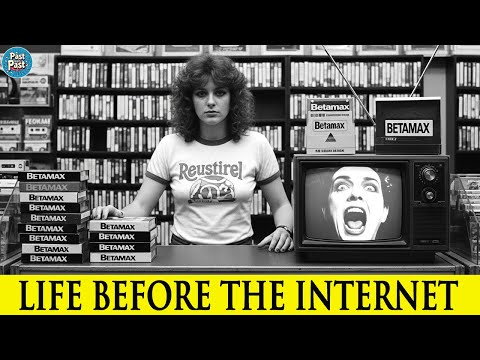
Entertainment was an event, not an endless scroll. Renting a VHS tape from the video store was a treasure hunt, and movie nights were immersive experiences without pause buttons. TV shows aired on strict schedules, creating loyalty and shared anticipation. The limitations made each moment unforgettable.
Shopping required effort and patience. Black Friday meant camping out in the cold, not clicking from your couch. Malls were social hubs, and holding a newly purchased item brought a satisfaction that digital carts can’t replicate.
Travel planning relied on paper maps, guidebooks, and travel agents. Getting lost was part of the journey, leading to chance encounters and memorable stories. The slow preparation deepened your connection to the destination.
Game nights were about direct interaction—gathering around a table with friends and family, no screens, just real conversations and laughter. LAN parties required hauling computers to a friend’s house, creating bonds that online gaming struggles to match.
Cooking was a hands-on tradition, passed down through generations. Handwritten recipe cards, stained cookbooks, and intuition guided home chefs. Every dish was a lesson, and failures were part of the learning process.
Photography was deliberate. Each click of the shutter consumed precious film, making every shot count. The wait for developed photos added to their value, and albums were treasuries of memories.
Design was a meticulous art form, crafted by hand with pens, inks, and brushes. Every poster and advertisement was a work of art, created with patience and skill. The slowness brought depth and soul to each piece.
Privacy and disconnection were normal. Disappearing for days without a trace was freedom—a space to think and be present. Relationships deepened without constant distractions, and self-reliance was a core value.
Life before the internet taught us to cherish every moment, every relationship, and every piece of information. It was a different way of life, one that we’re only now beginning to fully appreciate.
But the story doesn’t end with nostalgia. It continues in the small, unglamorous rituals that shaped entire generations. Take the family telephone, for instance. It wasn’t just a device—it was a shared resource with rules. In many homes, one phone line served everyone, and a teenager tying up the line meant someone else’s call went unanswered. Parents negotiated, siblings bargained, and the coiled cord stretched across hallways as privacy was invented one stretched inch at a time.
Then there was the answering machine, blinking its red light like a tiny beacon of hope. Coming home to that blinking light was its own kind of thrill—a message from a friend, a missed call from a crush, or news from a relative far away. You’d gather around as a family to listen, rewinding the tape to hear a familiar voice one more time.
And who could forget the phone book? Thick, heavy, and delivered to your door each year, it was the original search engine. Flipping through those thin pages to find a plumber, a restaurant, or a long-lost friend was a skill in itself. Sometimes you’d stumble on a name you recognized and wonder what they’d been up to for all these years.
The classroom was another world entirely. Research papers meant index cards, library stacks, and the Dewey Decimal System—not copy and paste. You learned to cross-reference sources, to distrust anything without a bibliography, and to write in your own words because plagiarism was harder to hide when you had to physically copy it out.
Show-and-tell wasn’t a video clip. It was a shoebox diorama, a carefully drawn poster, or a real object brought from home, explained in your own trembling voice. The stakes felt enormous, and the pride of a job well done lasted for weeks.
Recess was unsupervised in ways that would terrify modern parents. Kids roamed neighborhoods on bicycles without helmets, built forts in vacant lots, and came home when the streetlights flickered on. That flicker was the original curfew—a universal signal understood by every child on the block.
Even waiting rooms and road trips had their own rituals. There was no tablet to quiet a restless child—just a paperback, a deck of cards, or the license plate game. Boredom was a companion, and learning to sit with it was an unexpected gift. It taught patience, observation, and the art of making something out of nothing.
And when you finally got home and the phone rang, you had no idea who was on the other end. There was no caller ID, no screen to glance at—just a ringing phone and the delicious mystery of who might be calling. You answered it, every time, because that’s what you did.
These weren’t limitations. They were invitations—to slow down, to pay attention, to be fully where you were. The world before the internet didn’t ask you to be everywhere at once. It asked you to be somewhere, completely.
That invitation extended into the world of work, too. Offices ran on paper trails, carbon copies, and the satisfying thunk of a rubber stamp. Memos were typed, signed, and physically carried from desk to desk. If you wanted to reach a colleague, you walked down the hall—and often came back with a story you hadn’t expected.
Job hunting meant scanning the classifieds with a pen in hand. You circled openings, typed up a resume on a typewriter, and mailed it in an envelope you addressed by hand. Then you waited. And waited. A callback was a small victory; an interview, a genuine event worth rehearsing aloud in the mirror.
Banking was an errand, not an app. Friday afternoons meant long lines at the teller, deposit slips filled out in triplicate, and a passbook updated by hand. Your balance was a mystery until you stood at the counter, and payday was a physical ritual—a paycheck to endorse and cash.
Even the weather had a different rhythm. You read the sky like a book, or waited for the evening forecast to learn whether to hang the laundry out. Farmers, sailors, and picnickers all lived by the same quiet gamble with the clouds, and a surprise rainstorm was a shared misfortune worth complaining about for days.
Then there were the small institutions that held neighborhoods together. The corner barber knew every family’s business, and the diner counter was a parliament of regulars. You didn’t need a review site to find a good mechanic—you asked the man who fixed everyone’s cars, and his reputation was the algorithm.
Community bulletin boards, tacked with index cards and tear-off phone numbers, were the original marketplace. Babysitting gigs, lost dogs, used furniture, guitar lessons—all of it pinned to a corkboard at the laundromat. The whole town’s needs, crowded onto one square of cork.
Children learned the neighborhood by foot. You knew which house had the friendly dog, which shortcut led past the grumpy neighbor, and whose mother always had lemonade. That mental map was drawn slowly, block by block, and it belonged to you in a way no GPS coordinate ever could.
And when someone moved away, the goodbye was real. There was no promise to ‘keep in touch’ that meant a few likes on a screen—letters were exchanged, and sometimes they stopped, and that silence meant something. Distance was honest back then, and so was the effort it took to cross it.
Perhaps that’s the thread running through all of it. Every small inconvenience carried a hidden gift: the gift of intention. You chose who to call, what to write, where to go, and you did it with your whole attention, because the world didn’t offer you a shortcut.
The past wasn’t simpler, exactly. It was slower, heavier, and more deliberate—and in that weight, there was a kind of richness we’re still trying to name.
And that richness showed up in the most ordinary places. The kitchen radio hummed while dinner simmered, and nobody felt the need to check anything else. A knock at the door was an actual event—you never knew who it might be, and you were genuinely glad to see them.
Even the way we handled mistakes was different. If you forgot a birthday, there was no auto-reminder—just the quiet guilt and the handwritten apology that followed. That guilt meant something, and so did the fix.
Maybe that’s what we’re really mourning when we look back. Not the inconvenience, but the attention it demanded—and the connection that attention created. Every letter, every call, every knock on the door was a small vote for someone else.
So the story ends where it began: with a ringing phone, a full mailbox, and a world that asked you to show up in person. It wasn’t perfect, but it was present—and presence, it turns out, was the whole point.
What’s one pre-internet ritual you’d bring back tomorrow if you could? Tell us in the comments—we’d love to hear your story.
Report this article
Select a reason for reporting:






