It was spring, 1934. John Dillinger, the most wanted man in America, with a $10,000 federal bounty on his head, walked into a Chicago apartment, lay down on a bed, and let two doctors cut his face apart with a scalpel. This is the story of the most dangerous plastic surgery in American crime history.
They tightened his cheeks with tendons pulled from a kangaroo. They poured hydrochloric acid on his fingertips and scraped what was left with a blade. He nearly died on that bed, choking on his own tongue while the ether took hold. 48 hours of butchery, all for one purpose: to erase John Dillinger from the face of the earth before the FBI’s G-men could find him.
It almost worked. Almost, because two months later, when the bullets stopped flying outside the Biograph Theater, the very fingerprints he tried to burn away told the coroner exactly who he was.
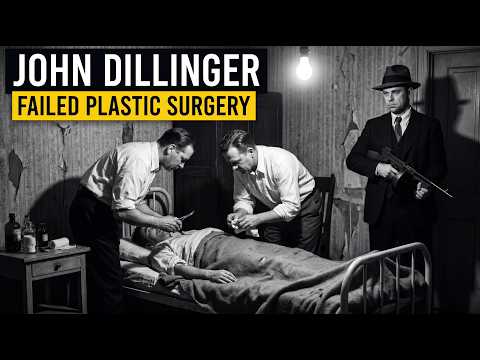
What you just heard sounds like something out of a horror film. It isn’t. Every detail of it happened in a second-floor bedroom on the north side of Chicago over two days in late May of 1934. And the man who let it happen to him was the most photographed criminal in the country at that time.
Hey folks, I’m Mr. V, and welcome back to the Hidden Lands. Today, we’re walking you into a room most history books skip right past. A room with no surgical lights, no nurses, no operating table. A back room bedroom with a bare mattress, a pile of bandages, a bottle of ether, and a glass jar of hydrochloric acid waiting on the side of a table. The man at the bed has a price on his head. Two men standing over him are about to spend 48 hours trying to make him disappear.
So, let’s walk in.
To understand why John Dillinger laid down on that bed, you have to understand what the last 12 months of his life looked like. Between the summer of 1933 and the spring of 1934, Dillinger and his gang tore through the American Midwest like a storm with a road map. 11 bank robberies, over $300,000 stolen. And remember, this was the Depression era, when a working man counted himself lucky to bring home $25 a week.
Three jailbreaks, including one in Crown Point, Indiana, that he pulled off using a wooden pistol he carved himself and blackened with shoe polish. 10 dead bodies trailing behind him, by some counts, a sheriff among them, along with bystanders who had the bad luck of being in the wrong bank on the wrong morning.
What a lot of people don’t know is that Dillinger learned much of what he knew from a man named Harry Pierpont, the sharp, calculating bank robber he had met while doing time at Indiana State Prison, who became his mentor and, for a time, the real strategic brain behind the gang’s early operations. Pierpont was already behind bars when Dillinger was making his biggest headlines, but the education stuck.
The newspapers couldn’t get enough of him. His face ran on the front pages from coast to coast, that famous half-smirk, the dimple in his chin, the small mole on his upper lip. Americans who had lost their farms to those same banks treated him like a folk hero. Songs got written about him. Children played Dillinger in their backyards.
J. Edgar Hoover did not see it that way. On Dillinger’s 31st birthday, June 22, 1933, Hoover and the newly formed Division of Investigation officially named him public enemy number one. A $10,000 reward went out for his capture, dead or alive. The equivalent of well over $200,000 today. Hoover preferred dead.
Special Agent Melvin Purvis got the assignment to bring him in. And Purvis had every federal resource at his disposal. He was hunting other names that same year—Pretty Boy Floyd, Baby Face Nelson—but Dillinger was one Hoover wanted most.
What gave the Division of Investigation, soon to be renamed the FBI, federal jurisdiction over Dillinger in the first place was the charge under the Dyer Act, the National Motor Vehicle Theft Act. When Dillinger drove a stolen car across state lines during one of his escapes, he crossed from one state into another, making it a federal case. That single legal hook gave Hoover’s G-men the authority to pursue him anywhere in the country. It was, in a way, the same legal thread that would eventually pull the whole operation tight around him.
By May 1934, the squeeze was on. Two of Dillinger’s closest associates had already been killed in a shootout up in Wisconsin at a resort called Little Bohemia Lodge, where the FBI tried to trap the whole gang and botched it up badly enough to make the front pages for different reasons. The safe houses were running out. The friendly faces were getting nervous. Dillinger’s girlfriend, Billie Frechette, had already been arrested by federal agents just weeks earlier, cutting off one of his most trusted connections.
Every gas station attendant in the Midwest knew that mole, that dimple, that small scar on his right cheek. Running wasn’t working anymore. Dillinger needed a different plan. He needed to stop being Dillinger.
Every great escape needed an architect. Dillinger’s came in the form of his attorney, a smooth-talking Chicago lawyer named Louis Piquett, who had defended bootleggers, killers, and crooked aldermen for two decades. Piquett knew that the man Dillinger needed was not a hospital surgeon. The man Dillinger needed had to be skilled with a scalpel, comfortable around criminals, and desperate enough to take the job.
That man was Dr. Wilhelm Loeser. Loeser had not always been a back-alley butcher. Born in 1876 in Prussia, he came to America at the age of 12, made his way through the medical schools of Chicago, and graduated as a physician in 1905. He built a respected surgical practice in the city. Colleagues called him a magician with a knife. For a German immigrant who had arrived with nothing, he had climbed about as high as a man could climb.
Then came the fall. Loeser developed a taste for the drug trade. He started selling cocaine and heroin out of his pharmacy. And in 1913, the federal government caught up with him. Three years in prison, paroled after 18 months with help from a young lawyer named Louis Piquett. The same Piquett who would call in a favor 20 years later.
When Loeser came out, his medical career was finished. He fled to Mexico to escape further trouble, and it was down in Mexico that he taught himself something useful. Working alone, with no patient willing to be the first, he started experimenting with hydrochloric acid on his own fingertips, burning away the skin, watching it grow back, refining the technique until he believed he could erase fingerprints for good.
By the spring of 1934, Loeser was broke, exiled, and ready to come home. The deal was simple. A $10,000 bribe, paid through underworld connections, would buy him his safe passage back to Chicago. In exchange, he would do a job for Louis’s most famous client. He would alter the face and the fingerprints of John Dillinger. Loeser accepted.
The location was chosen: the home of Chicago mobster named James Probasco. A small apartment at 2509 North Crawford Avenue. The date was set: May 27, 1934. The doctor was ready, and so was the patient.
The apartment at 2509 North Crawford Avenue was not a clinic. It was a small upstairs flat in a working-class neighborhood, the kind of place a man could rent without anyone asking questions. The bedroom had a bare mattress laid down on the upper floor for the operation. A second man, Dr. Harold Cassidy, an old colleague of Loeser’s, was brought in as an assistant. He was already there, so Homer Van Meter, Dillinger’s lieutenant and best friend, who had decided to go under the knife the same weekend, had his own list of changes. Smooth out the features, get rid of an anchor tattoo on his right arm, burn off his prints.
Dillinger went first. He brought a written list with him. He wanted the small mole off his upper lip removed. He wanted the dimple in his chin filled in. He wanted that depression at the tip of his nose smoothed out. He wanted the moles and scars on his cheeks taken off, and he wanted his fingerprints gone.
Loeser offered him a choice: local anesthetic, where he would be awake and feel every cut, or general anesthesia, where he would be unconscious. Dillinger chose the general ether. Cassidy applied the ether-soaked cloth. Loeser stepped into the bathroom next door to wash his hands one more time before he picked up the scalpel.
Then Cassidy started shouting. Dillinger’s body had gone rigid on the mattress. His face was turning blue. Under the ether, his tongue had rolled back into his throat and sealed off his airway. America’s most wanted man was suffocating on a stranger’s bed in a rented apartment, 60 seconds from being a corpse.
Loeser came running in. He grabbed a pair of forceps on the side table, forced Dillinger’s jaw open, and dragged his tongue forward until the air came back. Dillinger’s color returned. His chest started moving again. That was the closest John Dillinger had ever come to dying, and the FBI had nothing to do with it.
When he came back around, Dillinger refused more of that general anesthetic stuff. He’d take the local, meaning he would be awake for everything that came next. What came next lasted for hours. Loeser worked over his face by lamplight. He cut out the mole on his upper lip. He sliced into his cheeks and pulled tendons—tendons taken from a kangaroo because they were tough enough to hold tension under skin—and stitched them in to tighten the loose flesh. He worked on the chin, trying to fill the famous dimple. He smoothed the nose. Through all of it, Dillinger was conscious. The most photographed criminal in America lay on a rented mattress in a Chicago apartment, eyes wide open while two doctors carved on his face for hours with nothing between him and the pain but a needle of local anesthetic and his own grit.
When they finished, his face was raw, swollen, and barely recognizable to himself or anyone else. Dillinger spent the night on the same mattress. There was no recovery room and no nurse. Just a man with a price on his head and a face that hurt to touch, sleeping a few hours before the worst pain began.
The second day was for the fingerprints. Dr. Loeser had spent months refining his method on his own skin. He believed he had it figured out. What he was about to do to Dillinger and to Van Meter was the procedure he had been practicing for.
Step one: cut away the top layer of skin from each fingertip with a scalpel. Step two: apply hydrochloric acid to what remained, burning the deeper layer of the dermis down to where the ridge patterns live. Step three: scrape that burned tissue away with the blade until the surface looked smooth. That was the theory.
The reality was that Dillinger spent hours sitting up, his hands shaking while Loeser worked one finger at a time. The acid did not numb; it burned. It blistered. The smell of it filled the room. Each fingertip was cut, washed, treated, scraped, bandaged. Then the next one, then the next one. Ten in a row.
Then Loeser was finished with Dillinger. He moved to the second mattress and started on Van Meter. Van Meter got the same treatment: the cuts, the acid, the scraping. Some people think, like me, he must have been nuts. Just saw what happened to Dillinger, but he did it anyway. So all he got was the anchor tattoo carved out of his arm, leaving a raw wound that would take weeks to heal.
By the time the second day ended, both men were, in the words of one historian who studied this case, mutilated and in agony. Their faces were swollen masks. Their hands were wrapped in gauze and could not be used. The total bill came to $5,000. Loeser got that share, while Piquett held back the rest of the bribe money.
What happened next would have been comedy if it wasn’t so dangerous. Van Meter, fevered and furious at the pain, picked up his Thompson submachine gun with bandaged hands and pointed it at, you guessed it, Loeser. He blamed the doctor for the agony. He nearly killed the man who had just spent 48 hours trying to save his life. It took convincing from the others in the room to talk him down. Loeser walked out of the apartment alive, barely.
When the bandages finally came off, Dillinger walked to a mirror and looked at his reflection. The man who looked back at him was still John Dillinger. The dimple on his chin had been filled in, but the shape of his face had not really changed. The mole on his upper lip was gone, replaced by a small scar. His cheeks had been tightened with kangaroo tendons, but they had also been pulled in ways that left him looking puffy, almost feverish. He dyed his hair black, grew a thin mustache, and started wearing wire-rimmed glasses. He thought it would be enough, but it wasn’t.
Over the next 8 weeks, Dillinger hid in a Chicago brothel run by a Romanian madam named Anna Sage. He went to movie theaters. He went to ball games. He walked the streets of his own city, and people kept recognizing him. The face that had been on the cover of Time and Newsweek and every front page in the country was still unmistakably his face.
On the night of July 22, 1934, Anna Sage walked Dillinger into the Biograph Theater on Lincoln Avenue to see Manhattan Melodrama, a Clark Gable gangster picture that was playing that week. She had cut a deal with the FBI’s G-men. In exchange for help with her own immigration troubles, federal agents were waiting outside when Dillinger came out into the warm summer night. He sensed something was wrong, broke for the alley beside the theater, and reached for the pistol in his pocket. Three shots brought him down. One bullet entered the back of his neck, just under his right eye.
The next morning, a Chicago coroner pressed each of his fingertips onto an inked card. The ridges that Loeser had cut, burned, and scraped—the ridges that had cost $5,000 in 1934, that had taken 48 hours of agony to destroy—were still there. Blurred at the centers, but legible at the edges. Enough to match, and enough to confirm without any doubt that the dead man in the Cook County morgue was John Dillinger. The third degree failed.
48 hours of butchery, $5,000, a man who nearly choked to death on his own damn tongue, a doctor who walked out of the apartment with kangaroo tendons in his pocket and a tommy gun pointed at his chest. All of it. Every minute of it. For nothing.
Wilhelm Loeser was arrested two days after Dillinger was killed. The FBI picked him up in Oak Park, Illinois. He turned state’s witness to get Louis Piquett, the same lawyer who had once sprung him from prison, and was then sent back to finish the rest of his old narcotics sentence. He was released a year later, his name finished. He lived another 18 years in obscurity and died in 1953, almost no one remembering what he had done in a Chicago bedroom for the most wanted man in America.
Homer Van Meter outlived Dillinger by exactly one month. He was shot down in a St. Paul alley on August 23, 1934. The anchor tattoo was gone from his arm, but his fingerprints, like Dillinger’s, were still legible enough to identify the body.
John Dillinger himself was buried at Crown Hill Cemetery in Indianapolis, the same city where years before a young man had made a choice that put him on a path to that back-room bedroom in Chicago. The grave drew visitors for decades. Some left flowers, some left small wooden guns.
The faces could be cut, the fingerprints could be burned, but the men underneath them—the choices they had made, the trails they had left, the country that wanted them gone—those things no scalpel could remove.
I’m Mr. V. Thanks for looking through the hidden lens. If this story pulled you in, the public enemy era has no shortage of rooms like that one. Next time, we may be walking into the aftermath of Baby Face Nelson or the final days of Pretty Boy Floyd. Both stories end the same way they always do.
But here’s a question for you: if you were John Dillinger, would you have gone under that knife, knowing it might not work—or would you have taken your chances on the run? Let me know in the comments below.
Report this article
Select a reason for reporting:






