Ernst Weber stepped off the transport train into the biting December air of the Canadian Rockies, his breath misting before his face. He had spent weeks imagining this moment—the barbed wire, the armed guards, the freezing tents that Nazi propaganda had promised awaited captured Germans in Allied hands. But as his eyes adjusted to the blinding snow, he saw none of that. Instead, smoke curled lazily from the chimneys of sturdy wooden barracks, and the faint glow of firelight flickered through frost-rimmed windows.
He assumed the warm buildings were for the Canadian guards. Surely, prisoners would be herded into unheated sheds, left to endure the legendary Alberta winter as punishment. But that first night, as he was led not to a tent but to a heated barrack with a working stove, he realized the truth: the Canadians had built this comfort for them.
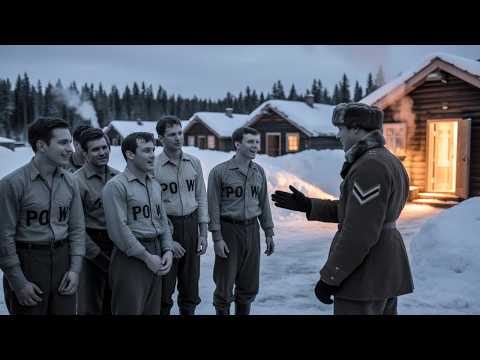
Weber, a 25-year-old merchant navy sailor who had survived the sinking of his ship in the Atlantic, had been conditioned to expect brutality. Nazi indoctrination had painted capture as a fate worse than death—a descent into Allied cruelty designed to break men’s wills. Yet here, in Camp 130, the barracks were permanent, the heating functional, and the chimneys vented smoke safely through the long winter nights. It was a contradiction so complete that some prisoners initially suspected a trick.
By 1945, Canada held approximately 34,000 German POWs in camps from Lethbridge to Medicine Hat, the largest facilities designed to hold 12,500 men each. These were not makeshift compounds but sprawling installations with recreation halls for 3,000, educational huts, workshops, and dining facilities—all equipped with heating systems built to withstand temperatures that plunged to minus 30°C and below.
The decision to invest in such infrastructure was both humanitarian and practical. The Geneva Convention required that prisoner conditions match those of the detaining power’s own troops, and Canadian authorities recognized that inadequate shelter would breed disease, disorder, and death. Heated barracks were not a luxury; they were a necessity for survival.
But the psychological impact was profound. Prisoners like Weber, who had endured the North African heat or the Russian front, now found themselves in wooden dormitories where stoves glowed through the night. The daily routine revolved around maintaining the fires—rotating schedules, fuel rationing, and the constant vigilance required to keep the heat alive. It was work that gave them a semblance of control, a familiar structure in an unfamiliar world.
Outside, the snow piled meters high, and escape meant almost certain death. Yet inside, prisoners organized skiing trips into the surrounding mountains, a surreal contrast to the grim expectations of captivity. Letters home describing such activities were often met with disbelief.
Canadian guards, many of them World War I veterans too old for overseas service, shared the same harsh conditions. They, too, depended on the heating systems, and the shared struggle against the cold created an unexpected camaraderie. “Better than the trenches,” one guard muttered, and the prisoners nodded.
Not all prisoners accepted the comfort gracefully. Hardcore Nazis denounced it as weakness, insisting that accepting Canadian hospitality dishonored the German military. But others began to question the propaganda that had shaped their beliefs. If the enemy was capable of such decency, what else had they been lied to about?
For Weber, the heated barrack became a symbol of something larger—a crack in the wall of hatred. As the winter deepened and the stoves burned on, he found himself facing a question he had never expected: What does it mean when your enemy treats you better than your own country promised?
The question gnawed at him through the long nights, when the wind screamed against the barracks walls and the stove ticked as it cooled. Weber had spent his youth believing in the righteousness of the German cause, in the villainy of the Allies, in the necessity of sacrifice. Now he lay in a warm bed built by Canadian hands, and the certainty that had carried him through the Atlantic crossing began to crack.
His bunkmate, a gaunt sailor named Klaus from Hamburg, refused to entertain such thoughts. “They are fattening us for something,” Klaus insisted, his voice low and bitter. “Red Cross inspections. Propaganda. Do not be a fool, Ernst.” But the inspections came and went, and the stoves kept burning, and no cruelty followed.
The camp commander, Colonel Watson, walked the grounds without escort, his breath pluming in the cold. He spoke to prisoners as men, not as animals, and once Weber watched him help a guard clear snow from a barrack roof. It was a small thing, but small things accumulated.
Fuel duty fell to Weber that January, and he found himself hauling split wood alongside a Canadian corporal named Lévesque, a French-Canadian from Quebec who spoke broken German and laughed easily. They worked in silence at first, the cold too sharp for talk, but by the third day Lévesque offered him a cigarette and a question.
“Your family,” the corporal said, gesturing vaguely eastward. “They are safe?”
Weber hesitated. He did not know. The last letter had come before his ship went down, before the weeks of transit, before this strange warm prison. He shook his head. Lévesque nodded, and for a moment the two men stood together in the snow, united by the same gnawing uncertainty.
That night, Weber wrote a letter home. He described the barracks, the stove, the skiing trips into the mountains. He described Lévesque and the cigarette and the question about his family. He did not write about ideology or loyalty or the Führer. He wrote about the cold, and how the Canadians had kept him from it.
The letter would take months to arrive, if it arrived at all, and Weber knew the censors would read every word. But the act of writing it felt like a small rebellion, a quiet admission that the world he had been taught to expect did not match the world he now inhabited.
In the bunk above, Klaus stirred and muttered something in his sleep. Weber folded the letter and tucked it beneath his pillow, listening to the stove settle and the wind fade. Somewhere beyond the mountains, the war ground on, and men died in the cold for causes they believed in. He had been spared that fate, and he did not yet know what to make of it.
By morning, the snow had stopped, and the camp lay under a silence so complete it seemed to hold its breath. Weber stepped outside to find the mountains glowing pink in the dawn, and for the first time since his capture, he allowed himself to wonder what peace might look like—not the peace of victory, but the peace of a man who had stopped expecting cruelty and found something else entirely.
The thaw came late that year, and with it, a restlessness that spread through the barracks like a fever. Prisoners who had spent the winter huddled around stoves now stood at the wire, staring at the mountains as if they might find answers written in the melting snow. Weber felt it too—a strange reluctance to leave the warm barrack that had become, against all reason, something like home.
The camp authorities, sensing the shift, announced a new program: educational courses in mathematics, languages, and agriculture. Klaus scoffed, calling it re-education by stealth, but Weber signed up for the English class taught by a young lieutenant from Toronto who had never seen combat and seemed almost embarrassed by his own kindness.
“Why do you do this?” Weber asked him one afternoon, after a lesson on irregular verbs. “Teach us. Heat our barracks. Let us ski.”
The lieutenant considered the question for a long moment. “Because when this war ends—and it will end—I would rather you remembered Canada as a place that treated you like a man.”
Weber carried those words with him through the spring, turning them over like stones in his pocket. He wrote another letter home, this time describing the English lessons and the lieutenant’s answer. He did not know if the letter would reach Hamburg, or if his family still lived, but the act of writing had become a kind of anchor.
In April, a new transport arrived from Europe—prisoners captured in Italy, gaunt and hollow-eyed, men who had seen the collapse of the Afrika Korps and the long retreat north. Among them was a sergeant named Vogel, a Berliner who had served under Rommel and who looked at the heated barracks with open suspicion.
“You have been softened,” Vogel declared when Weber showed him to a bunk. “This is not a camp. This is a holiday resort. The Führer would weep to see Germans living like this.”
Weber did not argue. He remembered his own first night, the disbelief, the suspicion. Instead, he showed Vogel how to work the stove, how to ration the fuel, how to judge when the fire needed more air. “The cold does not care about ideology,” he said quietly. “Neither does the stove.”
Vogel watched him with narrowed eyes, but he took the offered kindling and knelt before the iron door. By nightfall, he had stopped speaking of holidays and begun speaking of survival.
The spring brought other changes. The camp garden was plowed, and prisoners were assigned plots to cultivate—vegetables for the camp kitchen, but also flowers, absurd and beautiful against the barbed wire. Weber planted tomatoes, remembering his mother’s garden in Hamburg, and found himself talking to the seedlings as if they might carry news from home.
Colonel Watson, walking the grounds with his hands clasped behind his back, stopped to inspect the garden and pronounced it “damn fine work.” Behind him, a young guard rolled his eyes, but the prisoners beamed. It was a small thing, praise from an enemy, but small things accumulated.
One evening in late May, Weber found Vogel sitting alone on the steps of the recreation hall, staring at the mountains. The Berliner’s hands were trembling, and when Weber sat beside him, he saw that Vogel’s eyes were wet.
“My wife,” Vogel said, his voice cracking. “A letter came. She is dead. Bombing. Hamburg.”
Weber said nothing. There were no words for this, no ideology that could soften the blow. He simply sat beside the man, the way Lévesque had sat beside him in the snow, and watched the sun sink behind the peaks.
That night, Weber lay awake listening to Vogel’s muffled sobs and thought about the lieutenant’s words. When this war ends—and it will end—I would rather you remembered Canada as a place that treated you like a man. He wondered if Vogel would remember Canada that way, or if the grief would swallow everything else.
In the morning, Vogel was quiet but steady. He tended the stove without being asked, and when Weber brought him coffee from the kitchen, he nodded his thanks. They did not speak of Hamburg, but something had shifted between them—a wall that had cracked, if not yet fallen.
The summer stretched on, and the war in Europe entered its final convulsions. News filtered through the guards, through smuggled newspapers, through the BBC broadcasts that some prisoners were permitted to hear. The Allies had landed in Normandy. The Russians were advancing. Germany was bleeding from a thousand wounds, and the men in Camp 130 could only wait.
Weber found himself hoping—not for a German victory, not anymore, but for an end. Any end. The war had become a machine that consumed everything, and he was tired of being fed into its gears.
One August evening, a guard named O’Brien pulled him aside and pressed a folded paper into his hand. “Paris is liberated,” he whispered, his Irish accent thick with excitement. “The war will be over by Christmas. You’ll see.”
Weber looked at the paper, at the words that confirmed what he had already sensed. He should have felt despair—his country was losing, his cause was lost—but instead he felt something lighter, something almost like relief. The war would end. The killing would stop. And he would go home, if there was still a home to go to.
Weber folded the paper and tucked it into his pocket, nodding at O’Brien without a word. That night he told Vogel, and the Berliner stared at the stove for a long moment before whispering, “Then it was all for nothing.” Weber shook his head. “No. We lived. That is not nothing.”
Autumn came, then winter again, and the stoves burned on as they always had. In May 1945, the guards gathered the prisoners and announced the end. Some wept, some cheered, most simply stood in silence beneath the mountains.
Weber returned to Hamburg years later, but he never forgot the heated barracks or the lieutenant’s words. Some winters, he swore he could still hear the stove ticking.
What would you have done, standing in that snow, discovering your enemy had built you a home?
Report this article
Select a reason for reporting:






