It was just a peaceful portrait—until you see what’s in the maid’s hand. In March 2024, historian Jennifer Walsh stood in a dusty Atlanta estate sale, sifting through boxes of forgotten photographs. She had no idea that a single image, tucked between two landscape paintings, would unravel a 129-year-old mystery and force her to confront the darkest corners of American history.
The photograph, an albumen print from 1895, showed the wealthy Caldwell family posed in their opulent parlor. But Jennifer’s trained eye caught something unusual: a black domestic worker in the background, her body angled away, her attention on a side table. Unlike the family, she wasn’t posing. She was working—or pretending to. And in her left hand, partially hidden by her apron, was a small metal object. A key.
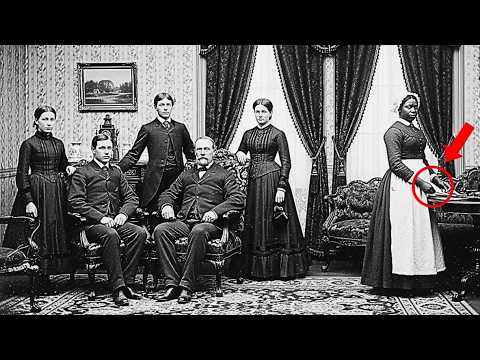
Jennifer purchased the photo for $40 and brought it back to her office at Emory University. Under a magnifying glass, the key became unmistakable. Why would a servant hold a key during a formal portrait? The question gnawed at her. She scanned the image at high resolution, enhancing details invisible to the naked eye. The woman’s posture was tense, purposeful. This wasn’t a casual inclusion—it was a message.
Her research led her to Marcus Caldwell, one of Atlanta’s most prominent businessmen in the 1890s. But beneath the veneer of respectability, newspaper archives revealed a darker truth: Caldwell was accused of labor practices that reeked of peonage—a system that trapped black workers in debt bondage after slavery’s legal end. A federal investigation in 1895 had been suspended due to “lack of witness cooperation.” The photograph was taken in March 1895, just one month before the investigation stalled.
Jennifer called Dr. Marcus Reed, a leading expert on peonage at Howard University. Together, they zoomed in on the woman’s face—strong, unreadable. “She’s the anomaly,” Marcus said. “That key gave her access to something—probably Caldwell’s private office.” They theorized she was an informant, gathering evidence for the federal investigation led by Samuel Price, a Justice Department attorney who actually cared about enforcing the 13th Amendment.
Digging through Caldwell’s household ledgers, Jennifer found a name: Esther Williams, housemaid, $4 per month. The woman finally had an identity. But domestic servants were rarely documented, and Esther’s name appeared only in sparse wage entries. Marcus suggested they search Price’s investigative files. A week later, digital scans arrived from the National Archives. In Price’s personal notebook, they found an entry dated March 10, 1895: “Met today with E.W., domestic servant in the Caldwell household. She reports that Marcus Caldwell maintains detailed records of labor contracts… EW has access to Caldwell’s private office and believes she can obtain copies of key documents.”
Another entry from March 15th confirmed: “EW successfully obtained access to Caldwell’s files yesterday evening. She copied several contracts and a ledger showing systematic debt inflation. The evidence is damning.” Jennifer’s heart raced. “She was gathering evidence the same week the photograph was taken,” she whispered. “That key—she used it to get into Caldwell’s office.”
But then, on March 30th, Price’s tone shifted: “I have received word that EW has disappeared… I fear the worst.” Jennifer and Marcus sat in heavy silence. Had Esther been silenced? Or had she fled? The answer came from church records. A letter from Reverend Thomas Shaw of the African Methodist Episcopal Church in Atlanta, dated April 1895, revealed that Esther had been moved to a safe location and assisted in relocating to Philadelphia. “She got out,” Jennifer breathed.
They traced Esther to Mother Bethel AME Church in Philadelphia, where she became an active member. Census records showed her working as a washerwoman, then a seamstress, and eventually owning a small house. She took in boarders—young women recently arrived from Georgia. “She was doing for others what the church had done for her,” Marcus observed. Esther lived until 1934, leaving a legacy of quiet courage and community service.
But the investigation she risked everything for had been closed without prosecution. The Justice Department determined that the contracts appeared voluntary. “They had documentation of crimes and did nothing,” Jennifer said, anger rising. Marcus nodded. “The federal government was never fully committed to enforcing the 13th Amendment in the South.”
Yet Esther’s actions had consequences. Caldwell’s reputation suffered, his business declined, and he died in 1903 with “business reversals.” Jennifer spent months developing an exhibition at the Atlanta History Center titled The Key to Freedom: Esther Williams and the Fight Against Peonage. The centerpiece was the Caldwell photograph, now understood in its full context. Visitors could zoom in on Esther and the key, then learn about her escape and her decades of activism.
At the opening, Reverend Sarah Johnson of Mother Bethel spoke: “Sister Williams was known as a quiet woman of deep faith, but we didn’t know the full story of her courage until now.” A local activist added, “This isn’t just history. The exploitation of black labor persists today. Esther’s story reminds us that resistance is always possible.”
One year later, the photograph had become a recognized historical image, requested by museums nationwide. But for Jennifer, it remained personal. She kept a copy on her office wall, often staring at Esther’s partially visible figure. “She stood in that room, surrounded by wealth built on exploitation, secretly holding the key to destroying it all,” she thought. And for 129 years, Esther had been invisible—until someone looked closely enough to see what had always been there.
Then came the letter that changed everything. Jennifer received an email from a genealogist in Savannah named Patricia Owens, who had seen news coverage of the exhibition. “I believe I may be descended from Esther Williams,” Patricia wrote. “My great-grandmother’s name was Esther, and family lore says she left Atlanta under mysterious circumstances in the 1890s. I have a trunk of her belongings that’s been passed down for generations. I never knew what to make of it—until now.”
Jennifer drove to Savannah the following weekend. Patricia, a retired schoolteacher in her seventies, greeted her at the door of a modest brick house. In the living room sat an old steamer trunk, its leather straps cracked with age. “I’ve only opened it twice in my life,” Patricia said. “My mother told me to keep it safe, that someday someone would come looking.”
Inside, wrapped in yellowed linen, lay a small bundle of papers tied with twine. Jennifer’s hands trembled as she untied it. There were letters—dozens of them—written in careful, looping script. And at the bottom of the bundle, wrapped in a scrap of white fabric, was a small brass key.
Jennifer recognized it instantly. It was the same key Esther had held in the photograph—the same size, the same shape, the same worn patina. “It’s hers,” she whispered. “She kept it. All those years, she kept it.”
The letters were dated between 1895 and 1910. Some were addressed to Reverend Shaw in Atlanta; others to unnamed friends in Philadelphia. But one letter, dated April 2, 1895—just days after Esther’s disappearance—was addressed to Samuel Price. Jennifer read it aloud, her voice unsteady.
“Mr. Price, I write to you from a safe place. I cannot tell you where, only that I am alive and free. The papers I sent you are true and complete. I copied them with my own hands and I swear before God they are accurate. I took the key from Mr. Caldwell’s desk the night I left. I keep it as a reminder that even a servant can open doors. I pray you will use what I gave you. If the law will not act, then let the truth be known another way. I am not afraid. I have seen what men like Caldwell do to people like me, and I will not be silent. Yours in hope, Esther Williams.”
Patricia wiped her eyes. “She never stopped fighting,” she said. “My grandmother told me stories about her—how she helped women escaping the South, how she fed families during the depression. But she never talked about Atlanta. She said it was a closed chapter.”
Jennifer turned to the remaining letters. They revealed a network of quiet resistance stretching from Atlanta to Philadelphia to Baltimore. Esther had corresponded with other domestic workers who had fled abusive employers. She had collected their testimonies, documented their experiences, and sent them to northern newspapers and church leaders. “She was building an archive,” Jennifer realized. “She wasn’t just helping individuals—she was creating a record. She knew that someday, someone would need proof.”
One letter, dated 1902, stood out. Esther wrote of a young woman named Lila who had arrived in Philadelphia with nothing but the clothes on her back. “She was held against her will on a farm in Alabama for three years. Her crime was that her father owed a debt of twelve dollars. Twelve dollars, Mr. Price. That was the price of her freedom. I have taken her in. She is learning to read. She will not be a victim again.”
Jennifer looked at Patricia. “Your great-grandmother didn’t just escape. She built a lifeline. She saved dozens of people—maybe more.” Patricia nodded, tears streaming down her face. “All my life, I wondered why my family never talked about the past. Now I understand. They weren’t hiding shame. They were protecting a legacy.”
Back in Atlanta, Jennifer and Marcus catalogued the letters and the key. They arranged for the trunk and its contents to be loaned to the Atlanta History Center, where they would become part of the permanent exhibition. The key—Esther’s key—would be displayed beside the photograph, a physical link between the image and the woman who had risked everything.
But Jennifer wasn’t finished. The letters mentioned other names, other families, other stories. She began tracing them, one by one, following Esther’s network of resistance across decades and state lines. Each name led to another letter, another testimony, another act of courage that had been forgotten.
One evening, as she sat in her office surrounded by photocopies and research notes, Marcus called. “I found something,” he said. “In the 1910 census, there’s a Lila Jackson living two streets over from Esther. Born in Alabama, 1878. Occupation: laundress. And in the 1920 census, she’s listed as a ‘matron’ at a home for colored women.”
Jennifer’s breath caught. “She became part of the network. Esther trained her, and she carried it forward.” Marcus’s voice was warm. “That’s how it works, Jennifer. Resistance isn’t a single act. It’s a chain. Esther forged the first link. Others picked it up.”
She looked at the photograph on her wall—the Caldwell family, stiff and proud, and Esther in the background, her hand holding the key. “We’ve only found the first link,” Jennifer said. “There are more. There have to be.” She picked up her pen and began writing a grant proposal—a new project, a new search. The story of Esther Williams was just the beginning.
The grant came through in the spring of 2025. Jennifer assembled a team of graduate students and archivists, and together they spent eighteen months tracing the names in Esther’s letters. They found descendants in Baltimore, Cleveland, and Chicago—families who had preserved fragments of the same story without ever knowing its full shape.
One descendant, a great-grandson named Elijah Freeman, traveled to Atlanta for the exhibition’s second anniversary. He stood before the photograph for a long time, then turned to Jennifer. “My grandmother used to say we come from a woman who carried a key,” he said. “I thought it was just a saying. I didn’t know it was real.”
Jennifer handed him a reproduction of Esther’s 1895 letter to Samuel Price. He read it slowly, his jaw tightening. “She wasn’t afraid,” he murmured. “She wrote that she wasn’t afraid.”
That evening, Jennifer stood alone in the gallery. The photograph hung in its place of honor, Esther’s small figure frozen in the background. But she no longer looked invisible. She looked like what she had always been—a woman holding a door open for everyone who came after.
What story in your own family has been waiting for someone to look closely enough to see it?
Report this article
Select a reason for reporting:






