Dr. Michael Hayes had examined thousands of photographs in his twenty-year career as a Civil War historian, but nothing prepared him for the image he found at a Charleston estate sale in August 2018. It was a simple portrait of two sisters, Catherine and Eleanor, taken in March 1901. Their Victorian dresses were immaculate, their expressions serene. Michael almost passed it by—until something in Catherine’s eyes stopped him cold.
Back in his office, he scanned the photograph at high resolution, a habit that often revealed hidden details. As the image loaded on his screen, he zoomed in on Catherine’s hands, folded primly in her lap. His breath caught. There, barely visible in the shadows of her dark wool dress, was the unmistakable outline of a small pistol. “Jesus Christ,” he whispered.
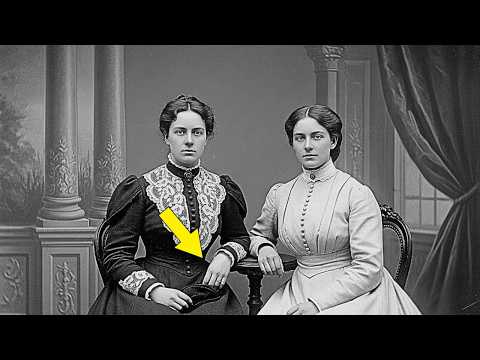
Why would a woman bring a concealed weapon to a formal portrait session? The question gnawed at him. He printed enlarged copies and rushed to the South Carolina Historical Society, where his colleague Margaret Wilson helped him search through studio records. They found the entry: “Catherine and Eleanor Brennan, March 14th, 1901, paid by Mr. Thomas Brennan.” So the husband had commissioned the portrait. But why would Catherine feel the need to arm herself?
Their research uncovered a police report from February 1901—a domestic disturbance at the Brennan home. Neighbors heard shouting, breaking glass, a woman’s scream. Thomas Brennan claimed his wife had fallen down the stairs. No arrest was made. “She didn’t fall,” Michael said quietly. “And a month later, she’s posing with a pistol hidden in her dress.”
Michael’s search through death records revealed the unthinkable: Catherine Brennan died on June 17th, 1901, just three months after the photograph. The cause: accidental drowning in Charleston Harbor. No autopsy, no investigation. Her husband identified the body. Eleanor? She vanished without a trace.
But then Michael found a letter, preserved by a friend of the sisters, dated March 10th, 1901—four days before the portrait. In it, Catherine wrote: “Thomas’s violence has escalated beyond what Eleanor and I can endure. He has threatened our lives directly. We have made arrangements to leave Charleston… I will bring protection with me.” She knew. She knew he would kill her.
As Michael delved deeper, he uncovered a ship’s log from the night of Catherine’s death. A night watchman had seen a man push a woman into the harbor and hold her under. The man walked away. The watchman, a Black sailor, never testified—he feared lynching. The murderer was never caught.
And Eleanor? A church journal from June 18th, 1901, recorded a terrified young woman seeking sanctuary, claiming her sister had been murdered. She disappeared during the night, leaving blood on the bedsheets. Weeks later, Thomas Brennan renovated his basement. He buried her under his own house.
Michael’s hands trembled as he pieced together the final clue—a train ticket to Atlanta found with Eleanor’s remains, dated June 19th, 1901. She had been so close to escape.
The story broke in January 2019, and the photograph went viral. Catherine’s terrified eyes, the hidden pistol, the century of silence—it all became a symbol of domestic violence and delayed justice. Thomas Brennan had murdered at least three wives and escaped consequences until his death in 1923. But now, 117 years later, the Fletcher sisters finally had their voice.
But the story did not end with the funeral. In the weeks that followed, Michael found himself unable to let go. He kept returning to the photograph, to Catherine’s eyes, to the tiny pistol that had spoken across the centuries. There had to be more. A woman like Catherine, who had planned an escape, who had written letters and purchased a weapon, would not have left everything to chance.
He began digging into the Brennan household records more deeply. Among the surviving papers from the probate file, he found a receipt from a Charleston attorney, a man named Josiah Frampton, dated May 1901. Catherine had consulted him about something, but the receipt gave no details. Michael tracked down Frampton’s surviving legal ledgers, stored in a private collection at the University of South Carolina. What he found there made his pulse quicken.
On May 2nd, 1901, Catherine Brennan had executed a new will, separate from the one her husband knew about. In it, she left everything she owned—her inheritance from her father, her jewelry, her personal effects—to her sister Eleanor, and in the event of Eleanor’s death, to a cousin in Baltimore named Margaret Fletcher. Thomas Brennan was explicitly excluded. The will had been witnessed by two clerks from Frampton’s office and notarized. It was legally binding.
Michael sat back in his chair, staring at the faded pages. Catherine had not just planned to escape. She had planned to cut her husband off completely. If she died, he would get nothing. That will was a death warrant, and Thomas Brennan must have discovered its existence. Perhaps that was the final trigger, the reason he acted when he did.
But there was more. Frampton’s ledger also contained a second entry, dated June 20th, 1901—three days after Catherine’s death. Thomas Brennan had visited the attorney, demanding to know if his wife had left a will. Frampton, bound by client confidentiality, had refused to disclose its contents. Brennan had grown furious, threatening the lawyer. Frampton had stood his ground, but noted in the margin: Client’s husband behaved in a threatening manner. Advised him to seek legal counsel. He left in a rage.
Michael realized then that Thomas Brennan had not simply murdered his wife and her sister. He had tried to erase every trace of them, including their legal existence. But Catherine had outsmarted him. She had hidden her will, and because of that, the cousin in Baltimore—Margaret Fletcher—had inherited everything. Michael traced Margaret’s descendants and found that the Fletcher family had used Catherine’s inheritance to establish a small charitable fund for women fleeing domestic violence in the 1920s. That fund still existed today, operating quietly out of a Baltimore office.
When Michael contacted the current director, a woman named Ellen Fletcher, she was stunned. “We always knew the fund came from a family tragedy,” she said. “But we never knew the details. Catherine and Eleanor were legends in our family, but their story was lost.” Ellen agreed to provide financial support for a permanent memorial and for a scholarship in the sisters’ names at the College of Charleston.
The final piece of the puzzle fell into place in March 2019, when a construction crew renovating a building in New Orleans uncovered a hidden safe behind a wall. Inside were documents belonging to Thomas Brennan, including a letter he had written to his third wife’s family after her death, claiming she had been depressed and suicidal. But the letter contained a slip of the tongue, a reference to “the unfortunate business in Charleston” that he quickly crossed out. The letter was donated to the Charleston Museum, where Michael examined it. The crossed-out words were still legible under ultraviolet light.
Michael stood in the museum’s archive, holding the letter, and felt a strange sense of closure. Thomas Brennan had never been punished in life, but his own words had condemned him. The evidence was now complete. The story was told. And the Fletcher sisters, silenced for over a century, had finally spoken.
But closure, Michael was learning, was a luxury historians rarely enjoyed. The letter from New Orleans had opened a door he thought was sealed, and behind it waited another question. If Thomas Brennan had kept a hidden safe, if he had hoarded documents across three marriages and two cities, what else might he have preserved? Men like Brennan did not destroy evidence out of shame. They kept it out of arrogance, convinced no one would ever come looking.
He shared the thought with Margaret over coffee in the historical society’s cramped break room. She set down her mug and fixed him with a look he knew well—the one that meant she was already three steps ahead. “You’re thinking about the Church Street house again,” she said. “The basement gave us Eleanor. But he lived in that house for seven years. Seven years of papers, ledgers, correspondence. Where did it all go?”
Michael had assumed the probate court had dispersed everything after Brennan fled Charleston in 1905. But when he pulled the estate records again, he noticed something he had overlooked. The inventory of goods sold at auction listed furniture, china, silverware, a carriage—but almost no personal papers. No business ledgers. No correspondence. For a cotton factor who had run an international shipping operation, that absence was glaring.
He contacted the Martinez family that same afternoon. The young couple had moved back into 67 Church Street after the excavation, though Jennifer admitted she still avoided the basement stairs after dark. When Michael explained his theory, David frowned. “There’s an attic space above the old carriage house out back,” he said slowly. “We’ve never really cleared it out. The previous owners used it for storage, and honestly, it’s full of junk we’ve been meaning to sort through.”
Michael arrived the next morning with a flashlight and a pair of work gloves. The carriage house attic was low-ceilinged and stifling, thick with dust and the smell of old wood. Cardboard boxes were stacked in precarious towers. Christmas decorations. Tax returns from the 1980s. Broken furniture. He worked methodically, opening each box, checking behind each stack.
It was nearly noon when he found the trunk. It was tucked into the far corner beneath a collapsed bookcase, a heavy iron-bound steamer trunk with brass fittings green with verdigris. The lock had been forced at some point, the hasp bent but still holding. Michael pried it open with a screwdriver, his hands shaking.
Inside, wrapped in oilcloth and tied with twine, were bundles of papers. Business ledgers from Brennan’s cotton factoring company. Receipts. Shipping manifests. And beneath those, a smaller bundle tied with a faded red ribbon. Michael untied it carefully, his breath shallow.
The first document was a letter in Thomas Brennan’s hand, dated June 19th, 1901—two days after Catherine’s death. It was addressed to a business associate in Savannah, and Michael read it with a growing sense of horror.
“My dear Whitfield, I write in haste and in confidence. My wife has met with a tragic accident, and her sister, who has long been of unstable mind, has fled the city in her grief. I fear she may attempt to slander my name with wild accusations. Should she approach you or any of our associates, I trust you will give no credence to her ravings. I have taken steps to ensure the family’s affairs are in order and that no scandal attaches to my business. Your discretion is, as always, invaluable.”
Michael read it twice, the words burning into him. Brennan had not only murdered Eleanor—he had preemptively poisoned the well against her, framing her as unstable and dangerous before she had even been killed. If she had reached Atlanta and tried to tell her story, no one would have believed her. Her brother-in-law had already made sure of that.
But it was the second bundle that made Michael’s blood run cold. Wrapped in a separate piece of oilcloth were three letters, all in the same elegant feminine hand. Catherine’s handwriting. Michael recognized it from the letter to Abigail Porter. These were letters Thomas Brennan had intercepted—letters Catherine had written and never sent, or perhaps letters she had sent to friends that had been returned to the house and confiscated.
The first was dated April 1901 and addressed to her cousin Margaret in Baltimore. “I am enclosing a copy of my will, which I have asked Mr. Frampton to keep in his files. Should anything happen to me, please ensure that Thomas receives nothing. I know this is a terrible thing to ask of you, but I trust no one else. He is not the man he pretends to be. He has hurt me, and I fear he will hurt Eleanor if I am not here to protect her.”
The second letter, dated May 1901, was addressed to Eleanor herself. It was short, barely a paragraph, and Michael could see where the paper had been crumpled and smoothed again, as if it had been read many times. “Dearest El, if you are reading this, then I am gone and you must run. Do not trust him. Do not go to the police. Go to Abigail. She will help you. I am so sorry I could not protect you better. You have been the best sister anyone could ask for. Live, El. Live for both of us.”
Michael sat back on his heels in the dusty attic, the letter trembling in his hand. Catherine had known. She had written a farewell to her sister, knowing she might never see her again, knowing that Thomas would likely kill her first. And Eleanor had found this letter, carried it with her, crumpled it in her fear and grief—and then Thomas had taken it from her, along with her life.
The third letter was different. It was dated June 18th, 1901—the day after Catherine’s death, the day Eleanor had fled to the church. It was not in Catherine’s hand. It was in Eleanor’s, written in a shaky, uneven scrawl that barely resembled the elegant script of her sister.
“I saw him do it. I saw him hold her under the water. I ran. I went to the church. Father Graves was kind but I could not stay. I knew Thomas would come. I went back to the house for my ticket and my mother’s locket and he was there. He knew I had seen. I am writing this in the garden shed. I do not know if I will survive the night. If anyone finds this, please tell the truth about what happened to my sister. Her name was Catherine. She was good and kind and she did not deserve to die. I am so afraid.”
Michael lowered the letter, his eyes stinging. Eleanor had written her own testimony in the last hours of her life, hidden it in the garden shed, and Thomas Brennan had found it and kept it—not destroyed it, but kept it, as if he could not resist preserving the proof of his own power.
He photographed every page, catalogued every document, and delivered the originals to Detective Martinez the following morning. The letters were added to the case file, and though Thomas Brennan was long beyond the reach of earthly justice, the historical record was now complete. Catherine and Eleanor had told their story in their own words, and those words had survived.
Ellen Fletcher wept when Michael showed her the letters. “She wrote to my great-grandmother,” she whispered, touching the April letter with a careful finger. “She trusted her. And she was right to.”
The Fletcher family arranged for the letters to be donated to the South Carolina Historical Society, where they would be preserved and made available to researchers. Margaret oversaw the cataloguing herself, handling each fragile page as if it were made of glass.
On a warm April afternoon, Michael stood in the garden of 67 Church Street—the same garden where Eleanor had hidden her final testimony—and thought about how close the truth had come to being lost forever. A photograph bought for twelve dollars. A letter preserved by a grieving friend. A trunk forgotten in an attic. So many small chances, so many fragile threads, and yet they had held.
David Martinez had planted two white rose bushes in the garden, one for each sister. They were blooming now, their petals pale and delicate in the afternoon light. Michael touched one of the blooms, and for a moment he felt as though Catherine and Eleanor were standing beside him, finally at peace.
The case was closed, the story told, the graves marked. But Michael knew that history was never truly finished. Somewhere, in another attic, another trunk, another forgotten drawer, there were more stories waiting. More silenced voices. More women whose courage had been buried beneath the weight of a century.
He would keep looking. It was, after all, what historians did—not just to understand the past, but to give it back its voice.
Michael knelt in the attic dust, the letters still warm in his hands, and understood at last what Catherine had truly done. She had not merely hidden a pistol in her dress. She had hidden her entire testimony in plain sight, trusting that someday a stranger’s curiosity would finish what her courage began. “She knew,” he whispered to the empty room. “She knew someone would come looking.”
He carried the trunk down to the waiting daylight, where Margaret was already on the phone with Ellen Fletcher. The papers would be preserved, catalogued, and read aloud at a small ceremony that summer. The Fletcher Fund would expand, its Baltimore office finally able to tell the whole story to the women it served.
That evening Michael returned to the portrait one last time. Catherine’s eyes met his across 118 years, no longer terrified, no longer pleading. They simply watched, steady and certain.
“You can rest now,” he told them. “We finally heard you.”
And somewhere beyond the frame, he liked to believe, two sisters smiled.
If a single photograph could hold such courage for over a century, what forgotten truth might be waiting in your own family’s attic?
Report this article
Select a reason for reporting:






