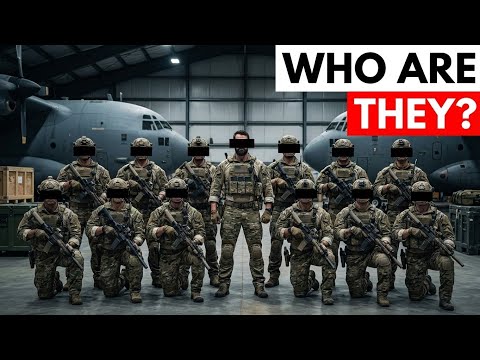
In the shadowy world of special operations, one unit stands apart—so secretive that its very existence is often denied. It’s not the Navy SEALs. It’s smaller, almost invisible, and its budget is hidden in classified files. Founded in 1977 to tackle threats no one else could reach, Delta Force demands a lifetime of silence from its operators. Why does this unit require such absolute secrecy? And what does it cost?
While Navy SEALs operate in the open, with around 2,500 active operators and a recruiting pipeline that reaches high schools, Delta Force is estimated at just 250 to 300—nearly a tenth the size. There are no public tryouts, no flashy commercials, no official acknowledgment of who makes the cut. Most Americans could name a SEAL, but almost no one outside the military can identify a Delta operator. As one former SEAL puts it, “We do outreach for recruiting. Delta stays in the shadows.” That leaves a single question: How does a unit this small keep its existence and its people so completely off the grid?
In 1977, Colonel Charles Beckwith returned from his time with Britain’s Special Air Service, convinced that the United States needed something radically different—an elite force built for operations no one could talk about. Beckwith’s blueprint called for a unit so small and so hidden that its very existence could be denied. He argued in his memoir that secrecy was not just a tactic, but the foundation for survival on missions where failure could spark an international crisis.
To make this possible, Delta Force was placed under a command structure that would mask its presence. Rather than report through a traditional army chain, Delta operated under the newly formed Joint Special Operations Command, known as JSOC. This move buried its funding and personnel within classified budget lines, away from the public and even most of Congress. As military journalist Sha Naylor explains, JSOC’s architecture was designed from the start to keep Delta invisible both on paper and in the field. Beckwith’s Special Air Service-inspired vision did not just shape how Delta would fight—it determined how it would disappear.
Delta Force does not post flyers or run commercials. Entry begins with a quiet tap on the shoulder, not a public tryout. Only seasoned Army veterans are considered. Most have served 8 to 12 years, often as non-commissioned officers in the 75th Ranger Regiment or Army Special Forces. The average candidate is in his early to mid-30s, already proven in combat and trusted by peers. There are no walk-ons and no civilian recruits. Invitations come through private channels, sometimes after a deployment, sometimes from a commander who knows what kind of person the unit needs.
Eligibility requires more than a clean record and a strong fitness score. Candidates must be airborne qualified or willing to train, eligible for top secret clearance, and free of disciplinary actions. This invitation-only approach keeps the pool small and the risks of exposure low. As one retired Ranger puts it, “You’re not just picked for your skills. You are picked because you know how to keep quiet.”
The North Carolina mountains become a proving ground where anonymity is the only constant. Candidates face The Long Walk, an endurance test that can last more than 18 hours alone with a heavy rucksack and a map. As fatigue and isolation grind down even the most experienced soldiers, the attrition rate climbs to 90 to 95 percent—and most will vanish back to their units without a word. For those few who finish, the ordeal is only the beginning. A six-month operator training course follows, filled with skills rarely discussed outside classified briefings: surveillance and counter-surveillance, clandestine entry, lockpicking, and the art of blending into foreign cities. Language training and cultural immersion round out a curriculum designed for missions that leave no trace. The silence forged here is as much a skill as any weapon.
Delta Force steps into situations where official footprints must vanish. Their missions often involve rescuing hostages from foreign soil, tracking high-value targets, or dismantling terror cells before the world ever hears a whisper. These operations rarely appear in headlines, and when they do, Delta’s name is left out. Teams frequently work side-by-side with the CIA, blending military precision with intelligence tradecraft to slip across borders undetected. Every detail—from planning to extraction—is designed so that American involvement can be denied if exposed. The success of these tasks depends on absolute silence, both during and long after the mission ends.
Delta operators sign legally binding agreements that forbid discussing missions not just during service but for life. These commitments are reinforced by the Espionage Act and by federal security statutes, making unauthorized disclosures a criminal offense. The legal shield around these activities helps keep details out of public view. Most operations remain classified for decades, and the very existence of some missions is never officially confirmed. In rare cases, the wall of secrecy cracks. One of those rare public acknowledgments came in 2019 when a raid that killed ISIS leader Abu Bakr al-Baghdadi was publicly credited by the Department of Defense to Delta Force by name. As a national security law scholar explains, these legal shields are designed so that silence is the norm and exposure is the exception. Delta secrecy is not just tradition—it is national strategy. As global threats evolve, their silence protects missions and policy alike. In a world of leaks, some shadows remain by design.
But the cost of that design is rarely counted in public. Operators carry the weight of missions they can never explain—not to spouses, not to children, not to the therapists the military quietly provides. A former Delta operator once described coming home from a deployment and being unable to answer the simplest question: “Where were you?” The honest answer was classified. The safe answer was a lie. Over time, the lies accumulate, and so does the distance they create.
This is the quiet bargain at the heart of the unit. The same silence that protects national secrets also isolates the men who keep them. Veterans of Delta often describe a peculiar form of loneliness—surrounded by people, yet unable to share the most defining experiences of their lives. Support networks exist, but they operate under the same veil. Even the unit’s own reunions are held off the record, with no press, no photos, and no names attached to the faces in the room.
Then there is the question of accountability. When operations go wrong—and some have—the public learns only fragments. A raid that misfires, a civilian casualty that shouldn’t have happened, a mission that crosses a legal line. Who investigates a unit whose very files are sealed? Congressional oversight exists on paper, but it is narrow, often limited to a handful of committee members briefed behind closed doors. Critics argue that this structure, however necessary, leaves little room for the kind of scrutiny that democratic societies typically demand of their armed forces.
And yet the demand for Delta’s capabilities has only grown. In an era of shadow wars, hostage crises, and non-state actors who operate beyond the reach of conventional militaries, the unit’s niche has expanded rather than shrunk. The more unstable the world becomes, the more valuable the invisible becomes. That paradox sits at the center of Delta’s story: a force built to be denied, now more essential than ever, and still almost entirely unknown to the country it serves.
Perhaps that is the point. Beckwith’s original vision was never about recognition—it was about results no one could trace back to America’s doorstep. But as the unit enters its fifth decade, the question lingers: how long can a democracy sustain a force this secret without eventually asking what, exactly, that secrecy is protecting?
The answer, according to those who have studied the unit from the inside, is more complicated than a simple cost-benefit ledger. Secrecy protects not only the operators but the political leadership that sends them. A mission that never appears on a briefing slide never becomes a talking point on a Sunday morning show. A name that never surfaces never becomes a hashtag. In this sense, Delta’s invisibility is a form of insulation for the entire chain of command—a buffer that absorbs risk before it can reach the White House or the Pentagon podium.
But insulation cuts both ways. When no one can see the mission, no one can question it either. Former JSOC commanders have acknowledged in closed testimony that the lack of public visibility creates a kind of moral vacuum. Decisions made in the field—about who to target, when to strike, how much collateral damage is acceptable—are reviewed internally, by people who share the same operational culture and the same institutional stakes. The result, critics say, is a system that polices itself with remarkable efficiency and remarkably little outside input.
There is also the question of what happens when operators leave. Delta’s alumni network is one of the most exclusive fraternities in the world—and one of the quietest. Many go into private security, defense contracting, or intelligence work, carrying skills that are enormously valuable and almost impossible to verify. A former operator can list “U.S. Army” on a resume and nothing more. Employers learn not to ask. The silence follows them out the door and into civilian life, where it becomes a kind of permanent shadow.
Some have tried to break that shadow. A handful of memoirs have been published over the years, carefully vetted by Pentagon lawyers, stripped of anything that might cross a legal line. Even those sanitized accounts reveal a recurring theme: the mission was never the hardest part. The silence afterward was. One operator described standing at his daughter’s wedding, surrounded by family, and feeling a sudden, irrational urge to scan the exits—a habit that never faded, even years after his last deployment.
The unit has adapted, at least on paper. Delta now fields its own psychologists and chaplains, cleared to hear things no ordinary counselor could be told. Reintegration programs exist, though their details remain classified. What is known is that the military has quietly expanded mental health resources for special operations personnel over the past decade, a recognition that the psychological toll of perpetual secrecy is real and cumulative.
Still, the fundamental equation has not changed. The nation asks a small group of men to carry secrets that would be dangerous to share and impossible to forget. In return, it offers them anonymity, a modest pension, and the promise that their sacrifices will remain, in the fullest sense, unknown. Whether that is a fair trade is a question no one inside the system is permitted to answer publicly—and no one outside the system is fully equipped to judge.
Perhaps the only honest answer is that Delta Force exists in a space where democracy’s usual rules are suspended—not out of malice, but out of necessity. The price of admission to that space is a silence that never fully lifts. Operators accept it, their families endure it, and the nation benefits from it, often without knowing.
But as the unit enters its fifth decade, the question Beckwith never fully answered remains: how much secrecy can a democracy tolerate before it becomes something else? The operators themselves rarely ask. They were chosen because they don’t.
So the shadows persist, by design and by sacrifice. And the rest of us are left to wonder what we owe the men we will never know—and whether we would even want to know them if we could.
What do you think: is Delta’s silence a necessary shield, or a dangerous blind spot? Share your thoughts below.
Report this article
Select a reason for reporting:






