Dr. Evelyn Carter had spent her career preserving the stories of African Americans in the post-Reconstruction South, but nothing prepared her for the moment she saw the photograph. It was a humid June afternoon in 2019 when she first examined the image labeled simply “Reception at Whitmore House, April 1902.” At first glance, it was a typical society portrait: fifteen white guests posed formally in an opulent parlor, men in dark suits, women in elaborate dresses. But behind them, an enormous gilt-framed mirror reflected the room—and in that reflection, something was terribly wrong.
Carter’s heart raced as she zoomed in on the mirror’s surface. Where a white male guest should have been reflected, there stood an elderly black woman. She wore a simple dark dress, her posture rigid, her face marked by unmistakable whip scars. Carter sat back, her mind spinning. This wasn’t a double exposure; both images were perfectly sharp. This was something else entirely.
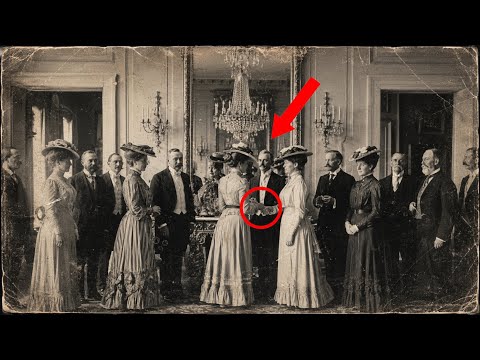
She began a methodical investigation, starting with the Whitmore family records. The reception had been held to celebrate a new wing of the mansion, but the guest list mentioned no black attendees. Carter visited the Whitmore Mansion, now a museum, and stood in the parlor where the mirror still hung. The architectural details matched perfectly. Who was the woman in the reflection?
Digging into the archives, Carter uncovered the Whitmore family’s dark history. Colonel Richard Whitmore had owned three rice plantations and enslaved 247 people. An 1853 inventory listed a girl named Sarah, age eight, a house servant valued at $400. A note from 1859 read: “20 lashes administered. Will not tolerate disrespect from servants.” Carter closed her eyes, imagining an eleven-year-old girl being whipped. The scars in the photograph suddenly made terrible sense.
After emancipation, Sarah remained with the Whitmores under exploitative labor contracts. Census records from 1870 to 1900 listed her as a domestic servant, no surname, no identity beyond her function. By 1902, she had served the family for nearly fifty years. Carter needed to identify the photographer. She found faint text on the original print: J. Matthews Photography, Charleston. Unlike his contemporaries, Matthews advertised to all respectable persons, regardless of station—a coded phrase suggesting he photographed black clients too.
Carter located Matthews’ business records at the Avery Research Center. His appointment ledger confirmed he had photographed the Whitmore reception on April 15th, 1902, noting “multiple exposures requested.” Her pulse quickened. Had Matthews deliberately created a double exposure, embedding Sarah’s image into the mirror? She found a letter he wrote in May 1902: “I continue to document what I see, not merely what my clients wish to be seen. The camera does not lie, though we who operate cameras often do. I prefer honesty, even when it must be hidden in plain sight.”
Hidden in plain sight. Carter was now certain this wasn’t an accident. Matthews had deliberately created this image, embedding Sarah’s presence in a photograph meant to celebrate white prosperity. But why? What had he wanted future viewers to understand? She expanded her search, contacting descendant communities. Within a week, an email arrived from Dorothy Washington in Atlanta: “My great-grandmother told stories about her aunt Sarah, who worked for a white family in Charleston her whole life. She said Sarah had terrible scars on her face and never spoke about how she got them.”
Carter arranged a video call. Dorothy shared that Sarah’s full name was Sarah Porter, born enslaved around 1845. “My great-grandmother said Sarah was beaten regularly,” Dorothy explained. “Mrs. Whitmore had her whipped so severely the scars never healed properly. She was 11 years old.” The story aligned perfectly with the 1859 entry. After emancipation, Sarah had nowhere to go. She couldn’t read or write. The Whitmores paid her $2 a month and controlled every aspect of her life. “It wasn’t really freedom at all,” Dorothy said.
Carter asked what happened to Sarah after 1902. Dorothy’s expression grew sad. “She died in 1903, still working in that house. Her body just gave out. The Whitmores didn’t even pay for a proper burial.” Carter felt tears welling up. Sarah had spent fifty years serving the Whitmore family, first as property, then as an exploited worker. She had lived and died in that house, her labor building the wealth the Whitmores displayed so proudly.
Armed with Sarah’s identity, Carter returned to Matthews’ records. She found references to his “true history series”—a project documenting the labor that built Charleston’s wealth. In a letter from 1901, he wrote: “I’m documenting what Charleston refuses to see, the labor that builds this city’s wealth, the servants who make possible the leisure of the elite, the people rendered invisible by their society.” Matthews had developed a technique of creating composite images that included both the celebrated subjects and the unseen workers. But Sarah’s image was different. He had placed her in the mirror’s reflection in a way that made her impossible to ignore once noticed, yet subtle enough that the Whitmore family had apparently never realized she was there.
Carter found Matthews’ journal entry from April 14th, 1902: “Tomorrow, I photograph the Whitmore reception. I have watched Sarah work, an elderly woman who moves through the rooms like a ghost, unseen by the family she serves. She has worked for them for nearly 50 years, first as a slave, now as a servant who earns barely enough to survive. The Whitmores will celebrate their prosperity tomorrow, never acknowledging that it was built on her labor.” The next entry, dated April 16th, read: “I have completed the Whitmore photograph. I used a technique I have been perfecting, a brief secondary exposure during which I asked Sarah to stand before the mirror while the family remains still. The result is perfect. Sarah appears in the reflection where Mr. Whitmore stands in the main image. She is finally visible, finally documented, finally part of the history that has tried so hard to erase her.”
Carter sat back, moved by Matthews’ words. He had known his act might not be discovered for years, but he had done it anyway, trusting that eventually someone would look closely enough to see what he had documented. The truth hidden in the reflection. But Sarah’s story was far from over. Carter still needed to understand her final year—and what the Whitmore family records revealed about how she was treated until the very end.
Carter returned to the Whitmore household papers with a new intensity, pulling every ledger, receipt, and letter from 1902 and 1903. What she found was cruelty so ordinary it was almost worse than the violence. The account books showed Sarah still receiving $2 a month throughout 1902—the same wage she’d earned for decades—while the family spent $150 on new parlor furniture and $200 on Mrs. Whitmore’s trip to New York. Sarah’s entire annual compensation was $24, less than they spent on a single chair.
Then came a letter from Mrs. Whitmore to her sister, dated November 1902. “Our old servant Sarah has become quite slow and forgetful lately. She can barely manage the stairs anymore, and yesterday she dropped one of my good plates. I told her if she cannot perform her duties properly, perhaps she should find employment elsewhere. Of course, she has nowhere to go and no one to take her in, so she wept and promised to do better. Really, the ingratitude of these people is astonishing after all we have done for her.”
Carter read the passage twice, her jaw tight. After all we have done for her. As if enslaving a child, whipping her until the scars never faded, and then extracting her labor for poverty wages for nearly forty years constituted kindness. She copied the letter into her notes, hands trembling.
The record of Sarah’s decline was fragmentary but relentless. A January 1903 letter mentioned she had been unwell but was still expected to work. A March entry noted she had fainted while carrying laundry up the stairs but recovered enough to finish her tasks. No doctor was summoned. No rest was granted. She simply kept working until her body refused.
The final reference came in May 1903. Mrs. Whitmore wrote to her daughter: “Our servant Sarah passed away yesterday quite suddenly. She simply collapsed in the kitchen and never regained consciousness. The doctor said her heart gave out, though she was not terribly old. We have hired a new girl to replace her. She is younger and much more energetic, which will be a great improvement.”
That was it. Fifty-eight years of service, dismissed in a single paragraph, followed immediately by a note about the replacement. Carter found Sarah’s death certificate in the city’s vital records. Cause of death: heart failure. Age: approximately 58. Name: Sarah. Surname: unknown. Burial: Morris Street Colored Cemetery. Even in death, the official record denied her a full identity.
She drove to the cemetery the following week—a small, neglected plot on the outskirts of Charleston, many graves unmarked or sinking into the earth. With help from the cemetery’s surviving records, she found the spot. A simple stone, weathered and half-swallowed by grass, read only: Sarah D. 1903. No surname. No birth year. No epitaph.
Carter knelt in the damp grass and thought about the photograph—Sarah’s scarred face caught in the mirror, visible only because a photographer had chosen to see her. That image was now the fullest record of her existence. The clearest proof that she had lived, worked, suffered, and endured for nearly six decades while the family she served looked straight through her.
Back at the society, Carter published a preliminary article in the Journal of Southern History, and the story spread quickly beyond academic circles. Among the letters that followed was one from a civil rights attorney named Michael Robertson, who specialized in historical labor claims. He read the article twice, he wrote, then sat down and read it a third time.
“These labor contracts you found,” Robertson said when they met in her office, “were legally questionable even by the standards of that time. Two dollars a month for full-time work, restrictions on movement, no ability to leave—this is what legal scholars call debt peonage. Neo-slavery. The Thirteenth Amendment abolished slavery except as punishment for crime, but arrangements like these found ways around that prohibition.”
He leaned forward, tapping the photocopied contract on her desk. “If Sarah’s situation is representative of dozens or hundreds of other workers in Charleston, then we’re looking at a systematic form of exploitation that was never properly documented—or legally challenged.”
Together, Carter and Robertson traced the Whitmore fortune through property records and estate inventories. Between 1865 and 1903, Sarah had been paid roughly $912 for thirty-eight years of full-time labor. At even the era’s minimal fair wage, she should have earned over $6,800. “The Whitmores effectively stole nearly $6,000 from Sarah,” Robertson said—and she was only one of many.
They knew legal claims after 120 years were impossible. But documentation mattered. Through genealogical research and outreach, they identified more than thirty living descendants of people enslaved by or bound to the Whitmore family. Dorothy Washington, Sarah’s great-great-niece, became a vocal advocate, organizing a gathering in Charleston in March 2020 where descendants shared stories passed down through generations.
Elijah Thompson spoke of his great-grandfather Marcus, who died on the same plantation where he was born. “He’d tell them, ‘I’m free in name only. Everything else is the same as before.'” Patricia Morris described her great-grandmother Ruth, a cook for thirty-five years at $3 a month, who died in a charity home. “The family she’d fed for decades never looked back.”
In October 2020, the Charleston Historical Society opened a permanent exhibition, Hidden in Plain Sight: The True Cost of Charleston’s Prosperity. The centerpiece was Matthews’ 1902 photograph, displayed at large scale with Sarah Porter’s full story. On May 19th, 2021, a new marker was unveiled at her grave: “She deserved freedom, dignity, and fair compensation. She received none of these. We remember her now.”
The Whitmore family’s representatives declined to attend but issued a statement acknowledging their wealth had been built partly through exploitation. Carter kept working—searching for other photographs, other reflections, other hidden truths waiting to be seen. Sarah Porter’s face had finally been seen. Her story had finally been told.
So when you look at an old photograph, do you look closely enough to notice who has been left standing in the reflection?
Report this article
Select a reason for reporting:






