June 22, 1941. Before dawn, the largest invasion in history erupted along the Soviet border. German artillery thundered, and tanks rolled across the frontier. Within hours, the world would witness the devastating might of Army Group Centre, led by Field Marshal Fedor von Bock.
Their target: the Soviet forces defending the Białystok–Minsk region. The operation was a strategic masterstroke—a double envelopment designed to trap and annihilate the Red Army in a massive cauldron.
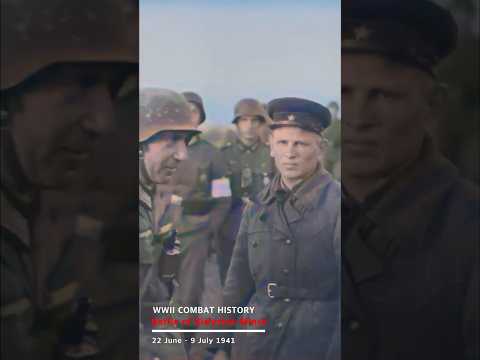
The Germans struck with unprecedented speed and coordination. Panzer divisions sliced through Soviet lines, while the Luftwaffe dominated the skies. “The Russians were caught completely off guard,” one German officer recalled. “Their communications were shattered, their units isolated.”
For the Soviet soldiers, chaos reigned. Orders were confused, supplies dwindled, and the enemy seemed everywhere at once. The battle raged from June 22 to July 9, 1941, and with each passing day, the encirclement tightened.
In Minsk, the city became a trap. German forces closed the ring, cutting off escape routes. Soviet troops fought desperately, but the odds were insurmountable. “We were surrounded, but we kept fighting,” a survivor later said. “We had no choice.”
The battle ended with a staggering German victory. Hundreds of thousands of Soviet soldiers were killed or captured. Army Group Centre had achieved a decisive breakthrough, paving the way for the drive on Moscow.
But the victory came at a cost. The sheer scale of the encirclement stretched German resources, and the fierce resistance foreshadowed the brutal war to come. As the dust settled, both sides knew this was only the beginning.
The men of the 2nd Panzer Group under Heinz Guderian had driven hard through the first week, their engines grinding day and night. “Speed is the whole secret,” Guderian had told his commanders. “Keep moving. Never let them form a line.”
By June 27, the panzers had reached Minsk from the south, while Hoth’s 3rd Panzer Group closed in from the north. The two pincers met east of the city, sealing the pocket.
Inside the cauldron, Soviet commanders received contradictory orders. Some were told to hold at all costs. Others were ordered to break out immediately. “We didn’t know whether to attack or retreat,” wrote one Red Army lieutenant. “So we did both, and neither worked.”
Then came the reckoning. The pocket held not one but three Soviet armies—the 3rd, 10th, and 13th. Nearly half a million men were trapped in a shrinking ring of fire and steel.
German infantry divisions, marching on foot behind the panzers, struggled to keep pace. The encirclement was vast, and the inner front was thin. “We had the lid on the pot,” a German staff officer noted, “but the pot was enormous, and the lid was too small.”
For days, Soviet troops launched desperate counterattacks, trying to punch a hole through the German lines. At one point, a Red Army tank brigade nearly broke through near Smilovichi, threatening the German rear.
But the Luftwaffe responded with relentless bombing runs, and the gap was sealed. The ring tightened once more.
Inside the pocket, the situation deteriorated by the hour. Ammunition ran low, and the men were reduced to scavenging from the dead. “We ate what the horses ate,” one survivor remembered. “When the horses died, we ate the horses.”
Still, the fighting never fully stopped. Isolated units, cut off from their commands, fought on their own initiative—ambushing supply columns, sabotaging bridges, and vanishing into the forests. The Germans had won the ground, but the woods belonged to the shadows.
Guderian, impatient as ever, was already looking east. “Minsk is finished,” he told his staff on July 2. “The real prize is the road to Smolensk.” Yet his panzers needed fuel, and the infantry needed time to reduce the pocket.
That delay would prove costly. While the Germans consolidated, the Red Army rushed new formations westward—fresh divisions pulled from the interior, untested but numerous. The Stavka had finally grasped the scale of the disaster, and Stalin himself issued a blunt directive: “No more retreats. Hold the line.”
Among the trapped men, hope flickered and died by turns. A group of officers proposed a mass breakout toward the east, hoping to link up with Soviet forces near Mogilev. The plan was suicidal, but standing still meant certain death.
On the night of July 5, under cover of a thunderstorm, several thousand men surged toward the German perimeter. Searchlights swept the fields, and machine guns opened fire. “The rain was our only ally,” a survivor said. “It hid us until it didn’t.”
Few made it through. The rest were driven back into the shrinking cauldron, where the surrender would come soon enough.
By July 9, the battle was over. The Germans counted their prisoners in the hundreds of thousands—a victory so vast it seemed to defy comprehension. But even as the reports were filed, a quiet unease spread through the German ranks.
“We have won a battle,” one divisional commander wrote home, “but I fear we have awakened something we cannot put back to sleep.”
Far to the east, the survivors of Minsk were already being reorganized, rearmed, and sent back into the line. The road to Moscow lay open—but the Red Army was not yet broken.
The summer of 1941 wore on, and the road to Moscow beckoned. Yet the men of Army Group Centre felt the change before they understood it. The Red Army they had shattered at Minsk was not the same army that now faced them. “They fight differently now,” a German corporal wrote in his diary. “They die differently too—but they do not run.”
The victory at Białystok–Minsk had been total, but it had also been slow. The pocket took longer to reduce than the planners in Berlin had hoped. Precious days slipped away, and the panzers sat idle while the infantry struggled to finish the job. “We won the battle,” Guderian reportedly grumbled, “but we lost the summer.”
When the advance resumed, the Germans found a landscape transformed. Villages were empty, wells poisoned, crops burned. The population had vanished eastward, taking with them whatever might have sustained the invader. “It was a strange kind of emptiness,” a German supply officer recalled. “As if the land itself had decided to fight us.”
By autumn, the first snows fell early. The panzers that had raced across the border in June now crawled through mud and ice. The soldiers who had celebrated at Minsk now stared at the horizon, wondering where the endless steppe would finally end.
And in the Kremlin, Stalin met with his generals. The disaster at Minsk had shaken him, but it had not broken him. “They have taken our armies,” he said quietly, “but they cannot take our will.” New divisions were already forming beyond the Volga, and the factories of the Urals were humming with production.
The battle of Białystok–Minsk was a German triumph, but it was also a warning. The Wehrmacht had won a victory of annihilation, yet the enemy refused to be annihilated. The road to Moscow lay open—but the road to victory had never been longer.
In the end, the cauldron at Minsk was not the end of the Red Army, but the beginning of its transformation. The men who survived would carry the lessons of that defeat into the winter battles ahead. “We learned to fight,” one veteran said decades later. “We learned to hate. And we learned to win.”
The German officer who had written home in July, fearing what had been awakened, lived to see his words come true. The war that began with a lightning strike at Minsk would end in the ruins of Berlin, four years and millions of lives later.
“The Russians are not human,” a German soldier wrote in his final letter. “They are made of something else.” He was wrong, of course. They were human—all too human. And that was the most terrifying thing of all.
So the question remains, hanging over the fields of Belarus like the smoke of that long-ago summer: was Minsk a victory that doomed the Reich, or simply the first act of a tragedy neither side could stop?
Report this article
Select a reason for reporting:






