They were called the Lords of the Plains, and their name alone was enough to make seasoned warriors tremble. The Comanche didn’t just fight—they waged war with a ferocity that halted empires and redefined the meaning of fear on the American frontier.
For decades, Spanish, Mexican, and American forces tried to break them. None succeeded. Their mastery of the horse, their ruthless raids, and their unyielding resistance turned them into legends. But behind the myth lies a story of survival, power, and a brutal code of honor that shaped the Great Plains.
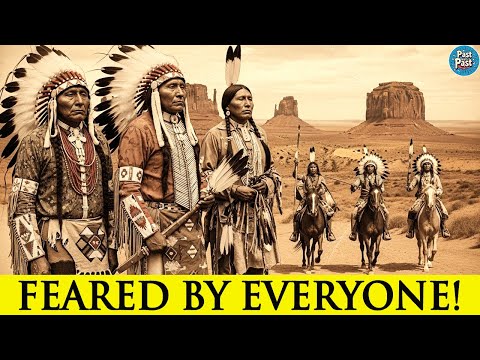
The Comanche were not always the formidable force history remembers. Their origins trace back to the Shoshone, a people who lived a more subdued existence. But everything changed with the arrival of horses in the 16th century. Through trade and cunning, the Comanche acquired these beasts and quickly mastered them, transforming into the most skilled horsemen the continent had ever seen.
With horses, they expanded their territory far beyond their homeland, into the rich buffalo plains of eastern Colorado and western Kansas. They became a dominant power, their name derived from the Ute word kami—meaning enemy, or someone who always wants to fight. And fight they did.
In battle, the Comanche were a terrifying sight. They charged with deafening war cries, using their horses as shields while loosing arrows with deadly precision. Each warrior had a favorite war horse, a bond that was almost sacred. Even Comanche women were fearless, riding into the hunt and lassoing animals with equal skill.
US General James Wilkinson called them “the most formidable indigenous group on the continent.” And he was right. The Comanche single-handedly halted Spanish expansion for nearly 50 years, their raids so intense that settlers dubbed them the Comanche Moon—a time of terror when the moon was full and the warriors struck.
But their reputation wasn’t just built on horsemanship. It was their brutal treatment of captives that cemented their fearsome legacy. One tragic incident in 1836 involved the Parker family at Fort Parker. Around 100 Comanche warriors approached under a white flag, deceiving the settlers. Benjamin Parker stepped out to parley and was quickly surrounded and killed. The Comanche attacked, killing and mutilating others. Granny Parker was impaled with a lance, and her granddaughter Cynthia Anne Parker was captured.
Cynthia eventually assimilated into Comanche life, marrying Chief Pada Nakona. Years later, after being recaptured by white society, she struggled to adapt and died in 1870. Her story is just one of many that illustrate the complex and often tragic interactions between the Comanche and the expanding United States.
But the Comanche were not the only tribe that struck fear into the hearts of their enemies. The Iroquois Confederacy, also known as the Six Nations, was a masterclass in indigenous governance and military strategy. Their name, given by rivals, meant rattlesnake—and for good reason. Known for their stealth and tactical brilliance, they could neutralize enemies before they even knew what hit them.
From a young age, Iroquois youth were trained in combat, mastering bows, spears, and clubs. By their teenage years, they joined raids, proving their mettle in battle. Captives were often forced to endure the gauntlet, a brutal trial where they ran between rows of warriors wielding thorny branches. This ordeal highlighted the intense warrior culture and the harsh realities of intertribal conflict.
The Beaver Wars of the 17th century marked one of the Confederacy’s most aggressive periods. Seeking to dominate the fur trade, they launched fierce campaigns, subjugating tribes and expanding their territory from Michigan to Tennessee. Their unity was their strength—a three-fold cord not easily broken.
And then there were the Apache, the tigers of the human race. Masters of guerrilla warfare, they used their knowledge of the rugged southwestern terrain to strike suddenly and disappear. General George Crook described them as having unmatched endurance and agility—they could outrun cavalry on foot and release seven arrows in the time it took for the first to reach its target.
Their brutality in battle was legendary. Captives were subjected to horrific fates—skinned alive or burned at the stake. Children were not spared, their heads crushed against walls. Cruelty was not only accepted but revered, and those who devised new ways to inflict suffering were held in high esteem.
These tribes—the Comanche, the Iroquois, the Apache—were not just warriors. They were forces of nature, shaped by a world where survival demanded strength, cunning, and an unyielding spirit. Their stories are woven into the fabric of American history, a testament to the resilience and ferocity of indigenous peoples.
But their legacy is not just one of warfare. It is also one of tragedy, as the tide of colonization brought devastation and displacement. The Indian Removal Act of 1830, the Trail of Tears, and massacres like Wounded Knee would leave deep scars. Yet, despite it all, Native American communities endured.
As we delve deeper into the history of these terrifying tribes, we uncover not just tales of brutality, but also of honor, survival, and a culture that refused to be erased. The Comanche, the Iroquois, the Apache—their names still echo across the plains and mountains, a reminder of a time when they ruled with fear and respect.
The Apache were not the only ones who mastered the art of surprise. The Comanche, too, understood that speed and deception were often more valuable than sheer numbers. A single warrior on a well-trained horse could scatter a dozen poorly prepared soldiers before they even reached for their rifles.
But the Comanche’s true genius lay in their ability to adapt. They learned the ways of their enemies—the Spanish, the Mexicans, the Americans—and turned those lessons against them. They traded for rifles, learned to repair them, and even manufactured their own ammunition when supplies ran low.
One of the most feared Comanche leaders was Quanah Parker, the son of Cynthia Anne Parker and Chief Peta Nocona. Quanah embodied the fusion of two worlds—his mother’s white heritage and his father’s warrior blood. He led raids that terrified settlers across Texas, and his name became synonymous with the Comanche resistance.
But Quanah was also a pragmatist. When it became clear that the buffalo were disappearing and the US Army was relentless, he chose a different path. He surrendered and became a voice for his people, negotiating with Washington and even befriending President Theodore Roosevelt.
His story reflects the broader tragedy of the Plains tribes—warriors who fought with everything they had, only to face an enemy that could not be defeated by bravery alone. The Comanche were not broken by battle, but by the systematic destruction of their way of life.
Yet even as their world collapsed, their reputation endured. Settlers spoke of the Comanche Moon with a shudder, and mothers warned their children to stay close when the full moon rose. The Lords of the Plains had left their mark on history, a mark that could never be erased.
The Iroquois Confederacy faced a different kind of challenge. Their strength was not just in war, but in diplomacy and governance. The Six Nations had created a system of consensus and representation that would later inspire the founders of the United States.
But unity could not protect them from the tide of European expansion. The American Revolution split the Confederacy, with some nations siding with the British and others with the colonists. The aftermath was devastating—their lands were seized, their power diminished, and their people scattered.
Still, the Iroquois spirit endured. Today, their confederacy remains one of the oldest participatory democracies in the world, a testament to the enduring power of unity and tradition.
And what of the Apache? Their most famous leader, Geronimo, became a legend in his own time. He led a small band of warriors and their families across the rugged Southwest, evading thousands of US and Mexican soldiers for years.
Geronimo’s story is one of extraordinary endurance. He was captured and escaped multiple times, each time fading into the mountains with a handful of followers. His name became a byword for resistance, a symbol of the Apache refusal to surrender.
But Geronimo, too, was eventually forced to yield. He spent his final years as a prisoner of war, never allowed to return to his homeland. His story, like so many others, is a reminder of the human cost of conquest.
The Apache’s mastery of guerrilla warfare influenced military tactics for generations. Their ability to live off the land, to move without being seen, and to strike without warning made them a model for irregular fighters around the world.
Yet their legacy is not just one of warfare. The Apache were also skilled artisans, healers, and storytellers. Their culture, like their warriors, refused to die.
As we look back on these tribes, we see more than just warriors. We see societies built on strength, honor, and a deep connection to the land. Their stories are not just about brutality—they are about survival, resilience, and the indomitable spirit of a people who refused to be erased.
The Comanche, the Iroquois, the Apache—their names still carry weight. They are reminders of a time when the Great Plains and the eastern forests were ruled by those who knew every river, every ridge, and every hidden trail. And they are reminders of what was lost, and what endures.
The descendants of these tribes did not vanish. They adapted. They fought in courts, in classrooms, and in the halls of Congress. They reclaimed languages, revived ceremonies, and taught their children the stories of Quanah Parker, Geronimo, and the great councils of the Iroquois.
Today, the Comanche Nation thrives in Oklahoma. The Apache still hold sacred the mountains of the Southwest. The Haudenosaunee Confederacy continues to meet, its council fires still burning after centuries. Their resilience is not a footnote—it is the final chapter of a story that refuses to end.
“We are still here,” they say. And they are. The terrifying tribes of history are not just ghosts of the past. They are living peoples, shaped by war and tragedy, but also by survival and pride.
So when the full moon rises and old stories are told around the fire, remember: the Comanche Moon was not just a time of fear. It was a time when the Lords of the Plains rode free. And that freedom, though changed, still beats in the hearts of their descendants.
What do you think—has history been too harsh on these tribes, or not harsh enough? Share your thoughts below.
Report this article
Select a reason for reporting:






