They could have driven west and vanished. California, the Pacific Northwest, even Canada—any place where the law wasn’t hunting them. But Bonnie and Clyde didn’t. Instead, they kept circling the same few states, same dusty roads, until a hail of bullets ended it all on May 23, 1934. Why? The answer is more twisted than you think.
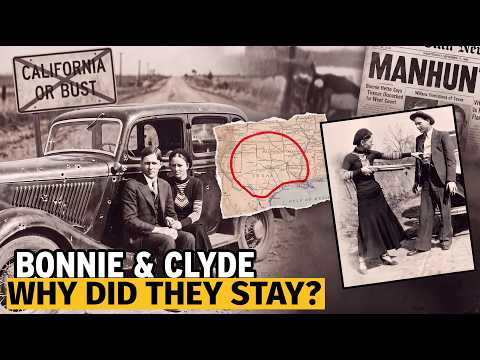
In the 1930s, local law enforcement was bound by strict borders. A county sheriff couldn’t chase a suspect across state lines. Crossing a state line effectively ended the pursuit—it wasn’t even a federal crime back then. Bonnie and Clyde exploited these uncoordinated boundaries aggressively. They drove fast, reliable Fords, hitting banks and stores and slipping into neighboring states before police could coordinate. Their loop along the Texas-Oklahoma-Missouri-Arkansas-Louisiana borders made ordinary pursuits useless.
But the real reason they didn’t just leave runs deeper. Clyde Barrow had lost his left big toe and part of the other. During the Great Depression, almost all jobs for working-class men required heavy manual labor. Clyde couldn’t do farm work, construction, or factory jobs—his foot couldn’t take standing and lifting all day. Even ordinary leather shoes were agonizing; he drove getaway cars in just his socks because shoes threw off his balance on the pedals. With so many able-bodied men jobless, no employer would hire a limping man who couldn’t wear a medical shoe. To earn a living honorably, he’d have to find rare, unglamorous work—cobbling, darning socks, clerking.
And Bonnie Parker? She suffered a horrific leg injury when battery acid spilled during a high-speed chase, burning flesh to the bone. Her right leg was permanently stiffened and bent at the knee, leaving her barely able to walk. She had to hop on one foot or rely on Clyde to carry her. In the 1930s, there were no accommodations for disabled workers. Almost every job available to a working-class woman required standing for hours—factories, restaurants, shops. She had worked in a café, but now she couldn’t even stand alone. No employer would hire her, leaving her with no honest way to survive the Depression.
Unlike most outlaws who cut ties and fled, Bonnie and Clyde stayed close to their families. They were so homesick and attached to their mothers that they risked their lives every few weeks to sneak into Dallas for secret visits. They had a precise system: they’d drive past their families’ homes and toss a bottle or cigarette tin with a note wrapped around it, specifying a time and an isolated road outside town. When they met, it was like a family reunion—they brought groceries and fried chicken, cooked by the roadside, took photos, and poured out their misery to their mothers. Clyde gave his family stolen money to help pay rent and buy food during the Depression. Their families were fiercely loyal—they lied to police, hid messages, never betrayed them. Even when police put the families under round-the-clock surveillance, they kept silent, and Bonnie and Clyde kept coming back.
They were broke. Most of their robberies targeted small-town grocery stores, gas stations, and rural banks with barely any cash—just a few dollars. Though they stole cars and guns from armories, they lived hand-to-mouth, spending everything on gas, food, and medicine for their injuries. They couldn’t afford a safe hideout, so they camped in forests or slept in the back of stolen cars. Their families were too poor to help—both lived in crowded slums in west Dallas during the height of the Great Depression.
They became nationally famous in 1933 after police found an undeveloped roll of film left in a hotel or hideout in Joplin, Missouri. After a shootout there, police got the film. Newspapers everywhere published photos of them joking and holding guns—one famous image showed Bonnie smoking a cigar. Those photos also featured gang members like Clyde’s brother Buck Barrow, his wife Blanche, and young accomplice W.D. Jones, who became part of the public’s fascination. The public was obsessed, making them household names. But in person, they were striking for their short stature and severe disabilities—not glamorous at all. Bonnie was under five feet and weighed only 90 pounds; Clyde was short and thin too. Both were heavily disabled from their injuries.
1934 was their inevitable end, and things quickly fell apart. First, they turned public opinion against them. In April 1934, they shot and killed two young highway patrolmen in Grapevine, Texas. Witnesses falsely claimed Bonnie laughed coldly and shot a dying officer point-blank in the face. Though the story was fabricated, the public was disgusted. People stopped seeing them as romantic heroes and began to see them as vicious killers. They lost the protection of ordinary citizens who used to look the other way.
Second, the law changed the rules entirely. Lee Simmons, head of the Texas prison system, personally authorized a hunt and appointed legendary retired Texas Ranger Frank Hamer to track them. Unlike ordinary police, Hamer was given a special multi-state commission—he wasn’t bound by state lines. He could chase them anywhere. Hamer assembled a team of fellow lawmen—Ted Hinton, Bob Alcorn, and others—giving the manhunt a coordinated authority Bonnie and Clyde had never faced. The federal government was also after them, using national resources to track the couple across state lines, because Clyde’s habit of driving stolen cars across state borders violated a federal law criminalizing interstate car theft. That charge gave federal agents legal authority to intervene anywhere, long before bank robbery or fleeing across state lines became federal crimes.
In the 1930s, an ordinary working person needed about $1,300 a year for a decent middle-class standard of living—equivalent to about $74,000 in 2026. That meant about $25 a week. That steady income easily covered rent, groceries, clothes, and some comfort at month’s end. But for Bonnie and Clyde, that basic level was utterly out of reach. With massive job losses during the Depression and Clyde’s severe foot injury preventing manual labor, their families fell below that $1,300 middle-class income, plunging them into deep poverty.
Bonnie and Clyde didn’t fail to move elsewhere because they couldn’t—they didn’t because Clyde Barrow was at the bottom of that poverty, a man who always sought easy solutions. When honest work meant standing in a field or on a factory floor, he wasn’t willing. When straight life demanded anything of him, he chose the gun. Robbing a grocery store was faster than earning a wage. He could have driven west and started over with nothing, as millions of broke men did in those years. But starting over was hard. Robbery and flight were easy—until the moment they weren’t.
So Bonnie followed Clyde through it all. She was nineteen when she met him and fell for a man with no future and no intention of building one. She had every chance to leave—her family even begged her—but she stayed. She boarded those stolen cars and rode the loop to the end because she lacked the ability to leave him. She chose the outlaw path over the honest one, just as he did. That’s why they never left. Not because the country was close, but because leaving meant choosing the hard, honest road—something neither of them ever did.
But there’s a piece of this story that rarely gets told—the part where leaving wasn’t just hard, it was practically impossible in ways that had nothing to do with willpower or morality. The America of 1934 had no safety net. No disability payments, no food stamps, no unemployment insurance worth the name. A man with a mangled foot and a woman who couldn’t stand upright had exactly two options: rely on family charity or find another way to eat. The Barrow and Parker families were already drowning. They couldn’t float two more bodies.
And there’s the matter of what Bonnie and Clyde actually wanted. They didn’t dream of a quiet farm in California. Clyde talked constantly about going straight—but only after one more score, one more bank, one more big haul that would set them up. It was always the next robbery that would buy their freedom. That’s the trap of the outlaw life: the escape fund never fills because you keep spending it on the escape.
Bonnie, for her part, wrote poems and dreamed of being famous. She wanted to be seen. A quiet life in Canada meant obscurity—no newspapers, no headlines, no one knowing her name. For a woman who had spent her life invisible, that was its own kind of death. She’d rather be hunted and known than safe and forgotten.
Then there was the practical reality that nobody talks about: they were terrible at being fugitives. Truly awful. They left fingerprints everywhere, dropped film rolls at crime scenes, wrote letters to their families that police eventually intercepted, and returned to the same towns over and over. They weren’t master criminals—they were desperate people making desperate mistakes. A clean break to California required planning, discipline, and patience. They had none of those things.
By early 1934, the net was closing faster than they understood. Frank Hamer wasn’t just another cop—he was patient, methodical, and utterly without mercy. He studied their movements, mapped their family visits, and waited. He knew they’d come back to Dallas. They always did.
And that’s the cruel irony of the whole thing. The very loyalty that made them human—the love for their mothers, the need to feel normal for a few hours—was the rope that hung them. Every visit home was a thread Hamer could pull.
On May 23, 1934, that thread snapped. Hamer’s ambush on a lonely Louisiana road wasn’t a chase—it was an execution. They never had a chance to drive west, to start over, to be forgotten. The bullets came before the engine could turn.
So the question isn’t really why they didn’t leave. It’s why we keep asking. We want them to have a choice, a clean escape, a redemption arc. But poverty, disability, and love aren’t obstacles you outrun—they’re the road itself. Bonnie and Clyde didn’t stay because they were brave or stupid. They stayed because leaving required a version of themselves they never learned to be.
Maybe that’s the real tragedy—not the gunfire, but the years before it. The quiet moments when they could have turned the wheel and didn’t. They chose each other over a future, and the future chose a roadside in Louisiana.
What would you have done—gotten in that car and driven until the past couldn’t find you, or stayed because leaving meant leaving yourself behind? Tell us in the comments.
Report this article
Select a reason for reporting:






