In the pitch-black jungle of Vietnam, a lone howitzer crew faced an impossible choice: fire directly into the swarming enemy overrunning their own position, or be overrun. That night, they pulled the lanyard on a weapon so devastating it would alter the course of the war. The beehive round—a 105mm shell packed with 8,000 steel darts—turned a standard artillery piece into a lethal shotgun, and its debut at LZ Bird would leave over 250 enemy dead and a permanent mark on the NVA’s tactical playbook.
But the true horror of the beehive wasn’t just its body count. It was the sound. A hiss, a buzz, something veterans still struggle to name—the noise of 8,000 fin-stabilized flechettes slicing through the air at 1,500 feet per second. For the NVA, that sound meant the final 100 meters of an assault had become a death sentence. And they adapted, because adaptation is its own form of fear.
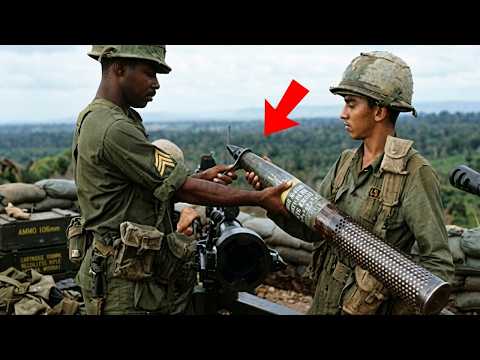
The story begins not in the jungles of Southeast Asia, but in the laboratories of Whirlpool Corporation in 1957. Yes, the washing machine company. Tasked with solving a problem artillery had faced since the Civil War—how to stop a massed infantry assault that had already reached your guns—Whirlpool’s engineers delivered a brutal answer. The M546 APERS-T round, known as the beehive, was designed for the war at the wire, not the war at range. When fired with a mechanical time fuse set to muzzle action, the shell burst the instant it left the barrel, spraying its deadly payload in a flat, expanding cone. One pull of the lanyard turned a field howitzer into a literal shotgun, firing not nine pellets but 8,000 steel darts in a single blast.
The first combat use came on December 27, 1966, at LZ Bird in Binh Dinh Province. Three battalions of North Vietnamese infantry, roughly 1,000 men, hit the fire base after a heavy mortar barrage. They breached the perimeter and overran gun positions. In a desperate, nearly suicidal move, the commander of Battery B ordered his crew to fire beehive rounds directly into the center of the fire base—into the space where NVA troops were swarming through his own positions. The rounds fired. The assault stalled. When the sun rose, over 250 enemy dead lay across the perimeter. Twenty-seven Americans were killed. Major General David Ott later wrote that LZ Bird validated the beehive round as a tremendously valuable asset to fire base defense. From that night forward, every fire base in Vietnam kept beehive rounds pre-positioned with designated sectors of fire.
But LZ Bird was chaos—a last resort. The question remained: what happens when the beehive is fired deliberately, as part of a planned defense, before the attackers reach the wire? Three months later, at Fire Base Suoi Tre, the NVA provided the answer.
On March 21, 1967, at dawn, two NVA battalions from the 272nd Regiment attacked Suoi Tre in Tay Ninh Province. This time, the defense was not improvised. The battery commander had pre-planned beehive sectors. When the assault wave reached the engagement zone, he ordered his infantry to get under cover and directed his 105mm guns to load APERS rounds. Forty beehive rounds were fired in a single engagement—the largest number of M546 rounds expended in any battle to that date. The after-action report described the result in one sentence: “Wide gaps had been blown in the attackers’ ranks.” Not wounded. Not suppressed. Gaps. Entire sections of the assault line ceased to exist. The momentum broke. The infantry went on the offensive, chasing survivors back into the tree line. When it was over, 299 NVA lay dead. Thirty-one Americans were killed. The ratio was nearly 10:1.
The after-action report noted something that changed Army doctrine permanently: “The beehive round was extremely effective at stopping assaulting enemy troops.” That clinical sentence, written by officers who had just watched 8,000 steel darts per shell tear through a battalion-strength assault, didn’t need adjectives. The results spoke for themselves.
But did the NVA actually fear this weapon? The documentary evidence is thin—no captured manual names the beehive, and most Vietnamese reports describe “heavy artillery” in general terms. What exists is behavioral evidence, and it tells a story the documents don’t need to spell out. Before LZ Bird and Suoi Tre, the NVA’s primary assault doctrine was massed infantry: concentrate forces, hit the perimeter at a single point, overwhelm with numbers, accept casualties because the objective justified the cost. After 1967, that doctrine changed. US intelligence noted that NVA units began modifying their tactics specifically to counter final protective fires. At Xa Cat in October 1967, NVA battalions approached by crawling, staying prone to reduce exposure to the flat trajectory of the flechette cone. They adopted hugging tactics, closing to within 20 or 30 meters of American positions before initiating contact so that defenders couldn’t fire beehive without risking their own men. They shifted from massed infantry waves to sapper-led penetrations—small teams of specialists cutting wire and breaching bunkers rather than entire companies charging through open ground.
The NVA didn’t announce that they feared the beehive. They didn’t need to. They changed how they fought. And the timing of those changes corresponds directly with the introduction of flechette rounds into fire base defense doctrine. By 1969, the concept had matured further. At Fire Base Crook in June 1969, ground surveillance radar and seismic sensors detected NVA forces massing in the tree line before the assault began. Artillerymen fired beehive rounds into pre-registered coordinates based on sensor data—not as a last resort, but as a first strike. Over two nights, 76 NVA bodies were found in a single sector. The kill ratio approached 76 to 1. The beehive had evolved from a desperate measure into a calculated weapon, stopping assaults before they started.
As the war continued, many units increasingly relied on “Killer Junior”—standard high-explosive rounds with mechanical time fuses set to detonate 10 to 30 meters above the ground, creating an air burst that scattered fragments in every direction. Killer Junior was more logistically sustainable and more versatile, but it couldn’t do what the beehive did at the wire. It couldn’t fill a 30-meter front with 8,000 projectiles in a single blast. It couldn’t turn the final 100 meters of an approach into a problem that had no solution for massed infantry moving in the open. At the ranges where fire base defense was life or death, nothing in the American arsenal matched what the M546 delivered.
The beehive round didn’t win the Vietnam War. No single weapon ever wins a war. What it did was change the terms of the fight at the one point where the NVA had always held the advantage: the final assault. Before the beehive, reaching the wire was a matter of acceptable casualties. After the beehive, reaching the wire was a death sentence for anyone standing upright. The NVA were not stupid. They were professional soldiers who adapted to every weapon the United States deployed against them. They adapted to the beehive, too—by crawling, by hugging, by sending sappers instead of battalions. But adaptation is its own form of testimony. You don’t rewrite your assault doctrine around a weapon you don’t respect.
8,000 steel darts, one pull of the lanyard, and the men who made the decision to charge a fire base knew, whether they had a name for it or not, that somewhere behind the wire a howitzer was loaded with something they had never been trained to survive. The artillerymen who fired those rounds at LZ Bird, at Suoi Tre, at Crook, and at dozens of fire bases that never made the history books—they remember the sound. Not the blast of the gun, but the sound that came after. 8,000 flechettes cutting through the air at 1,500 feet per second makes a noise that veterans describe as a hiss or a buzz or something they’ve never been able to find the right word for. The men on the other end of that sound never had to describe it. They just stopped coming.
But the story of the beehive round doesn’t end with the last American howitzer leaving Vietnam. The weapon had a long shadow, and that shadow fell across the next half-century of artillery doctrine in ways its Whirlpool engineers never could have predicted. The M546 was officially declared obsolete in the 1970s, phased out of active inventory as the Army pivoted toward precision-guided munitions. But the concept—the idea of turning a single tube into a wall of projectiles—refused to die. It resurfaced in the 1980s with the M494 APERS-T round for the 90mm recoilless rifle. It appeared again in the experimental flechette payloads tested for the M1 Abrams’ 120mm main gun. Each time, the same principle: one shot, thousands of projectiles, a cone of death that no infantryman could outrun.
The Soviets were watching. Declassified CIA assessments from the late 1970s reveal that Soviet military attachés in Hanoi had collected detailed reports on American fire base defenses, including the effects of flechette ammunition. By the 1980s, Soviet artillery manuals began referencing ‘arrow-shaped destructive elements’ for close-in defense. The Russians had learned the lesson the NVA taught them: in the final 100 meters, volume of fire beats precision every time.
What the beehive truly changed wasn’t just tactics. It changed the psychology of the assault. For a century, infantry doctrine had accepted a brutal calculus: if you send enough men at a defended position, some will get through. The beehive broke that equation. It didn’t just kill attackers—it erased the assumption that numbers could overwhelm firepower at close range. For the first time in the history of warfare, the final charge into an enemy position became statistically survivable only if the defenders ran out of ammunition.
Veterans of the NVA’s 272nd Regiment, interviewed decades after the war by Vietnamese military historians, described the sound in terms that echo their American counterparts. One survivor, a former company commander at Suoi Tre, recalled: ‘We called it the rain of needles. You did not hear the shot. You heard the needles, and then your men were gone.’ He described crawling through the aftermath, finding his soldiers pinned to trees by darts no thicker than a matchstick. The medics couldn’t remove them without X-rays. The field hospitals didn’t have X-rays. Men died of infections from wounds that looked like insect bites.
That testimony is the closest thing to documentary proof that the NVA feared the beehive. It isn’t a manual. It isn’t an after-action report. It’s the memory of a man who watched his battalion dissolve in a single hiss of steel. And it’s the reason why, even today, the beehive round occupies a unique place in the history of close-quarters artillery—a weapon designed by a washing machine company, first fired in desperation, perfected in doctrine, and remembered by both sides as the sound that ended the charge.
The beehive round’s legacy, however, isn’t just a story of steel and tactics. It’s a story about the terrifying ingenuity of ordinary companies. Whirlpool, a name synonymous with clean laundry, built a weapon that made the final 100 meters of a battlefield a no-man’s land. That contradiction—the mundane and the monstrous—is the heart of the beehive’s strange history.
Today, the concept lives on in weapons like the XM25 and the AA-12 shotgun, both designed to deliver overwhelming firepower at close range. But none have matched the sheer scale of the M546: 8,000 darts, one trigger pull, a sound that both sides still hear in their nightmares. The beehive didn’t just change the war—it changed what soldiers expected from the final charge.
So, the next time you see a washing machine, remember: the same company that built it also built a weapon that stopped a thousand men in their tracks. What other everyday corporations have a secret history of war-winning inventions? Let us know in the comments below.
Report this article
Select a reason for reporting:






