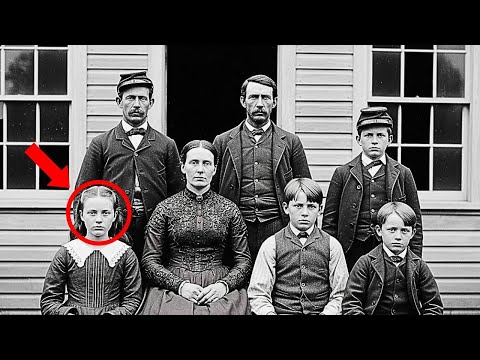
The afternoon sun filtered through the dusty windows of Morrison’s Antique Gallery in Charleston, South Carolina, casting long shadows across tables cluttered with forgotten treasures. Dr. Sarah Bennett, a historian specializing in Civil War era photography, moved methodically through the rows of artifacts, her trained eye scanning for anything of historical significance. She had spent the morning examining daguerreotypes and tintypes, most of them unremarkable family portraits from the 1860s, but then, tucked between a stack of yellowed newspapers and a cracked leather Bible, she found it: a large albumen print in a deteriorating wooden frame.
The photograph showed a family of seven posed in front of a modest wooden house. A stern-looking father stood behind a seated mother, with five children arranged around them. The image quality was remarkably good for 1865, the date inscribed on the back of the frame. What caught Sarah’s attention, however, was something indefinable—an unsettling quality in the composition that she couldn’t immediately explain.
“How much for this one?” Sarah asked the gallery owner, a weathered man named Tom Morrison who had been running the shop for 30 years.
Tom squinted at the photograph through his reading glasses. “Found that in an estate sale up in Columbia last month. Whole attic full of stuff. $20 and it’s yours.”
Sarah examined the image more closely. The family members were dressed in their finest clothes—the father in a dark suit, the mother in a high-collared dress with intricate lace details, the children in matching formal attire. Their expressions were solemn, typical of the era when long exposure times required subjects to remain perfectly still. But something felt wrong. The lighting seemed inconsistent, and one of the children—a young girl seated on the far left—had an unusual pose that stood out even in the faded sepia tones.
“I’ll take it,” Sarah said, handing Tom a $20 bill.
Back at her office at Charleston University, Sarah placed the photograph under her magnifying lamp. The inconsistencies became more apparent. She decided this warranted deeper investigation. Using her department’s new digital restoration equipment, she would recolor the image—a process that might reveal details invisible in the original print. She had no idea what darkness she was about to uncover.
Sarah’s office was a sanctuary of history, with shelves lined with leather-bound volumes and walls covered in archival photographs from the Civil War period. She carefully positioned the 1865 family portrait on her scanning table, adjusting the high-resolution camera mounted above it. The digitization process took nearly an hour. Sarah watched as the computer slowly captured every detail of the faded photograph, creating a file with millions of pixels that could be manipulated and enhanced.
Once complete, she transferred the image to her restoration software—a sophisticated program that historians and forensic analysts used to bring new life to old photographs. She began with basic adjustments, correcting the contrast and sharpening the blurred edges. The family’s faces became clearer, their clothing more defined. The father’s stern expression revealed deep-set eyes and a tight jaw. The mother’s face showed signs of exhaustion, with dark circles visible beneath her eyes even through the aged photograph.
Then Sarah started the colorization process, referencing her extensive knowledge of period-appropriate clothing dyes and skin tones. She carefully selected colors for each element: the father’s dark brown suit, the mother’s deep burgundy dress, the children’s various shades of blue and gray clothing. As the colors emerged on her screen, something immediately struck her as wrong.
The young girl on the far left, whom she had noticed earlier, appeared dramatically different from the rest of the family. While Sarah had applied the same skin tone palette to all the family members, this child’s face took on an unmistakably grayish-blue hue.
“That can’t be right,” Sarah muttered, adjusting the color temperature. But no matter how she modified the settings, the girl’s complexion remained unnaturally pale with a bluish tint that suggested something far more disturbing than a mere photographic anomaly.
Sarah leaned back in her chair, her heart rate quickening. She had seen enough Civil War era photographs to know what she was looking at, but she needed confirmation. She zoomed in on the girl’s face, examining every pixel. The child’s eyes were open but completely unfocused, staring at nothing. Her mouth was slightly parted, held in position by something Sarah could now see—a thin wire or stand behind her head supporting her in an upright position. Her hands, resting in her lap, showed the telltale signs of rigor mortis in their rigid positioning.
This wasn’t just a family portrait. This was a postmortem photograph—a memorial image taken with a dead child.
Sarah spent the entire evening researching postmortem photography, though she was already familiar with the practice. In the Victorian era, particularly during and after the Civil War, death was an intimate part of daily life. Families often commissioned photographers to take final portraits of deceased loved ones, especially children, as a way to preserve their memory. These memorial photographs were surprisingly common. Sometimes the deceased was photographed alone, arranged as if sleeping. Other times, as Sarah now suspected with this family portrait, the dead were posed alongside the living, propped up with stands, their eyes sometimes painted open on the final print to create the illusion of life.
But something about this particular photograph troubled her beyond the standard historical practice. The composition suggested the family was trying to hide the child’s death, not memorialize it. In typical postmortem portraits, the deceased was clearly the focus, often surrounded by flowers or religious symbols. Here, the dead girl was positioned at the edge of the group, almost as if they wanted her presence to seem incidental.
Sarah pulled up the image on her large monitor and studied each family member’s expression more carefully. The father’s stern look now seemed to carry an edge of anger. The mother’s exhaustion appeared more like profound grief. The four other children—three boys and another girl—all avoided looking toward their deceased sister. She zoomed in on the background of the photograph. The wooden house behind them showed signs of poverty: warped boards, a cracked window, weathered steps. This wasn’t a wealthy family that could afford elaborate memorial photography. So why had they gone to such lengths to include their dead daughter in this family portrait?
Sarah picked up the original photograph and examined the back of the frame again. Besides the date, April 1865, there was a small inscription she had initially overlooked, partially obscured by old paper backing: “The Thornton family. Mercy’s last day.”
Mercy. The dead girl had a name. And “last day” suggested something more than natural death.
Sarah opened her laptop and began searching historical records for the Thornton family in South Carolina during 1865. The Civil War had just ended that April with Lee’s surrender at Appomattox. It was a time of chaos, devastation, and widespread death. What had happened to Mercy Thornton? And why had her family photographed her this way?
The following morning, Sarah drove to the South Carolina Historical Society in downtown Charleston, a grand building that housed centuries of state records. She had called ahead to request access to death certificates, census records, and newspaper archives from 1865. Margaret Wells, the society’s senior archivist, met her in the reading room. Margaret was in her 60s, with silver hair pulled back in a practical bun and reading glasses hanging from a chain around her neck.
“Civil War period?” Margaret asked, setting down several boxes of documents. “You’re looking at a chaotic time for record-keeping. Many documents were destroyed, and deaths often went unregistered, especially in rural areas.”
“I’m looking for the Thornton family, specifically a girl named Mercy who died in April 1865,” Sarah explained, showing Margaret the photograph on her tablet.
Margaret’s experienced eyes studied the image. “Postmortem photography. Not uncommon for the era, though this composition is unusual.” She paused, her finger hovering over the screen. “That inscription—’last day.’ That’s peculiar phrasing. Usually, these memorial portraits were labeled with ‘in memory’ or ‘gone to heaven.'”
Together, they began searching through the 1860 census records for Columbia, South Carolina, where the photograph had been found. After an hour of careful examination, Sarah found an entry: James Thornton, age 34, occupation mill worker; wife Elizabeth, age 32; children Robert, age 12, William, age 10, Mercy, age 8, Thomas, age 6, and Catherine, age 4.
“There,” Sarah said, pointing to Mercy’s name. “She would have been about 13 in 1865.”
Margaret pulled out a thick ledger containing death records. The pages were yellowed and fragile, many entries written in fading ink. They searched through April 1865, scanning hundreds of names. Most deaths were attributed to disease, war injuries, or complications from malnutrition—the devastating aftermath of Sherman’s march through South Carolina. Then Margaret stopped, her finger resting on a single line.
“Here. Mercy Thornton died April 18th, 1865, age 13.”
Sarah leaned in closer. “What’s listed as cause of death?”
Margaret’s expression darkened. “It just says ‘fever,’ but there’s a notation mark here. See this asterisk? That usually means there was additional information recorded elsewhere, possibly in a coroner’s report or newspaper article.”
They spent another two hours searching through newspaper archives from that period. The Columbia newspapers from April 1865 were filled with reports of Lincoln’s assassination, the war’s end, and the chaos of Reconstruction beginning. Finally, in a small local paper called the Columbia Recorder, dated April 20th, 1865, they found a brief article that made Sarah’s blood run cold.
The article was short, tucked away on the third page between advertisements for tonic medicines and notices of estate sales. Margaret placed the preserved newspaper under a protective sheet and adjusted the reading lamp so Sarah could see it clearly. The headline read: “Tragic Death of Mill Worker’s Daughter—Questions Remain.”
Sarah read aloud. Mercy Thornton, age 13, daughter of James and Elizabeth, had collapsed at her station in the Granby Textile Mill weaving room on April 17th and died the following morning. Fellow workers reported she had worked fourteen-hour shifts, six days a week, and had complained of feeling unwell for days before her collapse. One anonymous worker stated that children at the mill frequently fell ill from cotton dust and poor ventilation. Superintendent Harold Pierce disputed the claims, insisting Mercy’s death was due to a fever unrelated to her employment. An inquest may be convened.
Margaret nodded grimly. “Child labor was legal and common. The dust caused respiratory problems, the machinery caused injuries, and the long hours led to exhaustion. But why pose her like this?”
“Look at the date,” Margaret said, pointing to the inscription. “April 1865. The war had just ended. This family would have been desperate, financially devastated, probably in debt.” Sarah’s mind raced. If Mercy’s death was tied to working conditions, and an inquest was coming, the family might have been under pressure.
They spent the next three hours in a box labeled Coroner’s Inquests, 1865. Inside was a folder bearing Mercy Thornton’s name. Dr. Edmund Foster testified that her lungs showed prolonged exposure to cotton dust and that she bore bruising consistent with physical labor. A worker named Ruth Porter swore she had seen Mercy coughing up blood two days before her collapse. “Mr. Pierce told all the children that if they couldn’t keep up, they’d be replaced and their families would lose their housing.”
Then came James Thornton’s testimony, and Sarah’s hands trembled as she read. “I watched my daughter die slowly over two years. The dust took her breath away piece by piece. On her last day, she could barely speak, but she asked me to tell her brothers and sister not to be afraid.”
The coroner ruled death by respiratory failure due to prolonged inhalation of cotton dust, with workplace conditions a significant factor. But attached was a settlement dated May 1st, 1865: fifty dollars, the family’s silence, and continued employment and housing in exchange for waiving all claims. “They bought this family silence for fifty dollars and the threat of homelessness,” Sarah said quietly.
She looked at the photograph again, seeing it clearly now. The strange composition, the girl propped at the edge, the stiff unnatural pose, the inscription Mercy’s last day. This wasn’t denial. It was documentation—a family’s act of resistance, preserving the truth they had been legally silenced from speaking.
Over the following weeks, Sarah traced the survivors through census records. James became a carpenter; none of the remaining children were ever listed as mill workers. Robert became a school teacher, William a clerk, Thomas a printer’s apprentice, Catherine a student. They got out. And in 1895, Thomas Thornton published an article naming his sister: “Thirty years ago, my sister Mercy died at age thirteen after two years of labor in Granby Textile Mill. Her death must mean something. Her sacrifice must lead to change.”
Three months later, Sarah stood in the university gallery, watching visitors move through her exhibition, Hidden in Plain Sight: Postmortem Photography and Labor Justice in the Civil War Era. The restored photograph hung at the center, flanked by inquest documents and Thomas’s articles. A woman named Jennifer Harrison—Mercy’s great-great-niece—stood beside her, tears in her eyes. “You can see it now, once you know what you’re looking for. They were showing the world what happened to her.”
That evening, alone before the portrait, Sarah thought of Mercy, thirteen years old, who spent her last day at a loom before collapsing, who died gasping for breath, asking her father to tell her siblings not to be afraid. Mercy Thornton’s last day had become her lasting testimony.
But two thousand names were never recovered—children who died without anyone preserving their stories. So here is the question I leave with you: how many Mercy Thorntons are still waiting in some forgotten attic, in a faded photograph no one has looked at closely enough—and will you be the one to ask the right questions?
Report this article
Select a reason for reporting:






