Dr. Marcus Thompson had seen thousands of photographs in his career as a curator at the Chicago History Museum, but none had ever made his blood run cold like this one. It was a seemingly ordinary image from 1919: a crowd celebrating the return of Black soldiers from World War I, their faces alight with pride and hope. But when Marcus zoomed in on a shadowy doorway in the background, he discovered something that had been hidden for over a century—a woman holding a sign with four chilling words: “They served. They returned. They were murdered.”
That woman was Ida Freeman, a domestic worker turned activist who had risked everything to document the lynchings of Black veterans across the South. Her story, buried in a church basement for 100 years, would soon unravel a web of terror, cover-up, and a murder that authorities had refused to investigate. But before Marcus could piece together the full truth, he had to understand why Ida had stood in the shadows that day—and why someone wanted her silenced forever.
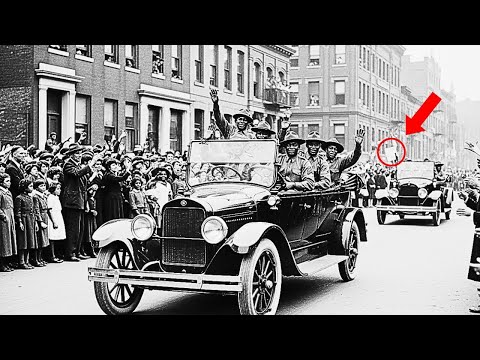
Marcus’s hands trembled as he enhanced the image, revealing the sign’s hand-painted letters and the names of states—Georgia, Alabama, Mississippi, Tennessee—scrawled below. Each name represented a soldier lynched for wearing his uniform, for demanding the rights he’d earned on foreign battlefields. “She wasn’t hiding,” a colleague would later tell him. “She was documenting.”
But Ida’s courage came at a cost. Threatening letters, police surveillance, and a fateful night in August 1919 when her body was found in an alley, her death dismissed as “undetermined.” No autopsy, no investigation—just silence.
Now, a century later, Marcus and a team of historians raced to uncover Ida’s archive: 67 folders, each detailing the murder of a Black veteran, preserved in a locked metal box labeled “IDF 1919.” The discovery would spark a national reckoning, but it also raised a haunting question: How many other Ida Freemans had been erased from history? And what would it take to finally bring their stories into the light?
Marcus stood in the museum’s conservation lab, the original photograph under a magnifier, when Evelyn called with news. “I found her in the 1910 census—Ida Freeman, age 18, in Mississippi. But there’s something else. She had a brother, Samuel, who served in the 371st Infantry.” Marcus’s pulse quickened. The 371st had fought in France, one of the Black combat units. He pulled up military records. Samuel Freeman had returned to Mississippi in January 1919 and was lynched three weeks later, his uniform shredded. “That’s why she started documenting,” Evelyn said quietly. “It was personal.”
The pieces clicked into place. Ida hadn’t just been an activist—she’d been a grieving sister. Her sign in the shadows wasn’t abstract protest; it was a memorial for Samuel and the 66 others she’d catalogued. Marcus thought of her diary entry: “I think of the mothers who gave their sons… Fear is small compared to their loss.” She’d known the risk because she’d already lost everything.
But the archive held one more secret. At the bottom of the box, beneath the diary, was a sealed envelope addressed to “The Editor, Chicago Defender—To Be Opened If I Am Killed.” Inside, Ida had written a detailed account of her surveillance: the names of two white men who’d followed her, their connection to the Chicago Police Department, and a warning that her murder would be made to look like a random act of violence. She’d signed it with a single line: “I do this for Samuel, and for all the soldiers who came home to bullets instead of parades.”
Marcus and Evelyn sat in stunned silence. Ida had known exactly who was threatening her—and she’d documented that, too. The final entry in her diary, dated two weeks before her death, read: “They think silencing me will erase the truth. But I have made copies. The work will continue.” She’d been right. The copies she’d distributed to trusted church members had survived, and now they were about to reach the world.
But as Marcus prepared to announce the discovery, a new question emerged: Who else had Ida trusted with her evidence? And had any of those copies been lost—or deliberately hidden?
Marcus pulled the church’s original accession ledger from the museum’s files, its pages brittle as autumn leaves. The box had been logged in 1921 under a single entry: “Materials deposited by Sister I. Freeman. To be held until such time as they may be safely shown.” No donor signature. No follow-up. Whoever had carried the box to Olivet’s basement had done so quietly, trusting the church to keep its secret.
He cross-referenced the names in Ida’s distribution list—seven trusted church members, each given a set of copied records. Evelyn tracked the surnames through marriage records and obituaries. Three had vanished from Chicago entirely. Two had died in the 1919 flu epidemic. But two families still had descendants in the city.
Angela reached the first, a retired schoolteacher named Beatrice Coleman, whose grandmother had been Ida’s closest friend at Olivet. “My grandmother kept a bundle of papers wrapped in oilcloth under her floorboards until the day she died,” Beatrice said. “She told my mother, ‘These are Ida’s. Don’t open them while I’m alive. The world isn’t ready yet.'”
The bundle arrived at the museum three days later, hand-delivered by Beatrice herself. Inside were duplicates of Ida’s veteran files—and something Marcus hadn’t expected. A small notebook in a different hand, its cover marked “Roster of the Watch.” It listed eleven names across six states, women who had agreed to collect testimony in their own towns, passing evidence north to Ida for safekeeping.
“She wasn’t working alone,” Evelyn breathed. “She built a network. A distributed archive, exactly like we suspected.” The graduate student’s discovery in North Carolina suddenly made sense—the woman with the protest sign was likely one of the Watch.
But the roster also carried a warning. One name had been crossed out, with a note in Ida’s hand: “Betrayed us. Gave names to the men in Chicago. Trust no one at this address.” Marcus felt the cold weight of it. Someone inside the network had sold them out—and that betrayal may have led the killers straight to Ida’s door.
He scanned the roster again, his eyes catching on the final entry: a name and a street address in Chicago, dated July 1919, just weeks before Ida’s death. The address was three blocks from the alley where she’d been found.
Marcus pulled up a map of the South Side from 1919, overlaying the address onto the old street grid. It was a boarding house, long since demolished—but the 1920 census still listed its residents. One name jumped out: “Ruth Ellison, 34, widow, occupation: laundress.” Ruth had been the last person to see Ida alive, and she’d never been interviewed.
Angela found her great-granddaughter in Detroit. The family had kept one story alive: that Ruth had walked Ida to the corner the night she disappeared, and that Ida had pressed a bundle into her hands, whispering, “If I don’t come back, get this to the church.” Ruth had obeyed—and then fled Chicago within a week, terrified.
Marcus stood before the exhibition’s final panel, the photograph enlarged so Ida’s shadowed figure was unmistakable. Visitors would see her sign, and beneath it, the names of 67 soldiers. But now there was one more name to add—Ida’s own, printed in the same hand-painted style.
The museum’s director asked him what he’d learned from all of this. Marcus thought of Ruth, of Beatrice, of the eleven women on the Watch. “That resistance is rarely a solo act,” he said. “It’s a chain of ordinary people passing truth hand to hand, in the dark, until someone finally turns on the light.”
Ida’s chain had held for a century. Now it was ours to carry.
What hidden act of courage might be waiting in your own family’s attic—and will you be the one to finally zoom in?
Report this article
Select a reason for reporting:






