In the hushed restoration studio, Margaret Chen’s hands trembled as she adjusted the lens. The photograph, dated June 1906, showed a young mother, Eleanor, waving gently at the camera, her baby cradled in her arms. It was a tender Edwardian scene—until Margaret magnified the space between Eleanor’s fingers. There, where empty air should have been, a face emerged. Not a trick of light, not a smudge, but a distinct human visage staring back through 117 years.
“James, I need you to tell me I’m not losing my mind,” Margaret whispered into the phone. Thirty minutes later, Dr. James Richardson stood beside her, his eyes wide behind wire-rimmed glasses. For five minutes, he said nothing. Then, barely audible: “How is this possible?”
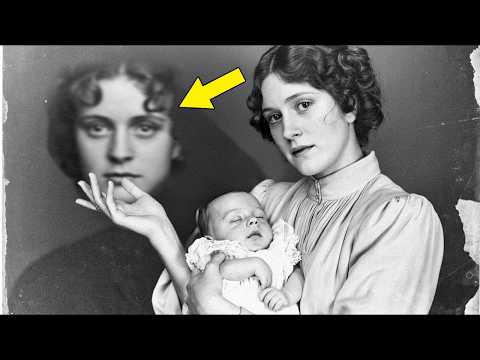
The negative showed no signs of tampering—no double exposure, no chemical anomaly. The emulsion was consistent with 1906 processes. Yet the face was there, unmistakably present. Margaret had spent 23 years in photograph conservation, encountering shadows and artifacts born of decay. This was different. “This has an intention to it,” she murmured, “a presence.”
Eleanor’s great-great-granddaughter, Sarah, arrived the next day carrying a worn leather portfolio. Inside lay letters, journal entries, and a confession that had haunted her family for generations. “To whoever discovers this truth,” Eleanor had written in 1907, “I do not expect to be believed.” She described whispers in the nursery, shadows in empty rooms, and the sensation of being watched while holding her son, Thomas. The photographer, Mr. Bellamy, had refused to speak of the intrusion he saw in the plate.
Margaret’s rational framework began to crack. She called in Dr. Elena Voss, a physicist specializing in light and photographic media. Elena’s theory was radical: “What if the plate captured wavelengths human eyes cannot perceive? A phenomenon invisible to Eleanor and Bellamy, but recorded by the camera.” The room fell silent. James frowned. “In 1906, what possible light source?” Elena shrugged. “I’m not saying it’s probable. I’m saying our assumptions about what the camera can see are incomplete.”
Sarah withdrew another journal entry, dated July 1906. Thomas would not sleep. He reached toward empty air, his small fingers grasping at something she could not see. “I fear I know what Bellamy saw,” Eleanor had written, “though I dare not speak it aloud.” She believed something was trying to communicate through her son—not a ghost, but a presence that existed at the boundary of the visible world.
Margaret stared at the magnified face between Eleanor’s fingers. It seemed to shift in the light, almost as if it were trying to speak across the decades. “Some mysteries are more valuable unsolved,” she would later say. But for now, the question burned: What had the camera captured that human eyes could not? And why had Eleanor spent her entire life searching for an answer that science refused to give?
Margaret pulled up the high-resolution scans on the monitor, the face now rendered in stark detail. The features were still soft, indistinct—like a portrait viewed through frosted glass—but the structure was undeniable. A brow, a cheek, the suggestion of a mouth. “It’s not random,” Elena said, leaning closer. “There’s symmetry here. Deliberate composition. Whatever this is, it’s not noise.”
James rubbed his temples. “I keep coming back to the same question. If this thing was present in front of the lens, why didn’t Eleanor or Bellamy see it?” Elena tapped the monitor. “Because human vision is a narrow window. Ultraviolet, infrared, X-rays—all invisible, yet all real. A photographic plate doesn’t have our limitations.”
Sarah, who had been silent for most of the morning, finally spoke. “Eleanor wrote about a ‘boundary moment.’ She believed the camera caught something at the exact instant it crossed into our world—or we crossed into its.” She slid a worn journal across the table, its pages brittle with age. “Read the entry from August 1906. I think it changes everything.”
Margaret opened the journal carefully. Eleanor’s handwriting was precise, almost clinical, as though she were documenting a laboratory experiment rather than a personal terror. “Last night, Thomas woke screaming. When I entered the nursery, the air felt thick, charged, as if a storm had passed through without sound. He pointed at the corner of the room and said one word: ‘Again.’ He is fourteen months old. He should not know that word.”
Margaret looked up. “He said ‘again’?” Sarah nodded. “Eleanor believed the presence was returning, growing stronger. She started sleeping in the nursery with a candle and a notebook, recording every occurrence. By September, she had filled forty pages.”
James flipped through the journal, his expression tightening. “These entries describe physical phenomena. Cold spots. Objects moved. A music box playing by itself. This isn’t just a photographic anomaly—she’s describing a haunting.” Elena shook her head. “Or she’s describing something that our language only allows us to call a haunting. The vocabulary of 1906 was spiritualism. Ours is physics. Neither may be accurate.”
Margaret turned to Sarah. “You said your mother made you promise never to discuss this. Why?” Sarah’s eyes glistened. “Because Eleanor’s final years were spent in isolation. The family thought she’d lost her mind. My grandmother burned most of the journals—these are the only ones that survived. She kept them hidden in the portfolio, along with the photograph. She told my mother: ‘One day, someone will have the tools to understand.'”
The room fell quiet. Outside, a Boston traffic helicopter droned overhead, a mundane sound that felt jarring against the weight of what they were discussing. Margaret looked back at the impossible face between Eleanor’s fingers. “She was right,” she said softly. “We have better tools now. But I’m not sure we have better answers.”
James closed the journal and set it down as though it might burn him. “There’s something else we haven’t considered,” he said, his voice careful. “If this presence was attached to Thomas, if it followed him, then what happened when Thomas grew up? What happened to his children?” Sarah’s face went pale. She reached into the portfolio and withdrew a smaller envelope, unmarked and sealed with old wax.
“I wasn’t going to show you this yet,” she admitted. “My grandmother gave it to me on her deathbed. She said it belonged to Thomas, written when he was an old man. She never opened it. Neither have I.”
Margaret took the envelope, her fingers tracing the brittle wax. The seal was intact. She looked at Sarah, who gave a small, reluctant nod. Margaret broke it open. Inside was a single sheet of paper, the handwriting shaky and uneven—the hand of someone very old and very tired.
“My mother spent her life trying to understand what visited us. She believed it meant no harm. I am not so certain. It came to me again the night she died. It stood at the foot of my bed, and for the first time, I saw it clearly. It wore my mother’s face. But its eyes were wrong. They were looking at something behind me. Something I could not turn to see.”
Margaret read the passage aloud twice. Elena had gone very still. “It wore her face,” she repeated slowly. “Not a stranger. Her own mother.” James pulled off his glasses and pressed the heels of his hands against his eyes. “That changes the emotional signature entirely. If Whitmore’s theory about emotional bonds has any weight, this presence wasn’t random. It was drawn to Eleanor, or it was mimicking her.”
Sarah’s voice was barely a whisper. “Thomas wrote one more line. I’ve never been able to forget it.” She pointed to the bottom of the page, where the ink had bled slightly, as though the writer’s hand had shaken.
“I have spent seventy years not looking at what stands behind me. My mother looked. That is why she never slept again.”
The silence that followed was thick enough to touch. Margaret set the paper down and walked to the window, staring out at the ordinary street below—cars, pedestrians, a dog tugging at its leash. The world outside continued, oblivious. “He never looked,” she said, half to herself. “He lived his whole life refusing to turn around. And Eleanor looked. Every single day.”
Elena rose and approached the illuminated negative, studying the face between Eleanor’s fingers with new eyes. “What if the photograph isn’t showing us what was there,” she said quietly, “but what Eleanor was looking at? The camera saw what she saw—or what she was about to see. The plate didn’t capture a presence. It captured her attention.”
James frowned. “You’re saying the face is a reflection of her own perception?” Elena shook her head. “I’m saying the boundary between observer and observed may not be as clean as we assume. She was looking at something. The camera recorded the act of looking itself.”
Sarah gathered the journal and the letter, her hands unsteady. “There’s one more thing,” she said. “Thomas’s daughter—my grandmother—she never spoke of any of this. But she kept a photograph of Thomas on her bedside table her entire life. And in that photograph, taken when he was about sixty, there’s a shadow behind him. Just a shadow. But it’s shaped like a woman.”
Margaret felt the floor tilt beneath her. “Do you have that photograph?” she asked. Sarah nodded and slid a small, faded print across the table. Thomas, gray-haired and stern, sat in a wooden chair. Behind his left shoulder, a soft gray shape hovered—indistinct, but unmistakably the silhouette of a woman in a high-collared dress.
James picked it up, holding it to the light. “Same posture as Eleanor in the 1906 image,” he murmured. “The angle of the shoulders. The tilt of the head. It’s her.” Elena shook her head slowly. “Or it’s the thing that wore her face. Thomas told us himself—it wasn’t his mother. It only looked like her.”
Margaret turned to Sarah. “Your grandmother kept this by her bed her whole life. She was watching him. Waiting to see if it came back.” Sarah’s chin trembled. “She died peacefully. In her sleep. But the nurse told my mother that in the final moments, she sat up and said one word: ‘Enough.’”
The word hung in the air. Margaret thought of Eleanor, documenting every whisper for forty pages. Of Thomas, spending seventy years refusing to turn around. Of his daughter, keeping vigil over a shadow. Three generations bound by the same quiet terror.
Elena spoke first. “We have three artifacts now. The 1906 plate. Thomas’s letter. This photograph. Each one shows the same phenomenon from a different angle. That’s not coincidence—that’s a pattern.” James nodded grimly. “And every witness is dead. We can’t ask them what they saw.”
Margaret walked to the window again. The streetlights had come on, casting long shadows across the pavement. “Eleanor believed the camera could see what we can’t. Thomas believed looking was dangerous. His daughter believed silence was safest.” She turned back. “We’re the first generation with the tools to test all three.”
Sarah stood, clutching the portfolio to her chest. “What will you do with it? The photograph, the letters—everything?” Margaret met her eyes. “Publish it. All of it. The evidence, the journals, the shadow behind Thomas. Let the world decide what it is.”
Sarah exhaled, something loosening in her shoulders. “Eleanor wrote that she left it to future generations to understand. I think she’d be glad it’s finally out of the dark.” She paused at the door. “But Margaret—if you publish this, people will look. That’s what Thomas feared most.”
Margaret looked back at the impossible face between Eleanor’s fingers, still hovering in the magnified light. “Then we’ll look carefully,” she said. “And we won’t look alone.”
The report went live three weeks later. Within a month, hundreds of families wrote in, each with a photograph of their own—a shape in a window, a figure at a christening, a face no one could name. The boundary, it seemed, had always been thinner than anyone knew.
But the last line of Eleanor’s journal stayed with Margaret, framed above her desk: “I do not expect to be believed. I only ask that someone look.”
So now it’s your turn. If you found a face in an old family photograph—one no one could explain—would you look closer, or would you, like Thomas, spend your life refusing to turn around? Tell us in the comments below.
Report this article
Select a reason for reporting:






