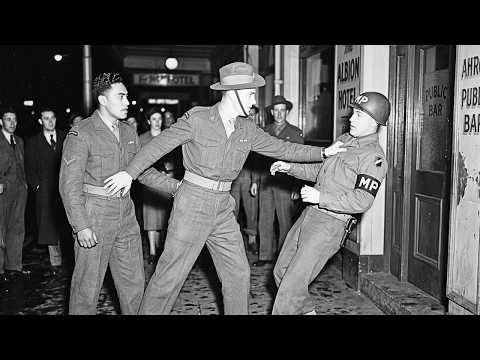
The autumn air hung cool and damp over Manners Street as the evening shift changed at the Wellington docks. Inside the Allied Services Club on Cuba Street, the sound of jazz drifted through open doors. American servicemen laughed over drinks. New Zealand soldiers in tan uniforms shared cigarettes near the entrance.
Two Māori soldiers in full dress uniform walked up the steps. Their boots were polished to a mirror shine. Ribbons decorated their chests—the kind men earned in places like North Africa where the sand ran red and the sun burned like fire. They were big men, broad in the shoulder, the kind who looked like they could carry a wounded mate across miles of desert. They had done exactly that.
One of them pushed open the door. Three American military police stepped forward. White helmets gleamed under the street lamps. The tallest one put his hand up like a traffic cop stopping a car. “You can’t come in here,” he said, loud enough for the street to hear. “This club is for white soldiers only.”
The words hung in the cool air like smoke. The two Māori soldiers stood very still. Their hands opened and closed. One started to speak. The officer put his hand on his baton. Two more military police appeared in the doorway behind him.
Across the street, a Wellington publican watched the confrontation unfold. He was in his late fifties, gray-haired, with hands rough from years behind a bar. Like many men his age, he had sons fighting overseas. He saw the Māori soldiers’ shoulders drop as they turned away. He saw the anger that spread through the watching crowd like heat from a fire.
The soldiers walked away with their backs straight and their heads up. But something in the way they moved looked broken.
Word spread down Manners Street faster than fire. Shopkeepers came to their doors. The story passed from mouth to mouth, getting sharper with each telling. American military police had turned away Māori soldiers. Our boys. The ones who volunteered when they did not have to. The ones bleeding in the desert while Wellington slept safe.
By April 1943, over 15,000 American troops were stationed in New Zealand. Their money filled cash registers. Their ships filled harbors. The New Zealand government needed them—needed their guns, their planes, their soldiers—badly enough to swallow a lot of things that tasted wrong.
The 28th Māori Battalion had around 3,600 men. Every single one had volunteered. In a country where European men could be conscripted, Māori men could only volunteer. And they did. They fought in North Africa with a fury that scared even their enemies. At Takrouna in Tunisia, they took a hill that everyone said could not be taken. The battalion suffered severe casualties—some companies losing nearly half their strength.
The survivors came home with medals and scars and memories that woke them screaming in the night.
The American military in 1943 was segregated like a house with separate rooms for different children. When American commanders looked at Māori soldiers with their brown skin and broad faces, they saw the same thing they saw in their black troops. They reached for the same rules. Separate. Unequal. Lesser.
But they did not understand New Zealand. They did not understand that the men they were turning away had fought beside European New Zealand soldiers in the same units, slept in the same tents, bled into the same sand. These were not strangers. These were neighbors, cousins, friends. They were our boys.
Prime Minister Peter Fraser and his government walked a tightrope stretched over a canyon. On one side, the powerful American ally they desperately needed. On the other, their own soldiers being treated like dirt in their own capital city. Wartime diplomatic correspondence showed officials quietly suggesting that certain social arrangements might prevent unfortunate incidents. The language was careful, diplomatic, weak. It meant perhaps Māori soldiers should just avoid places where Americans drank. Perhaps they should accept this. Perhaps they should stay quiet.
But Wellington’s ordinary people had a different thought. The publicans and shopkeepers and cinema owners who had watched what happened outside the Allied Services Club did not have diplomatic training or political concerns. They had something simpler. They knew whose country this was. And they knew whose boys those soldiers were.
The insight that would change everything was this: This is our country and those are our boys. If the Americans want to act like this here, then maybe the Americans are the ones who should be turned away at the door.
What happened next began with handwritten signs. No committees planned it. No officials approved it. Within weeks of the Cuba Street incident, dozens of establishments across Wellington put notices in their windows. The wording varied, but the message stayed the same: Māori soldiers welcome. Americans not served.
Some signs were polite. Some were blunt. One simply said, “No Americans.” Another explained, “We serve those who serve alongside our boys.” The signs appeared on pub doors, café windows, cinema ticket booths, and shop fronts like flowers blooming after rain.
Wellington publicans were among the first to act. Several chose the 25th of April to hang their signs. The date was not accidental. It was Anzac Day, the day Australia and New Zealand honored their war dead. Plain paper, black ink, hung in pub windows where the evening light would catch them. Publicans later explained their thinking to reporters in simple terms. They could serve Americans every night and fill their cash registers. Or they could serve Māori soldiers and keep their consciences clean. They did not find the choice difficult.
The first tests came quickly. At theaters and cinemas across Wellington, managers turned away groups of American servicemen who arrived expecting their usual welcome. The Americans seemed genuinely surprised, witnesses later recalled—like men who had never considered that their behavior might have consequences somewhere outside their own country. The seats went to Māori soldiers instead. The shows went on.
The American military response came fast and hard. Senior US liaison officers in Wellington filed formal complaints with New Zealand authorities. They argued that local establishments were creating dangerous division among Allied forces. They wanted the New Zealand government to act, to restore normal service to American personnel. The Americans had real leverage. Their soldiers spent money freely. Their ships and planes contributed to New Zealand’s defense. They expected gratitude, not rejection.
The New Zealand government felt the pressure like a tightening grip. But Prime Minister Peter Fraser found a way to answer without surrendering. On the 10th of May, 1943, he made a public statement carefully worded enough to give nothing away to American diplomats, but clear enough that every Wellington shop owner understood its meaning. “The New Zealand government cannot and will not compel private businesses to serve any particular clientele,” Fraser said. “We respect the autonomy of proprietors to determine whom they serve, just as we respect the dignity of all men who fight for freedom, regardless of race or creed.”
To anyone listening closely, Fraser had just given permission. He had said the government would not interfere. Business owners could choose. And he had reminded everyone that Māori soldiers had earned respect.
The words traveled through Wellington like electricity through spilled water, finding every crack in the floor. Records kept by servicemen’s social organizations through May and June of 1943 showed dramatic shifts in attendance at dances and events. Combined Allied events that had previously drawn large American crowds became Commonwealth gatherings. Māori soldier attendance rose sharply while American attendance fell. The Americans who did attend integrated events were noted by organizers as notably respectful, some quietly expressing opposition to their own military’s racial policies.
By June 1943, American servicemen in Wellington found themselves increasingly isolated. The pubs that had been loud with their voices grew quiet when they entered. The cinemas showed them signs instead of smiles. The shops that had taken their money now turned them away. Māori soldiers walked those same streets and found doors opening. Publicans called out, “Kia ora, boys. Welcome in.” Shopkeepers smiled and offered discounts. Cinema managers saved good seats. The city that had been neutral became actively welcoming.
The difference was not subtle. It was loud and clear as church bells.
Boarding housekeepers who housed American officers made their positions clear as well. They posted notices welcoming Māori soldiers for tea at reduced rates. When American officers asked for explanations, they received them plainly. “Our men have risked their lives in the desert. Your men will not share a drink with them in Wellington. That is why.” The officers kept paying rent because they had nowhere else to go.
The boycott required no money, no weapons, no military force. It required only the will to say no. A pub owner needed no government approval to refuse service. A cinema needed no budget to choose its audience. Each person made the choice alone, but the choices added up like drops of water filling a bucket. The decentralized nature made it impossible to stop. There was no leader to threaten, no headquarters to raid, no organization to ban. There were only dozens of individual people making the same choice for the same reason.
The pressure built on the Americans like steam in a sealed pot. By mid-June, they faced a simple reality. They could maintain their segregation policies and watch their troops become isolated, cut off from New Zealand society, drinking alone in their own clubs. Or they could adapt. They could change. They could treat Māori soldiers the way Wellington demanded they be treated—with respect.
The numbers told a story that words could barely capture. Before the boycott began, New Zealand military authorities received dozens of reports each month of racial discrimination against Māori soldiers in Wellington. Māori men in uniform were turned away, insulted, or humiliated. Multiple establishments explicitly barred Māori soldiers at American request. Formal complaints from members of the Māori Battalion filled pages of military correspondence, written in careful language that could not quite hide the anger and hurt beneath.
By August 1943, everything had changed like winter turning to spring. Incidents of racial discrimination dropped to occasional individual cases rather than systematic policy. Zero establishments barred Māori soldiers—not one. Official complaints from Māori Battalion members fell to nearly nothing. Meanwhile, dozens of establishments in Wellington and perhaps 60 to 70 nationwide had taken positions refusing or restricting service to American servicemen. The mathematics of respect had reversed completely.
The response grew beyond simple rejection into active celebration. The boycott had started as a no, a refusal, a closed door. Now it became a yes, an invitation, an open door with someone standing in it smiling. Wellington establishments did not just allow Māori soldiers—they created special events for them. The Working Men’s Club established weekly nights with reduced prices and live music. The Gaiety Theatre on Manners Street began showing newsreel footage of Māori Battalion victories before films, something they had never done for any specific unit. Audiences cheered until their throats hurt.
Surveys conducted by women’s organizations in June 1943 showed that a substantial majority of Wellington residents supported businesses that refused to serve Americans who discriminated against Māori soldiers. The city had chosen sides and the choice was overwhelming.
When the US military command tried to establish their own American-only facility by taking over a hotel on Waterloo Quay and renaming it the American Services Center, they discovered that isolation worked both ways. Wellington’s waterside workers began slowing the movement of non-essential supplies bound for American recreational use—not war materials, not ammunition or medicine, just the comforts, the beer and cigarettes and recreation supplies. The slowdown lasted only a few days before its message was understood. New Zealand controlled the docks.
The comparison with Australia was sharp and instructive. Over 100,000 American troops were stationed in Australia, far more than in New Zealand. Australia had its own tensions with the Americans. In November 1942, fighting broke out on the streets of Brisbane between Australian and American servicemen. One Australian soldier was killed. But Australia’s government consistently pushed for accommodation, for managing tensions quietly, for maintaining the alliance above all else. American segregation policies continued in Australia largely unchanged throughout the war. New Zealand’s grassroots resistance, backed by government non-interference, achieved what official diplomacy could not. It changed behavior through consequences.
The Americans in New Zealand learned that if they wanted to be part of New Zealand society, they had to follow New Zealand’s unwritten but absolute rule: Treat our soldiers with respect or drink alone.
The soldiers themselves provided the most powerful testimony. Hone Manahi, later recommended for the Victoria Cross for his actions at Takrouna, reflected that the men came back on leave to find a city that had stood up for them. “It meant something powerful to fight overseas for your country and find your country fighting for you at home.”
African-American servicemen left their own accounts of a country that did not enforce the boundaries they had known from birth. Some wrote that New Zealand had shown them segregation was not natural but chosen—and choices could be made differently.
By August 1943, US command issued new directives: military police were formally ordered to cease enforcing segregation in New Zealand establishments. The signs came down slowly through September, not because anyone forced them, but because they were no longer needed. Publicans folded their notices and kept them for decades—not out of pride, but because they were true.
The handwritten signs are gone now. But what they said remains clear: You cannot ask men to die for a country that will not stand up for them while they live. Sometimes courage looks like a soldier charging a hill under fire. And sometimes it looks like a tired pub owner with ink on his fingers, choosing conscience over cash register.
Both kinds of courage win wars. Both are worth remembering. So tell us—if a sign hung in your window tomorrow, what would it say?
Report this article
Select a reason for reporting:






