Somewhere in North Africa, there is a desert so vast and so lifeless that it is easy to forget it was ever anything else. No water, no shade, no evidence that anything ever lived there at all. That is the Sahara most people carry in their minds. It is also wrong.
7,000 years ago, that same desert was a different world entirely. Lakes, rivers, grasslands thick with wildlife. People living, hunting, building, burying their dead in a landscape that bore no resemblance to what stands there now. When the climate shifted and the desert returned, it buried everything. The people, the culture, the memory of what had existed there.
Then scientists found the mummies. Two women preserved by the same dry heat that had erased everything around them, recovered from a rock shelter in southwestern Libya. When researchers extracted DNA from their remains, what came back was not what anyone expected. Not a variation on a known population, not a branch that fits neatly into the existing map of human prehistory. A lineage that split from every other human group around 60,000 years ago, isolated across tens of thousands of years, and gone now in any pure form from the face of the earth.
The Sahara has not always been what it is today. That fact is worth sitting with before anything else because the entire story depends on it. Between 14,500 and 5,000 years ago, the desert that now covers roughly the size of the United States was something else entirely. Climatologists call it the African Humid Period. What that phrase describes in plain terms is a savanna. Lakes with fish, rivers running across terrain that today holds nothing but sand. Grasslands supporting wildlife dense enough to sustain large human populations across a landscape that now kills within days.
People found it. Of course they did. Humans moved toward resources and this region is full of them. Communities settled along the water, hunted the animals, and eventually began doing something that would have consequences reaching far beyond their own time. They started managing livestock, domesticating cattle, building the first pastoral economies in a region that had no word yet for desert. They left evidence. Cave paintings in the rock shelters of the central Sahara show cattle, daily life, the specific textures of a world that functioned. Stone tools, human burials arranged with intention, the record of people who understood this land as home and expected it to remain one.
Around 5,000 years ago, the rain stopped. Not suddenly, but with the kind of gradual, irreversible momentum that gives no clear moment to point to and say, here is where it ended. The lakes shrank. The rivers disappeared. The grasslands dried back into sand and kept drying. The Sahara returned.
For a long time, the assumption held that while the land was green, the populations of North Africa and the region south of it had moved freely across it, exchanging genes, mixing, becoming less distinct from one another with each passing generation. That assumption was wrong.
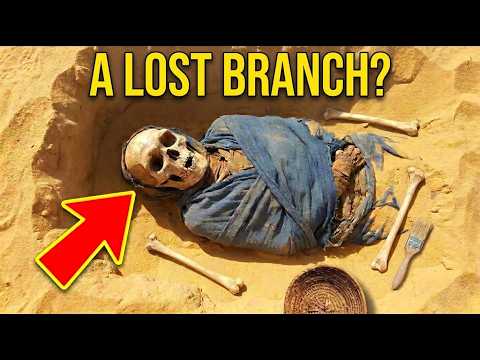
In southwestern Libya, set into the rock of a sheltered valley in the Tadrart Acacus Mountains, there is a site called Takarkori. It does not look like much from the outside, a shallow overhang of sandstone, darkened walls, a natural alcove worn into the rock face above the wadi floor. The kind of place that registers as unremarkable until someone starts paying attention to what was left inside.
What was left inside was everything. Archaeologists working the site found layers of human occupation stacked on top of each other across thousands of years. The oldest material dates to around 10,000 years ago. Hunter-gatherers who fished the lakes and hunted the animals of the green Sahara living in and around the shelter through generations that left tools, bones, and the residue of fires long since cold. Then the record changes. By around 8,300 years ago, something had shifted in how these people related to the animals around them. The bones in the layers are no longer purely wild. Domesticated cattle appear. The community had become pastoral, managing herds, organizing their lives around animals they no longer simply hunted but actively kept. The rock walls recorded it. Paintings of cattle, of human figures moving alongside them, of a daily life that had reorganized itself around the rhythms of herding. The art is not decorative. It is a documentary.
And then there are the mummies, bodies dried and preserved by the desert conditions rather than any deliberate human effort. The same environment that would eventually erase the lakes and the grasslands had, in the enclosed dryness of the rock shelter, held human remains intact across seven millennia. Skin, ligaments, tissue, details that normally surrender to time within a generation, held in place by heat and the absence of moisture. Two women, both in their 40s when they died, recovered, preserved well enough that the DNA inside their cells had not fully surrendered to time.
The question their existence immediately raised was the same question the entire site raised. Were these people from here or had they arrived when the Sahara opened up and made travel easy? The answer was not what the field expected.
Recovering ancient DNA from human remains found in a hot, arid environment was not supposed to be possible. Heat accelerates the chemical reactions that destroy genetic material. Humidity drives microbial activity that finishes the job. The standard assumption in the field was that ancient DNA work in desert conditions was a dead end before it started. Siberian permafrost preserved genomes. The Sahara did not.
The Takarkori mummies forced a revision of that assumption. Researchers extracted and fully sequenced the genomes of both women. The process itself was a technical achievement significant enough to open new possibilities for ancient DNA recovery across an entire continent previously considered off-limits. Takarkori became the first Saharan site from which ancient DNA had ever been successfully extracted. But the achievement of the extraction was immediately overtaken by what the extraction revealed.
The genomes did not match anything in the existing record. Most of the ancestry carried by these two women came from a lineage that had never been identified before. Not a variation on a known population. Not a group that fits somewhere in the existing branches of the human family tree with minor adjustments. A genuinely distinct lineage, deeply rooted and previously invisible to science.
The genetic data showed that this North African lineage had separated from all other human groups approximately 60,000 years ago. That timing is not incidental. It places the split at precisely the moment when modern humans were beginning their expansion out of Africa into Europe and Asia. While one group moved outward and eventually populated the rest of the world, another stayed. Remained in North Africa. And over the tens of thousands of years that followed, remained largely unto itself.
What the DNA did not show was almost as significant as what it did. Almost no sub-Saharan African ancestry appeared in the genomes. The Green Sahara, the period when north to south travel across the continent should have been easiest, had not produced the genetic mixing the field had long assumed it would. These women were not the product of populations flowing freely across a green landscape. They were the product of profound and sustained isolation.
The mitochondrial DNA traced to a deep branch of haplogroup N, a lineage descending from the same root that gave rise to all Eurasian populations. Connected to the broader human family, traveling an entirely different path.
The Takarkori women did not exist in isolation within the genetic record. When researchers compared their genomes against other ancient populations, a connection emerged that extended the story considerably further back and considerably further west. 15,000 years ago in a cave called Taforalt in what is now Morocco, a group of hunter-gatherers lived and died and were buried in the rock. They belonged to a culture called the Iberomaurusian, producers of distinctive stone tools, inhabitants of the northwestern edge of Africa at the end of the last ice age.
Their remains had been analyzed. And when their genetic profile was placed alongside the Takarkori genomes, the relationship was unmistakable. The same lineage separated by 8,000 years and thousands of miles of continent. Connected by a thread of ancestry that it held across ice ages, across the greening of the Sahara, and across the return of the desert.
What this meant was significant. A single North African population, genetically coherent and continuous, had occupied a vast sweep of the continent for at least 8,000 years. Through the most dramatic climate shifts the region had experienced in human memory, the same core people persisted. They changed what they did. They did not change what they were.
Then came the detail that reframes everything about where these people sat in the broader human story. When the Takarkori genomes were compared not just against African populations, but against the full global record, a counterintuitive result emerged. These women, buried in Libya 7,000 years ago, were genetically closer to a 45,000-year-old individual recovered from a site in Czechia than they were to populations living in sub-Saharan Africa at roughly the same period. Same continent. Closer in time, genetically more distant. The geography of ancestry does not follow the geography of place. The Takarkori women are proof of that.
The bones and the rock art had already established that the people of Takarkori were herders. Domesticated cattle, managed livestock, a pastoral economy operating in the central Sahara by at least 8,000 years ago. The archaeological record was clear on what they were doing. What it could not answer was how they came to do it.
Domestication of animals did not begin in North Africa. It began in the Near East, in the Levant, where wild species were brought under human management, and the technology and knowledge of keeping them spread outward from that origin point. The question for Takarkori was straightforward. Did that knowledge arrive carried by people, or did it arrive as an idea?
The DNA answered it without ambiguity. The genomes of the two women showed no significant influx of Near Eastern or Levantine ancestry. Only a small fraction of their genome reflected outside influence, traces, not a flood. The overwhelming remainder was the same deeply rooted North African lineage that had been sitting in this region for tens of thousands of years. There was no genetic signature of a migrating population arriving with their cattle and displacing or absorbing the people already there. The herding came, the herders did not.
What happened at Takarkori was cultural diffusion in its clearest documented form. Local hunter-gatherers encountered the practice, understood its value, and adopted it. The idea traveled. The people behind the idea did not follow in numbers large enough to leave a mark on the genome. A revolution in how these people organized their food supply, their daily rhythms, their relationship to the animals around them, absorbed without a detectable demographic replacement. The tools and pottery found at the site reinforce this. Distinctively local in style, even as the economy they served had reorganized itself around a foreign innovation. The Takarkori people took what was useful and made it their own without surrendering what they already were.
Compare this to Morocco. At Taforalt, roughly 60% of the ancestry was Levantine. A fundamentally different pattern separated by the same desert, the same period, the same greening. The Sahara was not one story. There were several.
The standard framework for thinking about North African prehistory has always operated on two tracks. Sub-Saharan African populations to the south, a North African population shaped by contact with the Middle East and Europe to the north. Two categories, a rough dividing line somewhere in the middle. The Takarkori genomes do not fit either track.
What this discovery established is a third category, an indigenous North African lineage with roots deep enough to predate the divergence of most other human populations outside Africa. Not an offshoot of sub-Saharan groups moving north through a greened corridor. Not a westward extension of Near Eastern expansion, something older than both. Something that was already there.
The Neanderthal signal in the genomes adds another layer. Both women carried traces of Neanderthal DNA, but the proportion was telling. 10 times less than what appears in the genomes of people from the Middle East. Enough to confirm that this lineage had not been completely sealed off from all outside contact across 60,000 years. Not enough to suggest sustained or significant interbreeding.
The lineage itself is no longer existing in pure form. That much is certain. Over the millennia that followed, a core mixture occurred. The boundaries that it held for so long eventually gave way. New populations moved, merged, and overlaid what had come before, but the ancestry did not disappear. It persists as a measurable component in modern North African populations across Morocco, Algeria, Libya, and Egypt. Diluted, distributed, still present. Every person alive today in those regions carries some fraction of what those two women carried whole.
The broader implication reaches beyond North Africa entirely. Major cultural transformations do not require the replacement of the people experiencing them. The Takarkori case is now one of the clearest examples on record of a population absorbing a revolution in how humans live without being replaced by the people who started it. The cattle arrived, the knowledge of how to keep them arrived. The genetic profile of the people who had that knowledge did not follow in any significant measure.
This is not a minor qualification to the standard model. It is an alternative to it.
The two women buried at Takarkori did not know what they were leaving behind. They did not know that the desert closing back in around them would become the thing that preserved them. They did not know that thousands of years later the dried remnants of their cells would be read by machines that would identify them as the last clear representatives of a human lineage that time had otherwise erased.
They were people, specific, particular, irreplaceable people living inside a society that had watched the world green and dry around it across more generations than most civilizations have managed to exist. They fished the lakes their grandparents had fished. They herded animals their great-grandmothers had never seen. They buried their dead in the deepest recess of the rock close to the wall with few possessions and no explanations left for whoever might come looking.
The science that recovered them is not finished. Improved techniques for extracting ancient DNA from hot and arid environments have opened a door that was considered permanently closed. There are almost certainly more sites like Takarkori waiting in the Sahara and across a continent whose prehistoric genetic complexity has barely begun to be mapped.
What the Sahara has already returned is this. A branch of humanity around 60,000 years deep, isolated, intact, and invisible to history until two women in a Libyan rock shelter held their shape long enough for the answer to be found. The desert buried them. The desert kept them. Both things were necessary.
So here is the question that lingers long after the data settles: how many other lost branches of our family tree are still waiting beneath the sand, holding their secrets in the dry dark, hoping someone will finally come looking? What do you think — should we keep digging, or are some doors better left closed? Tell us in the comments below.
Report this article
Select a reason for reporting:






