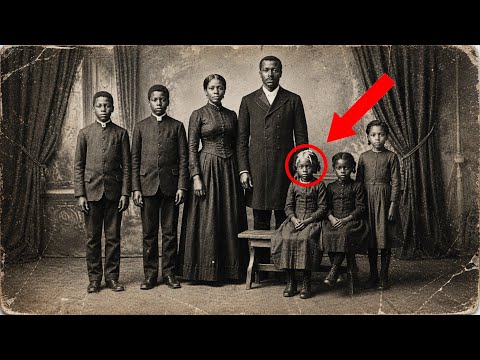
It was taken in 1882, somewhere in the American South—a black family, formal and dignified, posed inside a photography studio. At first glance, it looks like hundreds of other portraits from that era. But look closer. One member of this family, a young girl standing at the edge of the frame, has something in her eyes that no one noticed for over 140 years. Something that, when a genetic historian finally examined this photograph under digital magnification, made him go completely silent.
Because what he found wasn’t just a physical trait. It was a key—a biological key encoded in her DNA—one that had survived slavery, survived erasure, survived generations of silence, and was about to unlock the true origin of an entire family whose history had been deliberately destroyed.
Dr. James Okafor had spent 15 years reconstructing lost genealogies. His office at Howard University was lined with framed photographs—not of his own family, but strangers. People whose names had been erased, whose stories had been swallowed by history. Each framed image on his wall represented a case he had solved, a life reclaimed.
The morning Diane walked in, it was raining. She was in her early 50s, dressed in a gray coat, and she carried a flat cardboard envelope the way people carry something irreplaceable—close to her chest, both arms around it, as if protecting it from the weather outside.
“My grandmother left it to me,” she said, setting it carefully on his desk. “And her grandmother left it to her. Nobody knows who these people are. Not their names, not where they came from, nothing.”
James opened the envelope slowly. Inside was a photograph, approximately 8 by 10, mounted on thick cardboard backing. A cabinet card—the standard portrait format of the 1880s. It was in remarkable condition. The edges were browned and slightly warped, but the image itself was sharp and clear.
A family of seven stood inside what appeared to be a photography studio. The backdrop behind them was painted to suggest a garden, a common affectation of the era. The father stood at the center, tall and broad-shouldered, wearing a dark suit and a tie. Beside him, a woman—the mother, presumably—sat in a wooden chair, dressed in a high-collared blouse, her hands folded in her lap. Around them, five children were arranged with careful deliberation. Two older boys stood on the left, two younger girls sat on a low bench in the front, and one girl—the youngest, perhaps seven or eight years old—stood slightly apart at the far right of the frame.
At the bottom of the cardboard backing, in faded ink, someone had written a date: October 14th, 1882. There was no name, no location, no studio stamp on the reverse—only a faint rectangular ghost where one had once been, carefully scraped away.
James studied the photograph for a long moment without speaking. Then he picked up the magnifying glass from his desk.
“Has anyone ever looked at this closely?” he asked.
Diane shook her head. “Not really. We always assumed it was just a portrait.”
James brought the glass to the image, and that was when something stopped him cold.
He almost missed it. The magnifying glass had moved across the photograph the way it always did—methodically, left to right, top to bottom—cataloging details, searching for context clues: the style of clothing, the furniture in the studio, the quality of the photographic paper. These were the tools of James’s trade, the small forensic markers that helped him date and place an image with precision.
He already noted several things. The high-collared suits on the boys suggested the early 1880s rather than the 1870s. The painted garden backdrop was consistent with studio practices in the American South during the Reconstruction era. The quality of the paper and the mount card suggested a photographer with some professional standing—not a frontier amateur, but someone with access to decent equipment and chemical supplies. Whoever this family was, they had made a deliberate choice to be photographed by someone good.
It was when the magnifying glass reached the youngest girl—the one standing apart at the far right of the frame—that James paused. Her face was turned very slightly toward the camera, as if she had moved just before the shutter was released. In that slight turn, both of her eyes were visible, and they were not the same.
Even in the sepia tones of a 19th-century photograph, the difference was unmistakable. Her left eye was dark—a deep, uniform darkness consistent with brown, the expected pigmentation for a black child of that era. But her right eye was lighter—noticeably, significantly lighter. Where the left eye absorbed light, the right eye reflected it differently, with an almost gray, pale quality that jumped out of the image even in monochrome.
James set the magnifying glass down. He reached instead for the digital scanner on the shelf behind him.
It took him 12 minutes to scan the photograph at high resolution and pull it onto his monitor. He used the software he had been using for years to enhance archival images—increasing contrast, adjusting gamma, sharpening focus digitally without altering the original file. When the enhanced image filled the screen and he zoomed in on the girl’s face, he leaned back in his chair and was quiet for a very long time.
The right eye was blue-gray. Clearly, unmistakably blue-gray, rendered in the subtle gradations of light that the original photograph had captured without anyone ever noticing.
A black child. 1882. One brown eye, one blue-gray eye.
He turned to Diane, who was watching him from across the desk.
“Tell me everything you know about this family,” he said. “Everything.”
Diane knew very little. That was the honest truth, and she said so without embarrassment. The photograph had been passed down through four generations of women—grandmother to daughter, daughter to granddaughter—always with the same vague instruction: Keep this. It matters. But no one had ever been able to say why. No names had survived alongside it. No letters, no documents, no oral history specific enough to be useful.
“My great-great-grandmother received it from someone she called ‘the old woman,'” Diane said. “That’s all I know. The old woman gave it to her before she died and told her not to lose it.”
James nodded slowly, still staring at the screen. He typed quickly and pulled up a medical reference database he had bookmarked years ago. Not something a genealogist typically consulted, but James had learned long ago that genetics and history were not separate disciplines. They were the same story told in different languages.
Waardenburg syndrome, type 2A. Autosomal dominant inheritance pattern. He read the entry the way a detective reads a case file—looking for the specific, the actionable, the visible.
Waardenburg syndrome is a genetic condition affecting pigmentation of the hair, skin, and eyes. The most visible features include heterochromia iridis—irises of two different colors or one iris with two colors—and a white forelock, a patch of white or silver hair at the front of the scalp. It is caused by mutations in several genes, most commonly PAX3, MITF, or EDNRB, all of which affect the development and migration of melanocytes, the cells responsible for pigmentation.
James underlined the phrase autosomal dominant in his mind. It meant that the mutation only needed to be inherited from one parent to express itself. And it meant, crucially, that in a family line where the mutation existed, it would appear again and again, generation after generation, in roughly half of all children.
If the little girl in the 1882 photograph had Waardenburg syndrome, she had inherited it from one of her parents. And one of her parents had inherited it from one of their parents, and so on. An unbroken biological thread running backward through time.
He turned back to the enhanced image on the screen. The girl’s right eye—pale and luminous against her dark face—looked back at him across 140 years.
“This child,” he said carefully, “has a genetic condition called Waardenburg syndrome. It’s hereditary, dominant. It doesn’t skip generations the way some conditions do.”
Diane leaned forward. “What does that mean?”
“It means,” James said, “that this didn’t start with her.”
James spent the next weeks assembling the final pieces. The Freedmen’s Bureau record gave him Eliza’s name and the notation—“One eye brown, one eye gray blue, distinctive.” The 1849 Charleston manifest gave him two words that had waited 175 years: “Eyes different.”
Patricia’s lab confirmed the mitochondrial haplogroup L3, tied to a narrow corridor in Sierra Leone. The PAX3 variant matched a documented Mende population. Then came the letter from the Amistad Research Center, written in 1891 by a woman once called by another name: “My mother had eyes that did not match. One dark as river mud, one pale as morning sky.”
Diane came one last Thursday in October. James laid it all out—the river, the Sewa Valley, the name Eliza had carried like a buried seed.
She held the letter, read the passage twice, and looked at the little girl at the edge of the frame. “She didn’t know what her eyes meant,” Diane said. “But her great-grandmother did. She wrote it down for someone to find.”
“You found it,” James said. “It just took 140 years.”
Diane tucked the photograph against her chest, both arms around it, the way she had carried it in from the rain.
DNA does not forget. It simply waits. And sometimes, after long enough, someone finally knows how to read it.
What would you do if a single photograph held the key to a history someone tried to erase?
Report this article
Select a reason for reporting:






