The silence of the Russian night was shattered by a sound that froze the blood—a shrieking, howling wail that seemed to tear the sky apart. “Incoming! Nebelwerfer!” a soldier screamed, but it was too late. The first rocket landed with a thunderous roar, and the earth erupted in a storm of fire and steel. This was the terrifying signature of Germany’s 21 cm Nebelwerfer 42, a weapon that turned the battlefield into a nightmare of screaming rockets and devastating explosions.
Developed in the crucible of World War II, the Nebelwerfer—literally “smoke thrower”—was a series of rocket launchers that would become one of the most feared artillery pieces of the conflict. Its thin-walled rockets carried a deadly payload, delivering far more explosives than conventional shells of the same weight. “It wasn’t just the explosion; it was the sound that broke men’s minds,” recalled a veteran. The weapon’s psychological impact was as potent as its destructive power.
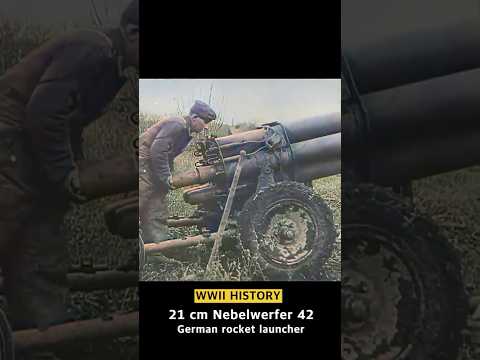
From the frozen steppes of the Eastern Front to the sun-baked deserts of North Africa, the Nebelwerfer saw action in every major campaign except the Balkans. Its versatility and sheer firepower made it a cornerstone of German artillery tactics. The 21 cm Nebelwerfer 42, with its six launch tubes, could saturate a target area in seconds, leaving nothing but craters and carnage.
But how did this weapon come to be? And what was it like to face its wrath? The story of the Nebelwerfer is one of innovation, desperation, and the dark ingenuity of war. As the conflict raged on, both sides would come to know the chilling howl of these rockets—a sound that heralded destruction on an unprecedented scale.
In the early years of the war, the German army recognized the need for a mobile, high-volume rocket artillery system. The result was the Nebelwerfer series, which evolved from the 15 cm Nb.W 41 to the more powerful 21 cm Nb.W 42. “The thin walls of the rockets allowed for a much larger payload,” explained a German engineer after the war. “We could deliver more high explosives, more smoke, more of everything—with less material.” This efficiency was crucial for a resource-strapped Germany.
The 21 cm Nebelwerfer 42 was typically mounted on a towed carriage, often pulled by a half-track. Its six tubes could fire in rapid succession, creating a barrage that overwhelmed enemy positions. The rockets were unguided, but their saturation effect made accuracy less critical. “When the Nebelwerfer opened up, you didn’t stay to watch,” said a British soldier who faced them in Italy. “You dove for cover and prayed.”
Despite its advantages, the Nebelwerfer had drawbacks. The bright flash and thick smoke from the rockets made the launcher highly visible, forcing crews to relocate quickly after firing. “Fire and move—that was the rule,” a German crewman recalled. “If you stayed, you died.” The weapon’s effectiveness relied on speed and surprise, and its crews were well-trained in the art of shoot-and-scoot.
As the war progressed, the Nebelwerfer became a symbol of German artillery prowess. Its howl was so distinctive that Allied soldiers nicknamed it the “Screaming Mimi” or “Moaning Minnie.” The sound alone was enough to instill fear, a psychological weapon as much as a physical one. “The noise was worse than the explosion,” one survivor remembered. “It got inside your head.”
But the tide of war was turning. With Germany on the defensive, the Nebelwerfer was increasingly used in desperate rearguard actions. Its story is not just one of technological innovation, but of the men who operated it and those who faced it. As we delve deeper into the history of the 21 cm Nebelwerfer 42, we will explore its development, its tactical use, and the harrowing experiences of those who encountered it on the battlefield. The scream of the Nebelwerfer still echoes through history—a chilling reminder of the horrors of war.
The origins of the Nebelwerfer lay in a secretive pre-war program that few outside the German high command knew about. In the 1930s, the Reichswehr had begun experimenting with rocket artillery as a way to circumvent the restrictions imposed by the Treaty of Versailles. “We called it a smoke projector to disguise its true purpose,” a former engineer admitted. “Smoke was the cover story—rockets were the reality.” The deception allowed Germany to develop a weapon that would later shock the world.
The first operational model, the 15 cm Nebelwerfer 41, entered service in 1940. It fired six rockets in a staggered sequence, creating a rippling barrage that marched across the target. But its solid-fuel motors left a massive trail of smoke, and the launcher was difficult to conceal. “The crews learned to fire and run before the first rocket even landed,” a German artillery officer recalled. “The enemy always knew where you were—you just had to be gone before they replied.”
By 1942, the demand for greater range and hitting power led to the 21 cm Nebelwerfer 42. Its rockets weighed over 100 kilograms, with a warhead packed with more than 40 kilograms of high explosives. “One hit could level a house,” a Soviet soldier testified. “The crater was as deep as a man.” The launcher itself was a simple six-tube frame, but its effect on the battlefield was anything but simple.
The tactical doctrine surrounding the Nebelwerfer was refined through brutal experience. German commanders grouped the launchers into battalions, allowing them to concentrate fire on a single sector with devastating results. “We didn’t aim at individual targets,” a battery commander explained. “We aimed at areas—and we erased them.” This saturation approach compensated for the rockets’ lack of precision and made the weapon ideal for breaking up enemy attacks or softening defenses before an assault.
Allied intelligence initially struggled to identify the weapon. Its distinctive howl—caused by the irregular burning of the rocket propellant—led to nicknames like “Screaming Mimi” and “Moaning Minnie.” “The first time you heard it, you thought the world was ending,” a British infantryman said. “The second time, you knew it was.” Captured launchers were rushed to laboratories for analysis, and the Allies soon developed countermeasures, including improved camouflage and dispersal tactics.
Yet the Nebelwerfer’s greatest weakness was its crew. The rockets left a brilliant flash and a towering column of smoke, making the launcher a magnet for counter-battery fire. “We had three minutes to get out,” a German crewman remembered. “Sometimes we didn’t make it.” The weapon’s effectiveness depended on surprise, and once spotted, it was vulnerable. Many crews were lost to artillery and air strikes while trying to reposition after a salvo.
As the war entered its final years, the Nebelwerfer was increasingly pressed into defensive roles. On the Eastern Front, massive Soviet offensives forced German units into desperate fighting withdrawals. “We fired until we ran out of rockets, then we fought as infantry,” a survivor of the 1st Nebelwerfer Brigade recalled. The weapon that had once terrorized the Allies was now a symbol of a crumbling army, its scream growing fainter as the Reich collapsed.
The men who crewed the Nebelwerfer were a special breed—part artilleryman, part acrobat, part ghost. They trained in secrecy, often under the guise of chemical warfare units. “We were told never to speak of our work,” one veteran recalled decades later. “Even our families thought we handled smoke canisters.” The deception was so complete that many soldiers only learned the true nature of their weapon on the firing range, when the first rocket shrieked from its tube.
Loading was a choreography of speed and precision. Each of the six rockets weighed over a hundred kilograms, and the crew had to hoist them into the launch tubes by hand, often under enemy fire. “Your back screamed, your arms burned, but you kept going,” a former loader said. “You knew that as soon as the first rocket left, the clock started ticking.” The entire process—from arrival to first shot—had to be completed in under a minute if the crew hoped to survive.
The firing sequence itself was a controlled chaos. Each rocket ignited in a staggered ripple, the launcher rocking with every launch. The noise was deafening, a physical force that hammered the chest and left ears ringing for hours. “You couldn’t hear the orders after the first rocket,” a gunner remembered. “You just followed the drill, muscle memory taking over.” The crew worked in a cloud of acrid smoke, their eyes streaming, their lungs burning, until the last tube was empty.
Then came the sprint. The launcher, now a smoking beacon, had to be hooked to its half-track and towed away before Allied counter-battery fire found its mark. “We lost more crews to return fire than to anything else,” a battalion commander admitted. “The enemy learned to watch for our smoke, and their artillery was waiting.” The survival of a Nebelwerfer crew depended on speed, discipline, and no small amount of luck.
On the receiving end, the experience was equally harrowing. Allied soldiers quickly learned to distinguish the Nebelwerfer’s howl from other artillery. “It started as a low moan, then rose to a scream that made your teeth ache,” a British sergeant recalled. “You had maybe ten seconds to find cover before the world exploded.” The rockets fell in clusters, each warhead powerful enough to flatten a building or shred a trench line.
For the Soviets, the Nebelwerfer became a hated symbol of the German war machine. “They called it ‘the organ’ because of the pipes,” a Russian veteran said. “But it played no music—only death.” Soviet tactics evolved to counter the threat: dummy positions, deep trenches, and rapid counter-battery fire. Yet the weapon’s psychological toll remained immense, especially during the brutal winter offensives where the howl seemed to echo across the frozen plains.
As the tide turned against Germany, the Nebelwerfer crews found themselves fighting a different kind of war. No longer the aggressors, they were now the desperate defenders, firing from hastily prepared positions as enemy tanks rolled toward them. “We knew the war was lost,” one gunner confessed. “But we kept firing because there was nothing else to do.” The scream of the rockets, once a herald of victory, now sounded like a lament for a doomed cause.
In the final months, the crews who had once terrified whole armies became refugees in their own uniforms. “We buried the launchers and walked west,” a survivor of the 21 cm batteries said. “The rockets were gone, but the scream stayed in our ears.” Many were captured by the Soviets, others vanished into the chaos of the collapse, their stories buried with the Reich.
After the war, the Nebelwerfer’s legacy lived on in the rocket artillery of both East and West. “We studied their designs, their tactics, even their mistakes,” an American engineer admitted. The howl that once broke men’s minds became a footnote in military manuals—a lesson in terror and efficiency.
Today, the scream of the Nebelwerfer survives only in memoirs and grainy footage. Yet for those who heard it, the sound never truly faded. “Sometimes, on a quiet night, I still hear it,” an old soldier whispered. “And I remember the men who never came home.”
Was the Nebelwerfer a weapon of genius or a symbol of desperation—and does its howl still echo in the wars of today?
Report this article
Select a reason for reporting:






