They were young, in love, and doomed from the start. Bonnie Parker and Clyde Barrow didn’t set out to become legends—they were just two kids from the wrong side of Texas, desperate to escape poverty and boredom. But their love story would leave a trail of blood across the Southwest, and their names would echo through history as America’s most notorious outlaw couple.
This is the story of how a 4-foot-10 honor student and a small-time crook became the targets of the largest manhunt of their time—and why, nearly a century later, we still can’t look away.
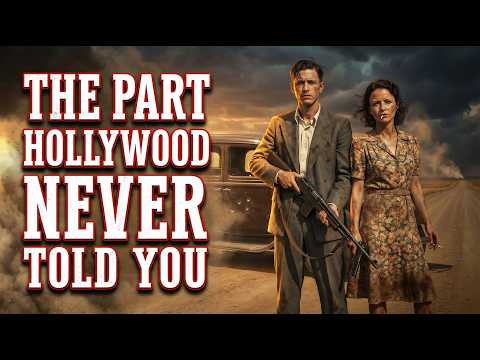
Bonnie Elizabeth Parker was born on October 1, 1910, in Rowena, Texas. She was tiny—just 4 feet 10 and 85 pounds—but she had a fierce spirit. An honor student who loved romance novels and wrote poetry, she seemed destined for a quiet life. At 16, she married her high school sweetheart, Roy Thornton, and tattooed his name above her knee. But the marriage soured quickly, and Bonnie refused to divorce—it simply wasn’t done in her world.
Clyde Chestnut Barrow was born on March 24, 1909, into a poor farming family near Dallas. One of seven children, he showed early musical talent, teaching himself guitar and saxophone. But the harsh realities of poverty and the influence of his older brother Buck steered him toward crime. By 13, he was already a chicken thief. His first arrest came at 17 for failing to return a rental car—a minor infraction that marked the beginning of a criminal career.
When Bonnie and Clyde met in January 1930 at a friend’s house in West Dallas, the attraction was immediate. Bonnie was 19, married to an imprisoned murderer, and working as a waitress. Clyde was 21, unmarried, and already a small-time crook. Just weeks later, Clyde was arrested for stealing a car. But love found a way: Bonnie visited him in prison and, on March 11, 1930, smuggled him a gun. He used it to escape with a cellmate, though they were recaptured within a week. That act of devotion foreshadowed the loyalty that would define their relationship.
After serving 20 months, Clyde was paroled in February 1932. Prison had hardened him. Desperate to avoid returning to the brutal Eastham State Prison Farm—known as “Little Alcatraz”—he had another inmate chop off two of his toes with an axe. The self-mutilation left him with a permanent limp and forced him to drive in his socks for the rest of his life.
When Clyde reunited with Bonnie in 1932, their crime spree began in earnest. But contrary to popular belief, they were hardly master criminals. In four years, the Barrow gang robbed fewer than 15 banks, and their biggest haul never exceeded $1,500. In one pathetic case, they netted just $80 and resorted to robbing gumball machines for meal money. They bathed in streams and held up small stores for basic supplies. This wasn’t a criminal empire—it was a desperate family business with deadly consequences.
The first confirmed murder occurred on April 27, 1932, when Clyde killed a merchant named J.W. Butcher during a robbery. That crossed a line from which there was no return. By Christmas Day 1932, the violence had escalated when gang member W.D. Jones and Clyde murdered a young family man named Doyle Johnson—shot while trying to protect his car. The body count continued to mount through 1933.
J. Edgar Hoover’s Bureau of Investigation had taken notice by 1932, recognizing that their crimes crossed state lines. The famous photograph that cemented their place in popular culture emerged from a bloody shootout in Joplin, Missouri, on April 13, 1933. The gang had been hiding out when police surrounded the building. During the gun battle, two officers were killed, but Bonnie and Clyde left behind six rolls of film. When developed, the photos showed them posing playfully with guns, embracing, and one of Bonnie with a cigar clenched between her teeth, a pistol on her hip. Those images transformed them into folk heroes—even though Bonnie desperately wanted people to know she didn’t actually smoke cigars.
But the romance of the photographs masked a harsh reality. By June 1933, their situation had become increasingly desperate. Near Wellington, Texas, their car rolled over an embankment, and Bonnie was severely burned when battery acid splashed onto her leg, eating through to the bone in some places. She was left barely able to walk for the rest of her life. The gang’s luck continued to deteriorate. During a shootout in Iowa on July 29, 1933, Buck Barrow was fatally wounded, and his wife Blanche was captured. By November, W.D. Jones had been captured in Houston. The circle was tightening.
Clyde’s loyalty to his criminal associates led to one of his most audacious crimes. On January 16, 1934, he returned to Eastham Prison Farm, where he had suffered so much abuse, and orchestrated the escape of five prisoners, including Raymond Hamilton. Two guards were shot. That assault on a state prison was the final straw for Texas authorities.
Lee Simmons, director of the Texas prison system, made a decision that would seal Bonnie and Clyde’s fate. On February 10, 1934, he hired former Texas Ranger Frank Hamer to track down the Barrow gang. Hamer was a legend—wounded 17 times in the line of duty, left for dead four times, and credited with killing as many as 53 men in gunfights. His approach was methodical and scientific. He studied the gang’s patterns, habits, and family connections. “An officer must know the habits of the outlaw, how he thinks, and how he will act in different situations,” Hamer explained. “When I began to understand Clyde Barrow’s mind, I felt that I was making progress.”
The manhunt intensified after two particularly brutal murders. On Easter Sunday, April 1, 1934, Barrow and Parker murdered two police officers in Grapevine, Texas. Five days later, they killed a constable in Miami, Oklahoma, and kidnapped a police chief. These killings eliminated any remaining public sympathy.
Hamer formed a six-man posse. For 102 days, they tracked the gang across multiple states. The breakthrough came through Henry Methvin, who had joined the gang after the Eastham break. Methvin’s father, fearing for his son’s life, began cooperating with authorities. He revealed that Bonnie and Clyde regularly visited the family home near Gibsland, Louisiana.
On the evening of May 22, 1934, the posse took positions along Highway 154, a remote stretch of road the couple would have to travel. They commandeered a truck and used it to block part of the road, hoping the couple would stop to offer assistance. After midnight on May 23, 1934, the six lawmen settled into their hiding spots in the woods. They had been waiting for hours when, at approximately 9:15 a.m., they spotted a tan Ford V8 sedan approaching at high speed. It was driven by Clyde Barrow, with Bonnie Parker beside him.
What happened next has been the subject of decades of controversy. According to most accounts, Deputy Prentiss Oakley stood up and called for the couple to surrender, but Bonnie and Clyde’s response was to reach for their weapons. The car was loaded with at least 17 firearms, including three Browning automatic rifles, two sawed-off shotguns, and ten Colt automatic pistols. The posse opened fire immediately. In a barrage that lasted only a minute or so, they fired about 130 rounds into the moving car. Bonnie was hit at least 26 times; Clyde, at least 17. The Ford V8 rolled to a stop, riddled with about 120 bullet holes. Its occupants were no longer among the living.
The aftermath was as chaotic as the ambush itself. Word spread quickly, and curious onlookers descended on the scene, taking souvenirs—shards of glass, bullet casings, locks of Bonnie’s hair, pieces of clothing. One individual reportedly tried to cut off one of Clyde’s ears as a trophy. Found in the death car were Clyde’s beloved saxophone and guitar, reminders of the musical dream that had long since given way to violence.
The couple had died together, just as Bonnie had predicted in her poem, “The Trail’s End”:
Someday they will go down together,
And they will bury them side by side.
To a few it means grief,
To the law it’s a relief,
But it’s death to Bonnie and Clyde.
But Bonnie’s poetic prophecy would not come to pass entirely as written. Her mother, Emma Parker, had endured enough. “He had her in life, he won’t have her in death,” she insisted, refusing to allow her daughter to be buried next to Clyde. They were interred in separate cemeteries about nine miles apart in Dallas, Texas.
The question of Bonnie’s actual guilt has fascinated historians for decades. While she was present during at least 100 felonies committed by the gang, statements by surviving members claim she never fired a gun at a police officer. However, during a bank holdup in Indiana, witnesses reported she fired at unarmed civilians, destroying any chance she might have had for mercy from the law.
In the immediate aftermath of their deaths, Bonnie and Clyde were viewed by many as cold-blooded killers who got what they deserved. They were believed responsible for 13 deaths, including nine police officers and three civilians. But over time, particularly during the Great Depression, a different narrative emerged. Some began viewing them as Robin Hood figures striking back against the banks and authorities during hard times—the same mythology that attached to Pretty Boy Floyd and other outlaws of the era.
That notion reached its peak with the 1967 film Bonnie and Clyde, starring Warren Beatty and Faye Dunaway. Despite being highly fictionalized and historically inaccurate, the movie was a critical and commercial success that cemented the couple’s status as folk heroes. The film’s portrayal of Frank Hamer as an incompetent buffoon so enraged his family that they successfully sued Warner Brothers for defamation.
The real Frank Hamer deserved better. His methodical approach to tracking the Barrow gang represented professional law enforcement at its finest. His study of their patterns and psychology was groundbreaking police work that would influence manhunts for decades to come. The 2019 Netflix film The Highwaymen, starring Kevin Costner and Woody Harrelson, finally gave Hamer and his partner their dues, telling the story from the lawman’s perspective.
Today, nearly 90 years after their deaths, Bonnie and Clyde continue to fascinate the public. The bullet-ridden death car is displayed at a casino in Primm, Nevada, surrounded by slot machines. The ambush site near Gibsland, Louisiana, remains a tourist destination, though the original stone marker was stolen and had to be replaced. The question of their burial continues to divide families. Bonnie’s great-niece has spent years trying to honor what she believes was her aunt’s wish to be buried next to Clyde. The legal battle over moving Bonnie’s remains continues, with cemetery owners reluctant to disturb the grave of their most famous resident.
Looking back, the story of Bonnie and Clyde represents something uniquely American: the transformation of criminals into folk heroes. They were neither the Robin Hood figures of popular imagination nor the master criminals of Hollywood fiction. They were young, desperate, and ultimately tragic figures whose belief that violence was the way to solve their problems led to their early graves. Their legacy lives on in museums, movies, and continuing debate over their final resting place.
But perhaps the most honest epitaph comes from the harsh statistics of their criminal career: two young people who robbed mostly small businesses for tiny amounts of money, killed 13 people including nine law enforcement officers, and died together in a hail of bullets before they ever reached their 25th birthday. In the end, that’s the real story of Bonnie and Clyde—not a romantic tale of love conquering all, but a stark reminder that violence begets violence and that some roads lead nowhere but to an early grave.
Their story ends not with a whisper, but with the deafening echo of 130 bullets on a Louisiana road. They died as they lived—together, defiant, and out of time. The car, the guns, the poetry, the photographs: all of it now belongs to legend, not to them.
What remains is the question we keep asking. Were they lovers or lunatics? Victims of poverty or architects of their own destruction? Perhaps they were all of it, and none of it, at once.
“They were just kids,” one witness later said, staring at the bullet-riddled Ford. Maybe that’s the truest thing anyone ever said about them.
So here’s the final question, the one that keeps us coming back: if you strip away the myth, the movie, the souvenir hunters—what’s left? A pair of desperate kids who chose the wrong road and paid for it with everything. Does that make them tragic heroes, or just a cautionary tale?
What do you think—were Bonnie and Clyde victims of their time, or villains who got exactly what they deserved? Let us know in the comments below.
Report this article
Select a reason for reporting:






