In 1798, just seven years after the First Amendment promised Americans the sacred freedom to speak their minds, the United States made it a federal crime to criticize the government. The men who had fought a revolution against tyranny—the very founders who pledged their lives to liberty—turned around and built their own version of it, wrapped in wartime fear and political desperation. What followed would ripple through American law and politics for centuries, raising a question as urgent today as it was then: How fragile is free speech really?
To understand this dark moment, you have to picture the world on fire. The French Revolution had descended into a nightmare of guillotines and purges. France, once America’s critical ally, now seized American ships and imprisoned sailors. Into this volatile situation stepped John Adams, a Federalist president who believed in a strong central government and viewed the French Revolution’s chaos with suspicion. His vice president? Thomas Jefferson, leader of the opposition, who saw the Federalists as closet monarchists.
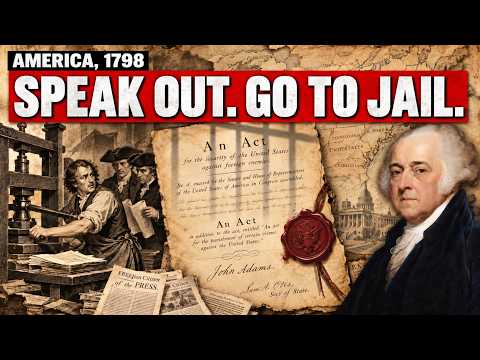
Their rivalry was not polite disagreement—it was a political war fought through savage newspapers. Federalist papers called Adams a hero and Jefferson a radical. Democratic-Republican papers returned fire, branding Adams a monarchist, a warmonger, a vain and pompous tyrant. The most prominent opposition paper, the Philadelphia Aurora, edited by Benjamin Franklin’s own grandson, was relentless in its attacks.
Then came the XYZ Affair. When Adams sent envoys to negotiate peace with France, French agents demanded a massive loan and a personal bribe just to begin talks. The envoys famously replied, “No, no, not a sixpence.” When Adams released the dispatches, public outrage exploded. “Millions for defense, but not one cent for tribute!” became the rallying cry. War fever swept the nation—and the Federalists saw their chance.
Riding the wave of anti-French hysteria, the Federalists in Congress passed the Alien and Sedition Acts in the summer of 1798. The first three targeted immigrants, extending the residency requirement for citizenship and giving the president power to deport anyone he deemed dangerous. But it was the fourth law—the Sedition Act—that struck at the heart of American liberty.
Signed by Adams on July 14, 1798, it made it a federal crime to “write, print, utter, or publish any false, scandalous, and malicious writing” against the government, Congress, or the president. Punishment: fines up to $2,000 (about $60,000 today) and up to two years in prison. The Federalists claimed truth was a defense, but in practice, juries were hand-picked by Federalist marshals and judges were staunch Federalists. The definition of “false, scandalous, and malicious” was vague enough to cover any criticism.
And one detail made the law’s true purpose unmistakable: it protected the president and Congress—but not the vice president. Thomas Jefferson, the opposition leader, was left completely exposed. This was not an oversight. It was a deliberate feature.
Prosecutions began immediately, targeting only Democratic-Republican editors and activists. Not a single Federalist was ever charged. The most famous case was Matthew Lyon, a Vermont congressman and Revolutionary War veteran. Lyon had accused Adams of “an unbounded thirst for ridiculous pomp” and “a continual grasp for power.” For those words—the very essence of the freedoms he had fought for—Lyon was indicted, dragged before a Federalist judge, and sentenced to four months in prison and a $1,000 fine. He sat in a cell shared with counterfeiters and runaway slaves.
But here is the remarkable thing: while Lyon sat in that cell, his constituents re-elected him to Congress in a landslide. The people of Vermont sent a convicted criminal back to the House—not because they approved of lawbreaking, but because they recognized the real crime was the law itself.
Lyon was not alone. Benjamin Franklin Bache, the Aurora editor, was arrested even before the law took effect. He died of yellow fever before trial, at just 29. Luther Baldwin of New Jersey was fined for a drunken joke about the president’s backside. David Brown was sentenced to 18 months for erecting a liberty pole—and rotted in prison because he couldn’t pay his fine. Every single prosecution targeted a political opponent.
Jefferson and Madison fought back in secret. Jefferson, as vice president, could easily have been the next target. They drafted the Kentucky and Virginia Resolutions, declaring the Sedition Act unconstitutional. Madison wrote that free speech is “the only effectual guardian of every other right.” Jefferson argued states could nullify federal laws they deemed unconstitutional—a radical doctrine that would echo for decades.
The resolutions were sent to other states, but no other legislature endorsed them. Yet they became a rallying cry for the growing opposition. The Sedition Act was set to expire on March 3, 1801—the last day of Adams’s term. Why? Because the Federalists wanted to silence opponents during the election, but ensure the incoming president couldn’t use the same weapon against them.
They miscalculated badly. Instead of silencing dissent, the law amplified it. Every prosecution created a martyr. The election of 1800 became one of the most vicious in American history. Federalists warned that Jefferson’s victory would lead to churches burning and Bibles destroyed. Jefferson’s camp called the Federalist government a “reign of witches.”
When the votes were counted, Jefferson and Burr tied, throwing the election to the House. After 36 ballots over seven agonizing days, Jefferson prevailed. The peaceful transfer of power—something never before seen in the young republic—was achieved. Jefferson called it the “revolution of 1800.” One of his first acts was to pardon every person convicted under the Sedition Act.
The law was dead, but its ghost lingered. The Sedition Act was never formally struck down by the Supreme Court. No court ruled it unconstitutional at the time. It would take over 160 years—until New York Times v. Sullivan in 1964—before the Supreme Court explicitly repudiated it. Justice Brennan wrote that the act had been struck down “not by a court of law, but by the court of history.”
And in the absence of a definitive ruling, the temptation to silence dissent kept resurfacing. During the Civil War, Lincoln shut down newspapers. During World War I, the Espionage and Sedition Acts led to over 2,000 prosecutions—Eugene Debs got ten years for opposing the draft. The Red Scare, Japanese internment, McCarthyism—each time, a real or perceived threat justified suppressing dissent.
That is the lesson buried in 1798. The Sedition Act was not passed by villains. It was passed by men who had fought in the revolution, who genuinely believed they were protecting the republic. But the cure was worse than the disease. Free speech is threatened whenever good people become convinced that the dangers they face are too severe for ordinary freedoms to withstand. Fear always makes censorship look reasonable.
The men who passed the Sedition Act thought they were saving America. What they were actually doing was proving that the greatest threat to liberty came from within—from the willingness of those in power to sacrifice principles the moment they became inconvenient. And the men who fought back—Jefferson, Madison, Lyon, Bache, and countless nameless citizens—proved something equally important: in a democracy, the ultimate safeguard against tyranny is not the Constitution, not the courts, but the willingness of ordinary people to stand up and speak, even when the government tells them it is a crime to do so.
The Sedition Act expired over two centuries ago, but the impulse behind it never did. That is why this story matters—not as ancient history, but as a warning about what happens when fear is converted into law, and law into silence. The founders learned that lesson the hard way. The question is whether we have learned it at all.
Yet the most unsettling chapter of this story is not what the Federalists did in 1798. It is what happened after the law expired. The prosecutions ended, the prisoners walked free, and the Republic moved on. But the legal architecture of suppression was never dismantled—it was simply left dormant, waiting for the next crisis.
Consider what the Sedition Act actually accomplished in the hands of its enforcers. It did not just punish speech; it created a template. Federalist judges like Samuel Chase and William Paterson did not merely apply the law—they weaponized it, directing juries, bullying witnesses, and treating the courtroom as an extension of the party machinery. When Chase later faced impeachment for his conduct on the bench, the case became a referendum on judicial independence. He was acquitted, but the damage was done: the judiciary had been exposed as a partisan instrument, and the lesson was not lost on future generations.
More importantly, the Sedition Act revealed something about the American constitutional system that its architects had never fully anticipated. The First Amendment, as written, begins with the words “Congress shall make no law.” But what happens when Congress does make such a law, and no court stops it? The founders had built a system of checks and balances, but they had left the enforcement of individual rights largely to the very branch that might be tempted to violate them.
Jefferson understood this flaw intimately. In his pardon of the Sedition Act prisoners, he did not simply forgive individuals—he issued a philosophical rebuke to the entire Federalist legal project. “I discharged every person under punishment or prosecution under the sedition law,” he wrote, “because I considered, and now consider, that law to be a nullity, as absolute and as palpable as if Congress had ordered us to fall down and worship a golden image.” A nullity—a law so fundamentally unconstitutional that it was void from the moment of passage. Yet no court had said so. Jefferson was asserting that the president himself could judge the constitutionality of laws, a claim that would echo in later debates over executive power.
The ghost of 1798 returned almost immediately. In 1803, the Supreme Court decided Marbury v. Madison, establishing the principle of judicial review—the power of courts to strike down unconstitutional laws. Chief Justice John Marshall, ironically a Federalist who had served as Adams’s secretary of state, declared that “a law repugnant to the Constitution is void.” It was a monumental decision, but it came too late for the Sedition Act defendants. The law had already expired, its victims already pardoned, its precedent already set.
What followed was a pattern that would repeat with almost mechanical regularity. Each generation of Americans confronted a new threat—real or imagined—and each generation reached for the same tool. In the 1830s, Southern postmasters began seizing and destroying abolitionist literature mailed from the North, arguing that anti-slavery pamphlets threatened the peace. President Andrew Jackson endorsed the practice, and Congress passed a law in 1836 banning the circulation of such materials in the South. It was the Sedition Act reborn, this time targeting speech about slavery.
During the Civil War, Lincoln’s suspension of habeas corpus and his shutdown of newspapers like the Chicago Times prompted fierce debate. “Must a government, of necessity, be too strong for the liberties of its own people, or too weak to maintain its own existence?” Lincoln asked Congress. It was the same question Adams had faced, and Lincoln answered it in much the same way—by choosing strength over liberty when the two seemed to conflict.
World War I brought the most sweeping suppression since 1798. The Espionage Act of 1917 and the Sedition Act of 1918 criminalized not just false statements but any criticism of the government, the military, or the war effort. Over 2,000 people were prosecuted. Eugene Debs, who had won nearly a million votes as the Socialist Party’s presidential candidate in 1912, was sentenced to ten years in prison for a speech in Canton, Ohio, in which he said, “The master class has always declared the wars; the subject class has always fought the battles.” Debs was not inciting violence—he was criticizing policy. But under the Sedition Act of 1918, that was enough.
The Supreme Court upheld Debs’s conviction in Debs v. United States (1919), and in the companion case Schenck v. United States, Justice Oliver Wendell Holmes introduced the famous “clear and present danger” test. Holmes wrote that the First Amendment would not protect a person who falsely shouted fire in a crowded theater. It was a reasonable standard on its face, but in practice, it gave judges enormous discretion to decide which speech was dangerous. During the Red Scare that followed, that discretion was used ruthlessly.
The pattern held through the twentieth century. Japanese internment during World War II was justified by the same logic: national security requires the suspension of ordinary rights. McCarthyism in the 1950s destroyed careers and lives based on suspicion and guilt by association. The House Un-American Activities Committee subpoenaed writers, actors, and academics, demanding they name names or face blacklisting. “Are you now or have you ever been a member of the Communist Party?” became the question that ended careers and silenced dissent.
Each time, the justification was the same: the threat was too great, the times too dangerous, the emergency too urgent. Each time, the American people were told that this was not a precedent, that the measures were temporary, that normal freedoms would return once the crisis passed. And each time, the crisis passed, the measures expired or were repealed, and the nation moved on—until the next crisis arrived.
What makes the Sedition Act of 1798 so important is not that it was unique. It is that it was the first. It established the template that every subsequent generation would follow: identify a threat, declare an emergency, pass a law, punish the dissenters, and promise that it is all temporary. The names change, the threats change, the laws change. But the logic remains identical.
And the most chilling part? The Sedition Act was never declared unconstitutional by the Supreme Court during the entire nineteenth century. It was not until 1964, in New York Times v. Sullivan, that the Court finally addressed the question directly. Justice William Brennan wrote that the Sedition Act had been “struck down by the court of history”—a poetic phrase that masked a troubling reality. The court of history is not a court of law. It has no jurisdiction, no enforcement power, no binding authority. It is simply the judgment of later generations, who can afford to be righteous because they did not face the fear that gripped the nation in 1798.
That is the uncomfortable truth at the heart of this story. The founders who passed the Sedition Act were not monsters. They were men who had risked everything for liberty, who had signed the Declaration of Independence, who had framed the Constitution. And yet, when faced with a genuine threat and a genuine political crisis, they chose suppression over principle. If they could fall, who among us can be certain we would not?
The answer, of course, is that we cannot be certain. That is why the story matters. Not because it offers a simple lesson about the evils of censorship, but because it offers a warning about the fragility of freedom even in the hands of those who claim to cherish it. The Sedition Act was not an aberration. It was a preview—a glimpse of what happens when fear becomes the primary lens through which a nation views the world.
In the end, the Sedition Act of 1798 stands as a mirror, reflecting a truth we rarely admit: the founders were not gods of liberty but men of their time, capable of the same panicked overreach we fear in our own leaders. They proved that the greatest threat to free speech is not a tyrant’s malice but a patriot’s certainty.
Jefferson’s pardons and the law’s quiet expiration did not resolve the question—they merely postponed it. Every generation since has faced its own XYZ Affair, its own moment when fear whispered that this time, the emergency justifies silence. And every generation has had to choose.
The founders learned that lesson the hard way, and they left us a warning etched in the ghost of a law that was never struck down by any court—only by the slow, uncertain judgment of history. The question is whether we, in our own age of fear, will remember what they forgot.
So here is the question for you: if your government today passed a law making it a crime to criticize it, would you speak up—or would fear convince you that silence is safety? Share your thoughts in the comments below.
Report this article
Select a reason for reporting:






