At 80,000 feet, the SR-71 Blackbird was a sleek, black phantom, cruising at three times the speed of sound. It was faster than a rifle bullet, higher than any other manned aircraft, and virtually invisible to radar. But on a fateful January morning in 1966, that invincibility was shattered in an instant.
Test pilot Bill Weaver and reconnaissance expert Jim Zwayer were pushing the experimental jet to its limits. Without warning, one engine exploded, and the aircraft began to disintegrate around them. “It was like being in a train wreck,” Weaver later recalled. At Mach 3.2, the unbalanced plane was impossible to control. It plunged into a catastrophic climb, and within seconds, the Blackbird was tearing itself apart.
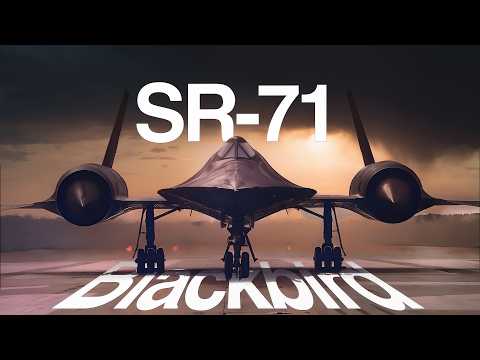
Weaver ejected, free-falling from the edge of space. He didn’t know if his parachute would open. Miraculously, it did. But his joy was short-lived. His friend Jim Zwayer had not survived. The crash was a devastating blow to the top-secret program, but it was just one chapter in the incredible story of the SR-71 Blackbird—a story that began nearly a decade earlier, at the height of the Cold War.
In 1957, the Soviet Union was developing intercontinental ballistic missiles, and the United States desperately needed intelligence on their nuclear arsenal. The CIA turned to Lockheed’s Skunk Works, led by the legendary Kelly Johnson, to build a spy plane that could fly higher and faster than anything before. The result was the A-12, which would evolve into the SR-71 Blackbird.
But building such a plane was a monumental challenge. It required titanium—a metal so rare that the U.S. had to buy it from the Soviet Union through shell companies. It required new manufacturing processes, new fuel, and new materials that could withstand temperatures over 600 degrees Fahrenheit. “The Blackbird was a miracle,” one engineer said. “Actually, it was a series of miracles.”
On December 22, 1964, the first SR-71 took to the skies. Test pilot Bob Gilliland, handpicked by Kelly Johnson, broke the sound barrier on that very first flight. The plane was a sensation. But it was also a deadly machine. The crash of Weaver’s plane in 1966 was a stark reminder of the risks.
Yet the Blackbird would go on to serve for decades, flying critical missions over Vietnam, North Korea, and the Middle East. It set speed records that still stand today. And it did so without ever being shot down by enemy fire.
But the story of the SR-71 is not just about its technical prowess. It’s about the men who flew it, the engineers who built it, and the incredible risks they took to keep the free world safe. As we delve deeper into the history of this iconic aircraft, we’ll explore the challenges, the triumphs, and the legacy of the Blackbird—a plane that truly was ahead of its time.
The Blackbird’s arrival at Beale Air Force Base in 1967 marked the beginning of a new era in aerial reconnaissance. The 9th Strategic Reconnaissance Wing was assembled from the best pilots the Air Force had to offer, yet none of them had ever laid eyes on the aircraft they would soon fly. “You can’t imagine how it felt to see that plane for the first time,” one pilot remembered. “It was breathtaking.”
Training was brutal. The SR-71 demanded constant attention—pilots called it the “three-second plane” because every three seconds you had to scan the instruments to ensure everything was functioning. At 80,000 feet, the smallest error could be catastrophic. The pressure suits, the oxygen systems, the celestial navigation—every detail mattered.
But the Blackbird’s first combat mission would not be over the Soviet Union, the enemy it was designed to watch. Instead, in March 1968, it was called to Vietnam. A Viet Cong supply depot was hidden deep in the jungle, supporting the siege of American Marines at Khe Sanh. The SR-71’s high-resolution ground-mapping radar pierced the canopy and revealed the secret location.
B-52 bombers struck the site, and the siege was broken. The Blackbird had proven its worth in the heat of battle. From that moment on, it became the nation’s primary eye in the sky, monitoring crises from the Middle East to the Far East.
Yet the plane was not invincible. By 1968, enemy radar had learned to track it, and surface-to-air missiles were becoming more effective. The crews knew that one day they would be targeted.
That day came on August 26, 1981, over North Korea. Pilot Maury Rosenberg was flying a mission along the DMZ when North Korean forces launched a Soviet-made SA-2 missile. “The timespan to fire the missile and for it to reach us was less than fifty seconds,” Rosenberg recalled. He banked the Blackbird hard left, away from the threat.
The missile streaked past, exploding less than a mile away. At Mach 3, that was only two seconds from impact. But the SR-71’s speed had saved it once again. The North Koreans had no time to recalculate and redirect their missile. “I saw it pass on the right side and explode,” Rosenberg said. “I felt relieved when we landed—nothing else happened.”
It was exactly as Kelly Johnson had predicted: even when detected, the Blackbird was simply too fast to catch. The Soviets even developed the MiG-25 interceptor specifically to hunt it, but no SR-71 was ever lost to enemy fire—an unmatched record.
For decades, the Blackbird remained the fastest and highest-flying spy plane in the world. But by the late 1980s, a new technology was emerging to take its place: satellites. In March 1990, the SR-71 program was officially retired.
The final flight to Washington, D.C., was a fitting farewell. The Blackbird covered the distance from Los Angeles in just one hour, four minutes, and twenty seconds—a speed record that still stands today. It was a poignant moment for everyone who had worked on the program. Many believed the retirement was premature.
Their concerns were validated only months later. In August 1990, Saddam Hussein invaded Kuwait, and the United States suddenly needed the very capability it had just mothballed. “The system we really needed at hand immediately to find out what was going on was the Blackbird,” one official admitted.
But the story of the SR-71 was not over. The Blackbird would be called back into service, its legacy refusing to fade quietly into history. Its stealth technologies would live on in the B-2 bomber and the F-117 Nighthawk, which used the same radar-absorbing black paint first pioneered on the SR-71.
Five decades after its construction, the Blackbird remains one of the world’s most iconic aircraft. It has appeared in Hollywood films like Transformers and X-Men. To this day, it holds the record as the fastest and highest-flying manned air-breathing aircraft ever built.
The Blackbird was revolutionary because it was the first aircraft designed for sustained flight at 2,000 mph. It was the first stealth aircraft ever designed. Everything about it was special—and the engineers had to invent it all.
It is the embodiment of the perseverance, ingenuity, and patriotism of the men and women who built it, and of those who flew it in service of six presidents. “It’s a plane that can make a statement,” one pilot said. “You know you can’t get us. We were here. We’re watching you.”
The Blackbird proved what we can accomplish when we take on an impossible challenge. One of the lessons of the SR-71 is that you give men and women a task, and you give them the authority and the resources to accomplish it. It’s amazing what you can create.
Perhaps the greatest legacy of the Blackbird, though, is the plane that helped keep the peace when the world stood on the brink of nuclear war. It was the fastest aircraft ever built. It helped win the Cold War. And that should be a pretty good little achievement.
But as the sun set on the Blackbird’s career, a new generation of engineers and pilots looked to the skies and wondered what impossible machine might come next. The SR-71 had shown them the way—a black phantom streaking across the edge of space, daring the world to catch it.
In the years that followed, the SR-71 was briefly reactivated in the mid-1990s, flying a handful of missions before being retired for good in 1998. But its spirit never left the hangars of Palmdale or the hearts of the crews who flew it. The Blackbird had become a legend, a symbol of American ingenuity and daring.
Today, you can find SR-71s in museums across the country—silent sentinels of a bygone era. Children press their faces to the glass, marveling at the sleek black shape that looks like it fell from another world. Veterans stand quietly, remembering the roar of the engines and the thin blue line of the atmosphere above.
“We didn’t just build an airplane,” Kelly Johnson once said. “We built a statement about what this country can do when it refuses to accept limits.” That statement still echoes in the halls of Skunk Works, where engineers now work on hypersonic vehicles and stealth drones.
The Blackbird’s legacy lives on not just in technology, but in the stories of the men who flew it. Bill Weaver, who survived that catastrophic crash in 1966, later became a test pilot for other experimental aircraft. He never forgot Jim Zwayer, and he never stopped marveling at the machine that nearly killed him.
Maury Rosenberg, who dodged a North Korean missile in 1981, still gives talks about his time in the cockpit. “People ask me if I was scared,” he says. “I tell them I was too busy flying the fastest plane in the world to be scared.”
And Bob Gilliland, the first man to fly the SR-71, remained a tireless advocate for the plane until his death in 2019. He knew that the Blackbird was more than metal and fuel—it was a testament to human ambition.
So the story of the SR-71 Blackbird ends not with a retirement party or a museum plaque, but with a question that still hangs in the air: What impossible machine will we build next? The answer, as Kelly Johnson and his team proved, is limited only by our imagination.
What do you think—will we ever see another aircraft like the Blackbird? Share your thoughts in the comments below.
Report this article
Select a reason for reporting:






