Dr. Elizabeth Morrison had seen countless photographs from the post-Civil War era, but none like this. The image, dated 1883 and taken in rural Alabama, showed two young men—one white, one black—sitting shoulder to shoulder on a farmhouse porch. In that time and place, such a pose was not just unusual; it was dangerous. Elizabeth leaned closer to her screen, her heart racing. Something about the photograph felt off, as if the image held a secret waiting to be uncovered.
She spent hours enhancing every detail, adjusting contrast and brightness until her eyes ached. Then, just as midnight approached, she saw it. In the reflection of the window behind the two friends, barely visible but unmistakable, were figures in white hoods and robes. Some held torches, and one gripped a coiled rope. “Oh my god,” Elizabeth whispered, her voice shaking. She grabbed her phone and called her assistant, Marcus. “Marcus, get back here now. You need to see this.”
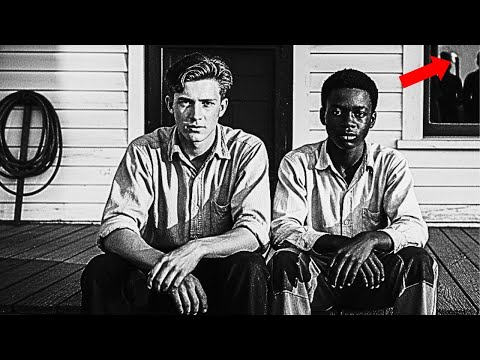
Twenty minutes later, Marcus stood beside her, his face pale. “That’s the Klan,” he said quietly. “Those boys were about to be attacked.” Elizabeth nodded, unable to speak for a moment. The photographer knew. The angle, the positioning—it was deliberate. Someone had documented this moment, knowing what was about to happen.
Four days later, Elizabeth and Marcus drove through the winding roads of rural Alabama, the November landscape a patchwork of bare trees and brown fields. They pulled up to the Willow Creek Historical Society, housed in a converted church with peeling white paint. An elderly woman with silver hair and sharp blue eyes met them at the door. “Dr. Morrison, I’m Ruth Patterson. We spoke on the phone.” Her southern accent was thick, but her handshake was firm.
Inside, the musty smell of old books filled the air. Elizabeth showed Ruth the photograph on her laptop. The old woman’s expression changed immediately. Her hand went to her mouth. “Lord have mercy,” Ruth whispered. “I never thought I’d see this.” She recognized the white boy as Thomas Wright, and the other as Samuel, a freed slave. “The story is about the night the Klan came to burn down the Wright farm,” Ruth said. “The night two boys nearly died for the crime of friendship.”
Ruth disappeared into the back room and returned with a weathered cardboard box. “These are personal papers donated by the Wright family in 1954,” she explained. Elizabeth’s hands trembled slightly as she opened the box. Inside were letters, diary entries, and newspaper clippings yellowed with age. She lifted out a leather-bound journal, its cover cracked and worn. “This was Thomas’s,” Ruth said quietly. “He kept it from 1882 to 1884.”
Elizabeth carefully opened the journal and found an entry dated June 15th, 1883. “Father discovered me in the barn again today with Samuel,” she read aloud. “We were working on his letters. He can now write his own name and read simple passages from the Bible. Father was furious. He said I was violating every decent custom.” Marcus leaned in closer. “So Thomas was teaching Samuel to read,” he said. “That was illegal in many southern states even after the war.” Ruth nodded grimly. “It was more than illegal. It was seen as a betrayal of the entire white community.”
Elizabeth continued reading, flipping through pages. The entries grew more urgent, more fearful. Thomas wrote of threats, of whispered warnings in town, of his father’s growing anger. Then, an entry dated July 3rd, 1883, shifted the tone. “They ask me why I risk everything for him,” Thomas wrote. “They do not understand that Samuel saved my life two years ago when I fell through the ice on Miller’s pond. He pulled me out, carried me home, stayed by my side until I woke.” Elizabeth paused. “So their friendship started with a rescue,” she said softly.
Ruth pulled out another document—a letter written in different handwriting, more careful and deliberate. “This is from Samuel,” she said. “It’s one of only three documents we have in his own hand.” Elizabeth took the letter carefully. The paper was fragile, but the words were clear. “Miss Mary, your brother gave me something no man could take away, the power of words. He treated me not as property or charity, but as a man with a mind and soul equal to his own.”
Elizabeth continued through Thomas’s journal, and the entries from late August grew darker. “August 28th, 1883. A burning cross appeared in our north field last night,” she read. “Father saw it at dawn and immediately ordered me to cease all contact with Samuel. He said the men in town are watching.” Marcus pointed to a newspaper clipping tucked between the pages. It was from the Willow Creek Gazette, dated September 2nd, 1883. The headline read, “Community concerns over racial mixing.” The article was brief but venomous, speaking in coded language about certain citizens who forget their place. “They were building a case in the public mind,” Elizabeth said, “preparing the community to accept whatever came next.”
Ruth nodded. “My grandmother said the Klan didn’t just act randomly. They were methodical. They would spread rumors, print articles, hold meetings. By the time they came for someone, half the town believed the victim deserved it.” Elizabeth found another entry, dated September 10th. “Samuel came to me today in great distress,” Thomas wrote. “His mother heard men talking at the general store. They spoke of teaching that educated boy a lesson. Samuel wanted to leave town, to flee north. I convinced him to stay, promised him we would find a way through this. Now I wonder if I have made a terrible mistake.”
Marcus stood and walked to the window, his jaw tight. “Thomas was 18, 19 at most,” he said. “Just a kid who thought doing the right thing would be enough.” The next journal entry was dated September 18th, 1883, just days before the photograph was taken. Thomas’s tone had shifted from fear to determination. “I spoke with Reverend Holmes today,” he wrote. “He is one of the few men in this county with courage enough to stand against the mob. He told me of a network—people who helped those in danger move north to safety. He called it a continuation of the old underground railroad. The reverend has agreed to help Samuel escape, but we need time. We need evidence of the threats against him—something that cannot be denied or dismissed.”
Elizabeth’s eyes widened. “That’s why they took the photograph,” she said suddenly. “It wasn’t just a portrait. It was documentation.” Ruth pulled out another letter, this one written in an elegant, feminine hand. “This is from Mary Wright, Thomas’s sister,” she said. “She was 21 at the time, unmarried, and by all accounts quite progressive for her era.” The letter was addressed to a Margaret Foster in Boston, dated October 1883. “Dear Margaret, I write to you in the aftermath of the most harrowing night of my life. My brother Thomas and his friend Samuel nearly died at the hands of a mob. But I must start from the beginning so you understand how close we came to tragedy—and how a single photograph may have saved two lives.”
Elizabeth felt her pulse quicken. She witnessed everything. The letter continued, “Thomas came to me on September 20th with a desperate plan. He had learned the Klan intended to attack our farm that very night. Rather than flee or hide, Thomas wanted to create a photograph that would capture the truth of what was happening. He asked me to operate Father’s camera—to position it so that both he and Samuel would be visible in the foreground, and if possible, their attackers in the background.” Marcus shook his head in disbelief. “They deliberately photographed themselves with the Klan approaching,” he said. “That’s incredibly dangerous.”
Mary’s letter provided the details Elizabeth had been desperate to find. “I set up Father’s camera on the porch at dusk,” she wrote. “Thomas and Samuel sat on the steps, both of them trying to appear calm, though I could see Thomas’s hands shaking. The sun was setting, providing just enough light for the exposure. I had positioned the camera to capture the window behind them, where I prayed the reflection might show what was coming. The exposure would need to be long—nearly 30 seconds—which meant they had to remain perfectly still even as danger approached.”
Elizabeth could picture the scene. The two young men frozen in place, maintaining their pose while knowing that violence drew near with each passing second. The letter continued, “I saw them first—white-robed figures emerging from the treeline like ghosts. My hands nearly slipped on the camera, but I steadied myself. Thomas had made me promise to complete the photograph no matter what happened. Through the viewfinder, I watched the mob advance—perhaps 15 or 20 men. Some carried torches, others had ropes. One had a rifle. The photograph was nearly complete when their leader, a tall man whose voice I recognized as belonging to Daniel Fletcher—our neighbor—shouted for Thomas to come down from that porch.”
Ruth interjected quietly. “Daniel Fletcher was a prominent landowner, served on the town council. No one would have questioned him.” Mary’s account grew more intense. “Thomas stood slowly. Samuel rose beside him. I wanted to scream at them to run, but Thomas had warned me to stay silent—to let events unfold. He descended the steps and faced the mob. Fletcher demanded to know if Thomas had been teaching a negro to read and write, violating the customs and laws of decent society. Thomas did not deny it. He said, ‘I have taught my friend to read the Bible. I have committed no crime.’ The word ‘friend’ seemed to enrage them more than anything else.”
Mary’s letter described the confrontation in vivid detail. “Fletcher raised his torch and declared that Thomas had betrayed his race and his family. He said the farm would burn as a warning to others who might forget their place. The mob began to advance. That is when Reverend Holmes appeared. I do not know how he knew to come—perhaps Thomas had sent word earlier—but he emerged from the darkness with 12 other men, both white and black, all armed. The reverend positioned himself between Thomas and the mob. He said, ‘Any man who touches these boys will answer to God and to the law.’ Fletcher laughed. He said there was no law that would protect a race traitor. But the reverend held his ground.”
Elizabeth realized her hands were trembling as she read. The courage it must have taken—for everyone involved—was almost incomprehensible. The letter continued, “What happened next still feels like a dream. Sheriff Coleman arrived with four deputies. I learned later that Reverend Holmes had sent word to him as well. Though the sheriff was known to be sympathetic to the Klan, Coleman had fought in the war and he had strong feelings about mob justice. He ordered both groups to disperse. Fletcher argued, but Coleman was firm. He said if there were crimes to be prosecuted, they would be done through the courts, not through violence. The mob retreated—but slowly, with threats and promises that this was not over.”
Ruth pulled out a brittle newspaper clipping, this one from the Montgomery Advertiser, dated September 25th, 1883. The headline read, “Standoff in Willow Creek prevents lynching.” The article was brief but confirmed Mary’s account. It mentioned Thomas by name and described him as “a young man of confused loyalties.” Samuel was referred to only as “a negro youth of questionable character.” “The photograph never made it into the newspapers,” Ruth explained. “But Thomas sent copies to several people, including a reporter in Montgomery and a lawyer in Birmingham.”
Elizabeth found the final pages of Mary’s letter. “Samuel left Alabama on October 3rd, traveling north with the help of Reverend Holmes and his network. Thomas accompanied him as far as Tennessee, then returned home to face the consequences. Our father disowned him for a time, and many in town refused to do business with our family. But Thomas never expressed regret. He told me that Samuel was worth more than comfort or acceptance. Last week we received a letter from Samuel. He has reached Philadelphia and has begun attending a school for colored students. He writes that he thinks of Thomas every day and considers him the brother he never had.”
Ruth opened a folder containing more recent documents. “Samuel became a teacher, just as he dreamed,” she said. “He opened a school in Philadelphia that operated for 42 years. He taught hundreds of students, many of whom went on to become teachers themselves, spreading literacy through the black community.” She pulled out a photograph from 1920 showing an elderly black man surrounded by students in a classroom. His face was weathered, but his eyes were unmistakable—the same determined gaze from the 1883 photograph.
“And Thomas?” Marcus asked. Ruth smiled softly. “Thomas became a lawyer. He spent his career defending poor clients, both white and black, often for free. He never married—devoted his life to justice. He and Samuel corresponded for over 40 years, until Samuel’s death in 1925. Thomas died six months later. Their letters are preserved at the Birmingham Civil Rights Institute.”
Elizabeth sat back, overwhelmed by the weight of the story. A single photograph, taken in a moment of desperate courage, had documented not just an attack but an act of resistance—a refusal to let hatred destroy friendship. “The photograph saved their lives that night,” Elizabeth said quietly. “But more than that, it preserved the truth. Without it, this would have been forgotten, dismissed as legend.” Ruth nodded. “That’s why we must keep telling it. Every photograph, every letter, every journal entry is evidence that ordinary people resisted.”
Elizabeth closed the journal gently, as if afraid to disturb the voices still echoing from its pages. “We should digitize everything,” she told Ruth. “These documents belong in every classroom in America.” Marcus was already photographing each page with his phone, his earlier skepticism replaced by quiet reverence.
On the drive back to the airport, the Alabama fields rolled past in amber light. “Two kids,” Marcus said, staring out the window. “One camera. Thirty seconds of pure courage.” Elizabeth nodded. “They didn’t just survive that night. They made sure we’d never forget it.”
Months later, the Smithsonian opened a small exhibit titled Thirty Seconds of Courage. The 1883 photograph hung at its center, the hooded figures in the window reflection now impossible to miss. Beneath it, a single line from Thomas’s journal: “How can friendship be a crime?”
Visitors lingered there longest, staring at two young men frozen in a moment that could have ended everything—and instead outlived them both. What would you have done, standing on that porch with the torches approaching?
Report this article
Select a reason for reporting:






