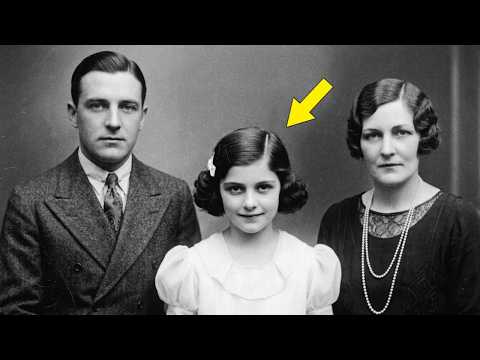
Dr. Sarah Mitchell had spent years studying the dead. As a Cambridge historian, she could reconstruct entire lives from a single ledger entry or a faded letter. But nothing in her archives prepared her for the moment she first laid eyes on the Ashford family portrait—a seemingly ordinary photograph from 1920 that would unravel a century of secrets and force her to confront the true face of evil.
It was a Saturday afternoon in Canterbury, and Sarah was browsing the cluttered aisles of Pemberton’s Antiques, the musty scent of old wood filling her nostrils. Near the back, tucked between pewter tankards and leather-bound volumes, she found it: a small wooden frame holding a formal studio portrait. A stern father in a three-piece suit, a mother with a cameo brooch, and their young daughter, perhaps nine years old, seated between them. At first glance, it was unremarkable—just another stiff, posed family portrait from the early 20th century.
But then Sarah noticed the child’s smile.
It wasn’t the innocent, joyful expression of a happy child. It was knowing, almost calculating, as if the girl possessed some secret knowledge that her parents lacked. The smile appeared too mature, too sophisticated for someone so young. Sarah found herself staring, unable to shake the feeling that something was fundamentally wrong.
“Interesting piece, that one,” said Mr. Pemberton, the elderly shop owner, appearing beside her with surprising quietness. “Came from an estate sale in Whitstable last month. The Ashford family—been in the area for generations.”
He explained that Herbert Ashford had owned successful shipping warehouses in Dover, and his wife Constance came from old money. Their daughter, Millicent, was born in 1911—about nine when the portrait was taken. But the family met with tragic circumstances not long after. Herbert died suddenly in late 1920, just months after the portrait was commissioned. Heart attack, according to the death certificate, though he was only 42 and had always been in excellent health. Constance suffered a complete nervous breakdown and was institutionalized until her death in 1925. And Millicent? She was sent to live with an aunt in Yorkshire but ran away in 1922, when she was about eleven. She was never found.
Sarah purchased the photograph, partly for her collection and partly because she couldn’t shake her fascination with Millicent’s disturbing expression. The following Monday, she sat in her office at Cambridge, the portrait propped against a stack of research books, and began to dig.
Her search for Herbert Ashford yielded several newspaper articles confirming his sudden death on November 15th, 1920. But the portrait bore a studio stamp indicating it had been taken on November 10th—just five days earlier. Why would a healthy businessman commission a formal family portrait and then die of a heart attack less than a week later?
Her research into Constance’s institutionalization led her to a medical journal from 1921, published by Dr. Edmund Hartwell of the Maudsley Hospital. The article described the case of a Mrs. C. A. who had been admitted following her husband’s sudden death. According to the notes, the patient exhibited persistent delusions regarding her daughter’s behavior, claiming that the child had undergone a fundamental personality change that preceded her husband’s death by several weeks. “Patient insists that her daughter, previously described as sweet-natured and obedient, had begun exhibiting disturbing behaviors including cruel treatment of household pets, inappropriate social responses, and what she described as an unsettling smile that never reached the child’s eyes.” Constance became increasingly agitated when questioned, insisting that something had taken possession of her little girl and that this transformation had somehow caused her husband’s death.
Sarah sat back in her chair, a cold realization washing over her. She pulled out a magnifying glass and examined Millicent’s face once again, paying particular attention to that enigmatic smile.
Determined to learn more, Sarah drove to Whitstable the following weekend to visit Henderson and Sons photography studio, the establishment whose stamp appeared on the back of the photograph. Mrs. Victoria Henderson, the current owner and great-granddaughter of the studio’s founder, greeted Sarah warmly and led her to a back room filled with filing cabinets containing a century’s worth of records.
“Oh, yes, I remember seeing that appointment in our old ledgers,” she said, retrieving a leather-bound book from 1920. “November 10th, 1920, the Ashford family portrait session. Mr. Herbert Ashford requested an urgent appointment. Payment in advance. Mentioned that time was of the essence, though did not elaborate on the reason for the urgency.”
Mrs. Henderson continued reading. “My great-grandfather made some additional notes about the session itself. He wrote, ‘Unusual sitting. Mr. and Mrs. Ashford appeared nervous, almost frightened. The child, however, seemed remarkably composed and cooperative, though there was something unsettling about her demeanor. She smiled constantly throughout the session, but it was not the natural smile of a happy child.’ Mrs. Ashford seemed particularly disturbed by her daughter’s behavior, frequently asking the child to stop smiling like that and act normally.”
Mrs. Henderson paused, looking up at Sarah. “That’s rather odd, isn’t it? Most photographers would be delighted to have such a cooperative young subject.”
The notes continued: “Mr. Ashford appeared to be in poor health, sweating profusely despite the cool November weather, and complaining of chest pains. When I suggested postponing the session, he became quite agitated, insisting that the portrait must be completed that day. ‘We may not have another opportunity,’ he said, though he refused to explain what he meant by this comment.”
Sarah felt her pulse quicken. “Did your great-grandfather make any other observations about the family?”
Mrs. Henderson turned the page. “Yes, actually. He wrote a final note after they left. ‘Most disturbing session in 30 years of portrait photography. The child’s smile never wavered once during the entire hour-long sitting, not even when her parents were clearly upset. There was something almost predatory about her expression, as if she were studying the camera and everyone in the room with calculating intelligence far beyond her years.'”
Sarah’s next stop was the Kent County Archives, where she hoped to locate Herbert Ashford’s death certificate and any related medical examiner’s reports. After several hours of searching through dusty filing systems, she finally located the document along with a more detailed coroner’s report that had not been made public at the time. The official cause of death was listed as cardiac arrest due to acute myocardial infarction. But the attending physician, Dr. Marcus Whitmore, had included several puzzling observations in his private notes.
“Patient exhibited symptoms consistent with severe poisoning,” Dr. Whitmore had written. “Pupils dilated, excessive sweating, irregular heartbeat, and signs of gastrointestinal distress. However, preliminary examination revealed no obvious source of toxic substances. The patient’s wife reported that he had been experiencing these symptoms intermittently for approximately three weeks prior to his death, always following meals prepared by their daughter as part of what Mrs. Ashford described as Millicent’s new interest in cooking.”
Sarah’s blood ran cold as she continued reading. The report detailed how Herbert had initially dismissed his symptoms as stress related to his business affairs, but they had grown progressively worse over time. “The patient’s wife expressed concerns about their daughter’s recent behavioral changes,” Dr. Whitmore had noted. “Mrs. Ashford reported that the child had begun experimenting with herbs and plants gathered from their garden, claiming she was learning to make special treats for the family. The patient had encouraged this interest, viewing it as childhood curiosity about domestic skills.”
But most disturbing was Dr. Whitmore’s final observation: “I attempted to question the child about her father’s symptoms, as she had been present during many of his episodes. The girl displayed no emotional distress regarding her father’s condition, and answered my questions with unsettling precision, describing his symptoms in clinical detail that seemed far beyond the medical knowledge of a 9-year-old child. When I commented on her remarkable composure given the circumstances, she smiled at me in a manner that I found profoundly disturbing, as if she were enjoying a private joke at the expense of everyone around her.”
The report concluded: “While I cannot definitively establish a cause of death beyond cardiac arrest, I have documented my concerns regarding the unusual circumstances surrounding this case. I recommend that the local constabulary investigate the family’s domestic situation, particularly regarding the preparation of meals and the child’s unusual behavior patterns. However, given the family’s social standing in the community and the lack of concrete evidence of wrongdoing, I doubt such an investigation will be pursued.”
Sarah sat in stunned silence, pieces of a horrifying puzzle beginning to fall into place. But this was only the beginning. The child’s smile in that photograph was trying to tell her something—and she was determined to uncover the truth, no matter how dark it might be.
Her investigation led her to the Kent Police Museum, where she found the private journal of Constable William Thornton. He had investigated Herbert’s death at Dr. Whitmore’s urging. “Mrs. Ashford appeared to be in a state of extreme distress, not simply from grief, but from what seemed to be genuine terror,” he wrote. “She repeatedly insisted that something was wrong with Millicent.”
Thornton documented dead animals found in the garden—birds, mice, the family cat—all consistent with poisoning. Millicent claimed she was studying anatomy. “The manner of the animals’ deaths was consistent with poisoning, and I observed that Millicent displayed no emotional response.”
His most chilling entry was dated November 25th: “I discovered that Millicent had been systematically gathering plants from the garden and countryside, many of which I recognized as potentially toxic species such as foxglove, nightshade, and yew berries.” When confronted, the child claimed she was learning about natural remedies from a book found in her father’s library. But the book was a comprehensive guide to poisonous plants, with toxic species carefully marked in what appeared to be Millicent’s handwriting.
Thornton’s final entry, December 1st, 1920, was damning: “I am convinced that young Millicent Ashford was systematically poisoning her father, likely using plant-based toxins that would be difficult to detect. However, I have been ordered to close the investigation due to lack of concrete evidence and the family’s prominent social position. The truth is that no one wants to believe that a 9-year-old child could be capable of such calculated murder, but I have looked into that child’s eyes and I am certain that we are dealing with something far more dangerous than anyone realizes.”
Sarah’s research then took her to North Yorkshire, where Millicent had been sent to live with her aunt, Penelope Weatherby. The correspondence between Mrs. Weatherby and the family solicitor painted a picture of escalating horror. “Millicent has been with us for six months now, and I must confess that I am deeply concerned about the child’s behavior,” she wrote in July 1922. “She shows no grief for her father’s death or distress about her mother’s condition. Instead, she seems almost pleased by the turn of events, as if everything has worked out exactly as she planned.”
Mrs. Weatherby’s cook fell gravely ill after eating soup Millicent had helped prepare. Village children avoided her entirely after several incidents involving toxic plants and sweets that made them violently ill. Her final letter, dated September 1922, was filled with desperation: “I can no longer care for this child. There’s something fundamentally wrong with Millicent that goes far beyond the trauma of losing her parents. She studies people the way a scientist studies laboratory specimens, always watching, always calculating. Yesterday, I caught her in my room going through my personal papers and medications. When I confronted her, she smiled at me with that same disturbing expression that Constance had written about. I fear for my safety, Mr. Matthews. This child is dangerous.”
Three days later, Millicent vanished, leaving a note: “Thank you for your hospitality, Aunt Penelope. I have learned everything I need to know here.”
Detective Inspector Harold Blackwood documented seven unexplained deaths across North Yorkshire between September 1922 and March 1923. All the victims were middle-aged adults who had befriended a young girl claiming to be an orphan. All died of apparent heart failure after weeks of intermittent illness. “I’m convinced that we are dealing with a child who possesses both the intelligence and the complete lack of moral conscience necessary to commit these calculated murders,” Blackwood wrote. “Most disturbing is the methodical way she tests different substances and dosages on her victims, as if she were conducting scientific experiments using human subjects.” The trail went cold. Millicent had disappeared.
Years later, Scotland Yard’s file on “The Smiling Woman Murders” detailed a serial killer who operated from 1930 to 1947. Victims were wealthy, elderly individuals poisoned by a young woman who insinuated herself into their lives as a housekeeper or companion. “The most consistently reported characteristic is her smile, described universally as disturbing, calculating, and never reaching her eyes,” Detective Chief Inspector Robert Morrison noted. A 1945 photograph confirmed it was the adult Millicent—the same dark eyes, the same chilling smile.
Immigration records showed a woman matching her description departed for Australia in 1948 under the name Margaret Mills. Australian records revealed a series of suspicious deaths in nursing homes across Sydney and Melbourne. The perpetrator, known as the “Angel of Mercy,” vanished before authorities could arrest her.
But the most shocking discovery came when Sarah traced her activities into the 1970s. Margaret Mills had returned to England in 1971 as Dr. Margaret Ashworth, administrator of Sunset Manor, a private nursing home in Surrey. Between 1971 and 1995, the home experienced an unusually high mortality rate. Former staff recalled the administrator’s tendency to smile inappropriately during family conferences about terminal diagnoses. Dr. Ashworth died in 1995 at the age of 84, her death attributed to natural causes.
She had spent over seventy years systematically murdering hundreds of victims, evolving from a disturbed child conducting crude poisoning experiments into a sophisticated serial killer who hid her crimes within legitimate medical institutions.
Standing in her Cambridge office, Sarah looked one final time at the 1920 studio portrait. That strange knowing smile hadn’t been the expression of a normal child at all, but the cold satisfaction of a born killer who had discovered her calling. She donated the photograph to Scotland Yard’s Black Museum, where it now serves as a cautionary reminder that evil can emerge at any age—and that society’s reluctance to believe in childhood monstrosity allowed one of Britain’s most prolific serial killers to operate undetected for over seven decades.
The strange smile that had first caught Sarah’s attention would continue to disturb viewers for generations to come, a frozen moment that revealed the terrifying truth about human nature’s darkest possibilities. But it also raised a question that haunted Sarah long after she closed her research files: how many other Millicents are out there right now, hiding behind innocent smiles, waiting for their first opportunity to strike?
What do you think—could a child truly be born evil, or does something in their environment create a monster? Share your thoughts in the comments below.
Report this article
Select a reason for reporting:






