The jungle was not silent. It breathed—a hot, wet, suffocating breath that stank of rot and cordite. On the slopes of Sattelberg, November 24, 1943, the Australian advance had stalled three times, and the men of the 2/48th Battalion were falling back, their faces etched with the exhaustion of a week-long nightmare. They had gained only a few hundred meters a day, each step paid for in blood. Now, as darkness threatened to swallow the ridge, Lieutenant Colonel Albert Caro gave the order: withdraw, regroup, try again tomorrow.
But one man had seen enough death. Sergeant Thomas “Diver” Derrick had watched his mates cut down by hidden machine guns, their bodies left to the mud. Something inside him snapped—or perhaps, something finally clicked. He turned to his commander, eyes blazing with a defiance that bordered on insubordination.
“Just give me twenty more minutes.”
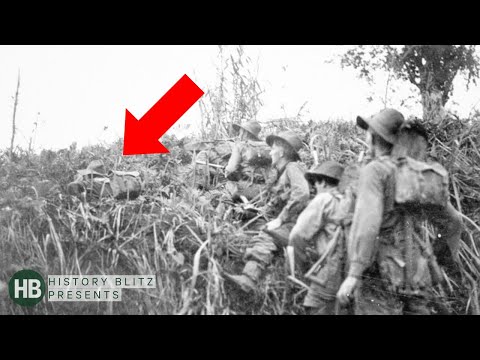
The words hung in the heavy air. It was a direct violation of orders, a gamble that could cost him his rank—or his life. But Derrick wasn’t thinking about consequences. He was thinking about the ten enemy positions still spitting fire from the ridge, the men who would die tomorrow if those guns weren’t silenced tonight. Without waiting for a reply, he gathered his platoon and began to climb.
The slope was a nightmare—so steep that Derrick had to scramble on hands and knees, his fingers clawing at roots and rocks. Bullets whizzed past, kicking up dirt and splintering bamboo. He moved ahead of his men, a lone figure in the fading light, grenades clutched in his fists. One by one, he crept up to the Japanese bunkers, pulled the pins, and tossed death through the slits. Ten times he did this. Ten explosions that tore through the jungle silence, each one a hammer blow to the enemy’s defense.
Behind him, his platoon watched in awe. They had seen bravery before, but this was something else—a kind of fury, a refusal to accept defeat. Derrick didn’t stop until the guns fell silent, until the ridge was his. By dusk, the path to Sattelberg was open.
The next day, the village fell. And Sergeant Thomas Derrick, the man who disobeyed orders, became a legend. His diary would later record the irony: “Swarmed by reporters and photographers—just like being King for a Day. All because of disobeying an order.” But the Victoria Cross he received told a different story—one of courage so extraordinary that it changed the course of a war.
Yet Derrick’s journey to that muddy ridge began long before, in the dusty deserts of North Africa, where a young soldier from Adelaide first learned that rules were made to be broken when lives were on the line…
The son of a laborer, Thomas Currie Derrick grew up in the working-class streets of Adelaide during the Great Depression. He left school at fourteen, taking whatever work he could find—picking fruit, driving trucks, digging ditches. It was hard, thankless labor, but it taught him something the parade ground never could: how to endure.
When war came in 1939, Derrick enlisted without hesitation. He was assigned to the 2/48th Battalion, and it was during training that the nickname “Diver” first stuck. The story went that a rowing oar slipped from a mate’s hands and vanished into the water. Without a word, Derrick dove overboard and retrieved it—earning a cheer and a name that would follow him across two continents.
But it was in North Africa that the name took on a deeper meaning. At Tobruk, during the long siege of 1941, Derrick led patrols into no-man’s-land with a recklessness that unnerved his superiors and inspired his men. He seemed to dive headfirst into danger, as if death were something he could simply outswim.
“He had a way of making you believe the impossible was just a matter of trying harder,” one of his soldiers later recalled.
At El Alamein, his legend grew. Under murderous machine-gun fire, Derrick led his section in a series of assaults that silenced enemy posts and captured over a hundred prisoners. For that, he received the Distinguished Conduct Medal. By the time the 2/48th was shipped to New Guinea, he was a sergeant—and a man his platoon would follow anywhere.
New Guinea, however, was a different kind of war. North Africa had been open ground and clear skies; here, the jungle closed in like a fist. The enemy was invisible, the terrain hostile, and the rain never stopped. Sattelberg would test everything Derrick had learned—and everything he was.
Now, on the evening of November 24, 1943, with the ridge finally silent and the smoke drifting through the treetops, Derrick slumped against a tree, his hands raw and bleeding. His men gathered around him, not speaking, just breathing. Somewhere below, the rest of the battalion was preparing to move up at first light.
But the Japanese were not finished. From the darkness beyond the ridge, the distant crack of a rifle echoed—a single shot, then another. A sniper, or perhaps a lone defender unwilling to surrender. Derrick’s eyes snapped open. He looked at his platoon, then toward the sound.
“Rest while you can,” he said quietly, reaching for his rifle. “Tomorrow, we take the village. But tonight, we make sure no one takes us.”
The men nodded, checking their weapons in the dark. The jungle breathed around them, and somewhere in the shadows, the enemy waited. Derrick had won the ridge, but the battle for Sattelberg—and for the Huon Peninsula—was far from over.
The night passed in fits and starts. Men dozed against tree trunks with rifles cradled to their chests, waking at every rustle, every snapping twig. The sniper—or snipers—kept up their intermittent fire, more a psychological weapon than a tactical one. No one was hit, but no one slept well either.
Derrick moved among his men before dawn, crouching low, speaking in a voice barely above a whisper. He checked ammunition, redistributed grenades, and marked the line of advance with a stick in the mud. “The village sits in a bowl,” he told his section leaders. “High ground on three sides. We go in fast, before they can regroup.”
At first light, the rest of the 2/48th moved up the ridge, joining Derrick’s platoon. Lieutenant Colonel Caro said nothing about the disobedience—not yet. There would be time for paperwork later, if they survived. The tanks of C Squadron rumbled up the newly cleared road, their engines a deep growl in the morning mist.
The assault on Sattelberg began at 0800. Matilda tanks led the way, their cannons punching holes in the remaining bunkers while infantry advanced on either side. The Japanese fought with the desperation of men who knew they were beaten but refused to admit it. Mortar shells walked across the Australian line; a tank threw a track on a landslide and had to be abandoned.
Derrick’s platoon was ordered to clear a cluster of huts on the eastern edge of the village. They moved through waist-high kunai grass, crouching low. A machine gun opened up from a trench, pinning them down. Derrick didn’t hesitate. He crawled forward through the grass, pulled the pin on a grenade, and lobbed it into the trench. The gun went silent.
“Move! Move!” he shouted, and his men surged forward.
By midday, the Australians had pushed into the village proper. The fighting became house-to-house, brutal and close. Bayonets and grenades, boots and fists. The Japanese garrison, cut off from reinforcement, fought to the last man. Some chose death over surrender; others slipped away into the jungle, heading north toward the next defensive line.
Derrick found himself in a captured headquarters building, its walls pocked with shrapnel. A Japanese officer’s sword lay on a desk, abandoned. Maps covered the wall—detailed positions, supply routes, the entire Japanese defensive plan for the Huon Peninsula. He grabbed them and stuffed them into his shirt.
Outside, the firing began to fade. The village was theirs.
But the cost was visible everywhere. Bodies in Australian khaki and Japanese green lay tangled in the mud. A Matilda tank sat burning at the crossroads, its crew evacuated but its hull a blackened ruin. Medics moved among the wounded, their hands stained red.
Derrick stood in the village square, breathing hard. His hands were shaking—not from fear, but from the sheer release of tension. A young private approached him, face pale. “Sarge, they’re saying you knocked out ten posts by yourself. Is that true?”
Derrick looked at him for a long moment, then spat into the dirt. “I did what needed doing. Same as anyone else.” He clapped the private on the shoulder. “Get some water. We’re not done yet.”
He was right. The capture of Sattelberg broke the back of Japanese resistance on the Huon Peninsula, but the enemy still held positions in the surrounding hills. The 2/48th would spend the coming weeks in pursuit, clearing pockets of resistance, enduring the rain and the mud and the endless jungle.
And somewhere in the chaos of it all, a recommendation for the Victoria Cross was quietly written up, signed, and sent up the chain of command. Derrick knew nothing about it. He was too busy trying to keep his men alive.
But the men knew. They had seen him climb that ridge, seen him throw grenade after grenade into the teeth of the enemy. They had followed him because he asked for twenty more minutes when everyone else had given up.
“You know what the difference is between a hero and a fool?” one of his soldiers said to a replacement, watching Derrick clean his rifle that evening. “A hero’s the one who survives to tell the story. Diver just doesn’t know how to be anything else.”
The jungle breathed around them, hot and wet and indifferent. Tomorrow, the advance would continue. But for one night, the men of the 2/48th rested—and the name Diver Derrick passed from mouth to mouth, already becoming legend.
The weeks that followed were a blur of patrols and ambushes, the 2/48th pushing north through mud that swallowed boots and rain that never seemed to end. Derrick led his platoon as he always had—from the front, with a grenade in one hand and a grin that unnerved the enemy more than any artillery barrage. But the jungle had a way of humbling even the fearless.
On a patrol near the coast, a Japanese sniper’s bullet found his thigh. He was evacuated to a field hospital, furious at being sidelined while his men fought on. “I’ll be back before they miss me,” he told the medics, but the wound was worse than he let on. Infection set in. The man who had survived Tobruk and El Alamein and the slopes of Sattelberg was finally stopped—not by the enemy, but by the jungle itself.
He died on May 24, 1945, just months before the war ended. He was thirty-one years old.
The Victoria Cross was announced later that year. His widow received it in a quiet ceremony in Adelaide, the city where he had once dived into the water for a lost oar. The citation read simply: “For valour and devotion to duty.” But the men who had climbed that ridge with him knew the truth—it was for the twenty minutes he refused to give up.
Today, a statue of Diver Derrick stands in Adelaide, his gaze fixed on some distant ridge only he can see. And on the slopes of Sattelberg, where the jungle has long since reclaimed the bunkers and the trenches, the story is still told—of the sergeant who disobeyed an order and won a battle, and of the courage that turned a muddy hill into a legend.
What would you have done with those twenty minutes?
Report this article
Select a reason for reporting:






