Emily Chun had restored thousands of photographs, but she had never seen damage quite like this. The image that arrived at her San Francisco studio in March 2024 was severely deteriorated—water-stained, torn at the edges, with large sections obscured by mold and discoloration. Yet something about it felt different. The client, Margaret Leu, had inherited it from her grandmother’s estate, and her words echoed in Emily’s mind: “My grandmother kept this photo in a locked box her entire life, separate from all the family albums. It must have meant something to her.”
As Emily carefully positioned the photograph under her high-resolution scanner, she couldn’t shake the feeling that she was about to uncover a story long buried. The image showed two young women, probably in their early twenties, standing close together with their arms around each other’s waists. Both wore high-collared white blouses and long dark skirts typical of the early 1900s. One woman was white with light brown hair pinned up elaborately; the other was Chinese with dark hair styled similarly, her smile bright and genuine. The date stamp on the photographer’s mark was partially visible: 1903, San Francisco.
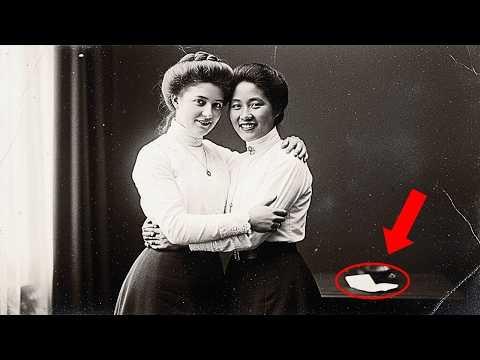
Emily spent hours working on the image, using specialized software to remove stains, repair tears, and enhance faded sections. As she worked on the lower right corner, one of the most damaged areas, she noticed something unusual. There was a small rectangular shape, darker than the surrounding damage, approximately one inch by half an inch. At first, she thought it was just another stain or piece of deterioration, but as she applied different filters and lighting adjustments, she realized it was something else entirely. It was paper. A tiny piece of paper folded multiple times and somehow adhered to the photograph itself, camouflaged by decades of water damage and grime.
Emily’s pulse quickened. She had restored thousands of photographs, but she had never found anything deliberately hidden in one before. She picked up the phone to call Margaret. “I found something in your grandmother’s photograph. Something that was intentionally placed there. Can you come to the studio?”
Margaret arrived within an hour, her curiosity evident. Emily showed her the enhanced digital image, pointing to the small rectangular shape in the corner. “What is it?” Margaret asked. “I think it’s a letter. A very small one, folded and sealed into the photograph itself. But I can’t remove it without potentially damaging both the photo and whatever is written on the paper. We need to bring in a conservator.”
Margaret stared at the image—at the two smiling women with their arms around each other. “My grandmother was Chinese,” she said quietly. “She came to America as a child in the 1890s, but she never talked about her early life here. She always said it was too painful to remember.” Emily looked at the Chinese woman in the photograph, at her joyful expression. “I think we’re about to find out why.”
Doctor James Morrison, a paper conservator from the San Francisco Museum of Modern Art, arrived at Emily’s studio three days later. He examined the photograph under magnification, his expression growing more intrigued with each passing minute. “This is extraordinary,” he said. “The paper was sealed to the photograph using what appears to be rice paste, a traditional adhesive. Whoever did this wanted it to stay hidden, but also wanted it to survive. The placement in the corner, the type of adhesive used—this was deliberate preservation.”
“Can you remove it without damaging either the photo or the letter?” Emily asked. “I believe so, but it will take time and extreme care.”
Over the next two hours, Emily and Margaret watched as James worked with tools so delicate they seemed like surgical instruments. He carefully applied a solution that softened the century-old adhesive, then slowly, millimeter by millimeter, separated the tiny folded paper from the photograph. When it was finally free, James placed it on a clean white surface. The paper was yellowed and fragile, folded into a square no bigger than a postage stamp. “The folding pattern is very specific,” James observed. “This is an origami technique. Japanese influence, but adapted. Each fold would have been deliberate, designed to make the letter as small as possible while still protecting what was written inside.”
Using micro-forceps and working under magnification, James began to unfold the letter. Each crease had to be softened carefully to prevent the paper from cracking. Margaret gripped Emily’s hand, both women barely breathing as they watched. Finally, after what seemed like an eternity, the letter lay flat. It measured approximately two inches by three inches, covered in tiny, meticulously written script in English. James photographed it immediately, then projected the image onto a large monitor so they could read it. The handwriting was elegant despite its microscopic size. The letter was dated October 15th, 1903, and began, “My dearest Catherine.”
Emily looked at Margaret. “Do you know anyone named Catherine in your family history?” Margaret shook her head, transfixed by the screen. They continued reading together, and with each line, the heartbreak became more evident. “By the time you read this, if you ever do, I will be gone. Not dead, but gone from San Francisco, from America, from your life. The new immigration laws mean I must leave. And there is nothing either of us can do to stop it.”
Emily spent that evening researching the Chinese Exclusion Act and its amendments. What she learned filled her with anger and sadness. The Chinese Exclusion Act, passed in 1882, had been the first federal law to explicitly ban immigration based on nationality. It prohibited Chinese laborers from entering the United States and prevented Chinese immigrants already in the country from becoming citizens. Over the following decades, the restrictions had grown more severe. In 1902, Congress had extended the Exclusion Act indefinitely and expanded it to include Chinese people from all countries, not just China. The Geary Act of 1892 had required all Chinese residents to carry certificates of residence, and anyone found without proper documentation could be deported immediately. For Chinese women, the situation was even more dire. The Page Act of 1875 had effectively banned Chinese women from immigrating based on racist assumptions that they were prostitutes. Chinese families were systematically separated, with men unable to bring wives or daughters to America.
Emily called Margaret. “I think I understand what happened. The woman in the photo with Catherine, your ancestor, was being deported under the exclusion laws. That’s why the letter talks about her being gone from America.”
“My grandmother’s name was May,” Margaret said quietly. “May. She was born in San Francisco in 1891, which would have made her about 12 in this photo. But wait, if she was born here, wouldn’t she have been a citizen? Why would she be deported?”
“That’s what we need to find out,” Emily said. She contacted Dr. Lisa Wong, a historian at UC Berkeley who specialized in Chinese American history during the exclusion era. Dr. Wong agreed to meet with them the next day.
In her office, surrounded by books and historical documents, Dr. Wong examined the photograph and the letter carefully. “This is remarkable,” she said. “Personal correspondence from this period is incredibly rare. Most Chinese immigrants were afraid to keep written records that might be used against them.”
“Can you help us understand what happened to May?” Margaret asked. “Let me search the immigration records. If May was deported, there should be documentation.”
Dr. Wong spent two hours combing through digitized records from the Angel Island Immigration Station and the San Francisco Immigration Bureau. Finally, she found what she was looking for. “Here,” she said, turning her monitor so they could see. “May, born in San Francisco 1891, deported October 1903, age 12. Reason for deportation: fraudulent birth certificate.”
Margaret gasped. “Fraudulent? What does that mean?” Dr. Wong’s expression was grim. “It means someone challenged whether May was actually born in San Francisco. Under the exclusion laws, Chinese people born in the US were citizens and couldn’t be deported. But immigration officials often accused Chinese families of creating false birth records. They would bring in witnesses who claimed the birth never happened, or they would find minor inconsistencies in paperwork and use that as justification for deportation.”
“So May might have been a real citizen, but they deported her anyway?” Emily asked. “Almost certainly. This was common practice. Thousands of Chinese Americans, including children born here, were deported on trumped-up charges. It was ethnic cleansing, dressed up as immigration enforcement.”
Emily looked at the photograph again—at 12-year-old May’s bright smile, her arm around her friend Catherine. “She was just a child.” “Yes,” Dr. Wong said sadly. “And Catherine, whoever she was, tried to preserve their friendship in the only way she could—by hiding this letter in their photograph, creating a time capsule of a bond that the government tried to erase.”
Finding Catherine proved harder than expected. The letter offered no surname, no family details—only the depth of her affection for May and her anguish at their forced separation. Emily returned to the photograph itself, examining every detail. The photographer’s mark in the corner, partially obscured by damage, read: Morrison Photography Studio, 1903, San Francisco.
She searched historical records and found that Morrison Photography Studio had operated on Market Street from 1895 to 1920. The studio’s client ledgers had been donated to the San Francisco History Center, and Emily requested access immediately. Three days later, she sat in the reading room, carefully turning pages of faded handwriting. On October 10th, she found the entry: Portrait, two young ladies. Names: Miss Katherine Morrison and Miss May. Paid in full, $2.50.
Katherine Morrison—the photographer’s daughter. Emily traced her through the census records. In 1920, Catherine appeared as Catherine Morrison Reed, married to James Reed, a banker. She lived a long life, dying in 1978 at age 95. Her obituary described her as a devoted wife and mother who had been active in social justice causes throughout her life. But there was something else that caught Emily’s attention: “Mrs. Reed was a founding member of the Chinese American Citizens Alliance and worked tirelessly for the repeal of discriminatory immigration laws. She maintained correspondence with friends around the world.”
Emily called Margaret immediately. “Catherine spent her life fighting the laws that took May away from her. And the obituary mentions a letter collection. We need to find Catherine’s descendants.”
She found Catherine’s grandson, David Reed, age 73, living in Berkeley. “I know about the photograph,” David said immediately. “My grandmother kept it on her desk her entire life. When she died, my father found dozens of boxes in her attic, all filled with letters. There are boxes specifically labeled ‘May Canton.’ My grandmother told me once that May was her best friend, that they’d been separated when they were young, but never stopped writing.”
David Reed’s garage contained treasures beyond anything Emily had imagined—seventeen boxes carefully labeled and preserved, containing hundreds of letters exchanged between Catherine Morrison Reed and May from 1904 to 1954. Fifty years of friendship maintained across an ocean and through two world wars.
They opened the first box, labeled 1904–1910. The earliest letter was dated January 15th, 1904, just three months after May’s deportation. Dr. Wong translated from the Chinese: “My dearest Catherine, I have arrived in Canton after a voyage of 37 days. Everything here is strange and frightening. I am supposed to be Chinese, but I feel entirely American. Most of all, I miss you. You are the only thread connecting me to the life I was torn from.”
Catherine’s reply was equally heartbreaking: “My beloved May, I go to the pier sometimes and imagine I can see across the ocean to where you are. I have been writing to everyone I can think of—congressmen, lawyers, immigration officials—begging them to review your case. They all say the same thing: the law is clear. But I will not give up. I promise you, May, I will fight these unjust laws for as long as I live. And I will write to you every week without fail so that you never feel alone.”
The letters painted a picture of two young women growing up on opposite sides of the world, sharing their lives through words because they could share nothing else. In 1924, Catherine wrote: “I think of you as my sister, not just my friend. Sisters separated by an unjust law, but sisters nonetheless.” May’s response: “You have always been more than a friend to me. I have a daughter now. Her name is Lynn. When she is old enough, I will give her your letters so she knows that friendship can survive anything, even oceans and unjust laws.”
Emily looked at Margaret. “Lynn would have been your grandmother.” Margaret nodded, overcome with emotion. “My grandmother Lynn—she died when I was 15. But I remember her talking about her mother’s American friend, the woman who wrote letters that arrived like treasures.”
In March 1954, May wrote her final letter: “My dearest Catherine, the doctors say my heart is failing. I am not afraid. I have lived 73 years, raised a beautiful daughter, and maintained the most important friendship of my life despite thousands of miles and decades of separation. When I am gone, please tell your family about me. Tell them that friendship like ours is the antidote to every evil law, every cruel policy, every attempt to divide people based on the color of their skin or the place of their birth.”
Catherine’s response, tear-stained and barely legible, read: “I love you, May. I have loved you since we were children playing together while my father took photographs. I will love you until I take my last breath. And if there is anything beyond this life, I will find you there. Wait for me, sister. I won’t be long.”
May died on April 3rd, 1954. Catherine Morrison Reed died on December 15th, 1954—just eight months later. “My grandmother died of a broken heart,” David said quietly. “She had kept her promise. She had maintained their friendship, fought for justice, preserved every letter. But without May to write to, she didn’t see the point of continuing.”
The exhibition opened at the Chinese Historical Society of America in San Francisco in September 2024, titled Letters Across the Ocean: The 50-Year Friendship of Catherine and May. It drew enormous crowds—Chinese Americans whose own families had been affected by the exclusion laws. One elderly woman stood before the photograph for nearly an hour, tears streaming down her face. “My grandmother was deported in 1905, just like May. But unlike May, she had no Catherine. She had no one who remembered her, no one who fought for her. Thank you for telling this story.”
In November 2024, Margaret and David flew to Hong Kong to meet May’s descendants. May’s granddaughter, Susan Chen, welcomed them into a small apartment filled with photographs. On the wall hung a faded copy of the 1903 photograph—the same image, but without the hidden letter. “My grandmother spoke about Catherine often,” Susan said. “She made me promise to keep the photograph safe, to remember that she had been American once before they took that away from her.”
Susan brought out a wooden box. Inside were Catherine’s letters to May, preserved in the same careful way. “My grandmother wanted these to stay in the family. She said, ‘Someday, Catherine’s family will want to know what happened to me. When they come, give them the letters.'”
David unpacked a box he had brought from California. Inside was a quilt sewn by Catherine in 1935, made from scraps of fabric sent back and forth in letters over the years. Susan gasped. “My grandmother made one, too.” She returned with a nearly identical quilt made from the same exchanged fabrics. The two quilts, separated for ninety years, lay side by side—mirror images of a friendship that had refused to die.
On October 15th, 2025—exactly 122 years after Catherine hid her letter in the photograph—a ceremony was held at Angel Island. Margaret spoke first: “My grandmother May was torn from her home at age 12. She survived because of Catherine. Because one person refused to forget her. Refused to accept that a law made their friendship illegal.” Susan read from a letter May had written in 1948: “I am not angry at America. I am angry at the people who claim to speak for America while betraying everything it promised. Catherine showed me the real America—through 50 years of letters, 50 years of love that no law could touch.”
As the crowd dispersed, Margaret and Susan stood together, looking out at San Francisco Bay—the same water that had separated their grandmothers for fifty-one years. “Do you think they knew?” Susan asked. “Do you think they understood that their letters would matter to people more than a century later?” Margaret thought about the tiny letter hidden in the corner of the photograph, about Catherine’s determination to preserve it. “I think they knew. I think they hoped. And I think they trusted that someday someone would find what they left behind and understand what it meant.”
The sun set over the bay, golden light reflecting off the water. Somewhere across that ocean in Canton, another sunset was beginning—just as it had every day for 122 years, connecting two cities, two families, two women whose friendship had proven stronger than hatred. Catherine and May were gone, but their legacy remained—in letters carefully preserved, in a photograph with a hidden promise, in a story that reminded everyone who heard it that love and loyalty can survive anything, even the cruelest laws, even the widest oceans, even time itself.
What hidden stories might be waiting in your own family’s photographs—and who will you refuse to forget?
Report this article
Select a reason for reporting:






