Dr. Linda Morrison had cataloged the secrets of America’s most powerful families for years, but nothing prepared her for the leather trunk buried in the attic of the Ashford mansion. It was August 2023, and the last Ashford sibling had just died, leaving their Boston estate to the historical society. Linda, chief archivist at the JFK Library, climbed the narrow stairs, the summer heat pressing down like a hand. Boxes labeled ‘1920s correspondence’ and ‘1960s campaign materials’ lined the walls, but one trunk, hidden under a heavy blanket, seemed to pulse with silence.
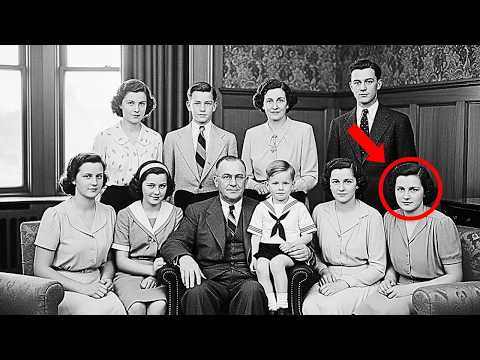
Inside, she found dozens of photographs of a young woman she’d never seen in any Ashford family history. Formal portraits, beach candids, school pictures—all featuring the same shy, uncertain face among the confident Ashford children. Then she found a 1938 family portrait. Eleven people posed elegantly, but Linda’s breath caught. Nine children surrounded the patriarch, yet published genealogies listed only eight. The young woman seated to her father’s right was a ghost. Linda turned the photo over. In faded ink: Ashford family Christmas 1938, complete. Complete? But who was this missing daughter?
Her hands trembled as she dug deeper. Letters, report cards, a birth certificate—Eleanor Marie Ashford, born March 15, 1918. School records from elite institutions, piano lessons, French tutoring. Then, abruptly, the trail stopped in 1941. No more photographs, no more letters. It was as if Eleanor had simply ceased to exist at age 23. At the bottom of the trunk, Linda found a medical invoice from November 1941. The procedure listed made her blood run cold: Prefrontal leucotomy, $200. Patient: E. Ashford. Referring physicians: Dr. James Watts, consulting Dr. Walter Freeman. The pioneers of the American lobotomy.
Linda sat back, the 1938 photograph shaking in her grip. This wasn’t just a missing piece of history. Eleanor Ashford had been lobotomized—and then erased from her family’s story. A young woman’s life stolen by a brutal procedure, all to protect a powerful family’s reputation. She pulled out her phone and called her supervisor. “I found something,” she said quietly. “Something the Ashfords never wanted anyone to see.”
The investigation into Eleanor’s forgotten life began the next morning. Linda spent a week assembling the Ashfords’ public image from the 1930s and 1940s—a carefully crafted narrative of American perfection. Richard Ashford, the patriarch, had built a banking fortune and political ambitions. Catherine, his wife, brought Mayflower lineage. Together, they created what newspapers called ‘America’s most promising family.’ Every public appearance was orchestrated, every photograph composed. But Eleanor appeared in very few articles. When she did, the descriptions were vague. A 1936 society column mentioned the Ashford daughters at a debutante ball but didn’t list Eleanor by name. A 1937 photograph at their Cape Cod estate showed her at the edge of the frame, partially obscured by a sister.
Linda contacted Dr. Harold Jennings, a medical historian at Boston University. She showed him the invoice and photographs. “This fits a pattern I’ve seen before,” Harold said, his expression grim. “Wealthy families in the 1930s and 1940s were obsessed with eugenics and genetic perfection. Any child who showed signs of intellectual disability or behavioral problems was seen as a threat to the family’s reputation.” He explained that Freeman and Watts promoted lobotomy as a miracle cure for everything from schizophrenia to rebellious behavior. “Wealthy families paid them enormous fees—$200 in 1941 would be about $4,000 today—to fix family members who didn’t fit the perfect image.”
Linda felt sick. “They mutilated a young woman to protect their reputation.” Harold nodded. “Yes, and it was legal, even considered progressive medicine at the time. The Ashfords would have been praised for seeking the most modern treatment available.” Linda returned to the archives, now searching specifically for Eleanor. She found private letters between Catherine Ashford and her sister. One from 1938 read: “Eleanor continues to struggle with her studies. The tutors say she tries hard but simply cannot grasp concepts her siblings master easily. Richard worries about her future. What marriage prospects does a slow girl have?” Another from 1940 was more troubling: “Eleanor’s episodes have become more frequent. She grows agitated easily, sometimes violent with the staff. Richard insists we cannot send her to an institution. The scandal would be unbearable. We must find another solution.”
The solution came in November 1941. After the lobotomy, Eleanor disappeared from all family records. Linda found a property deed from 1942: Richard Ashford purchased a private estate in rural Vermont, transferring ownership to a trust managed by a psychiatric care facility. The deed specified that one resident would live there permanently, all expenses paid by the Ashford family trust. Eleanor hadn’t died. She had been hidden away, institutionalized for life after the lobotomy destroyed her personality. The perfect Ashford family image had been built on the erasure of their most vulnerable member.
Linda needed to understand who Eleanor had been before the lobotomy. She contacted the historical societies of schools Eleanor attended. What she found painted a picture of a girl who had struggled but had been loved—until that love proved insufficient against her father’s ambition. A 1928 teacher’s note read: “Eleanor is a sweet, gentle child with a kind disposition. She struggles with mathematics and reading comprehension but shows talent in music and art.” By middle school, the gap had widened. A 1932 report card showed C’s and D’s across all subjects except music, where she earned an A. Linda found a heartbreaking letter from Eleanor to her mother, dated 1933: “Dear Mother, I’m trying my very best at school but the work is so hard. Patricia says I am stupid and that Father is ashamed of me. Please tell me you’re not ashamed. I love you. Eleanor” Catherine’s response was brief: “Dearest Eleanor, your father and I love you always but you must try harder. The Ashford name requires excellence. We cannot accept less from any of our children.”
Linda interviewed Margaret Sullivan, 94, who had been a housemaid at the Ashford estate from 1935 to 1943. “Eleanor was the sweetest of all those children,” Margaret said, her eyes glistening. “She wasn’t like the others. They were all so sharp, so clever with words. Eleanor was slower, gentler. She’d spend hours in the music room playing piano, the same simple pieces over and over. She loved the garden, loved animals. She’d talk to the dogs like they were people.” Margaret’s face darkened. “Mr. Ashford barely acknowledged her. He’d introduce his children to visitors—’This is Robert, headed to Harvard. This is William, top of his class.’ But he’d skip over Eleanor or just say ‘and Eleanor’ without any accomplishments listed. You could see it hurt her, the way her face would fall.”
As Eleanor got older, things got worse. “She’d have these episodes—she’d get frustrated when she couldn’t understand something and she’d cry or sometimes throw things. Not violent, just overwhelmed. But Mr. Ashford saw it as embarrassing behavior that needed to be controlled.” Linda showed Margaret the 1938 family photograph. “Look at Eleanor’s face,” Margaret said softly. “See how she’s sitting? She’s trying to make herself smaller, less noticeable. The others are all confident, looking straight at the camera. Eleanor’s turned slightly away, like she’s hoping no one will see her. That’s how she lived—trying to disappear.”
Linda found more evidence in private correspondence. A 1939 letter from Richard to his brother mentioned ‘the Eleanor problem’ explicitly: “She is 21 now and cannot be hidden much longer. Society expects her to debut, to marry, to contribute to the family standing, but she is incapable of any of this. Catherine insists we cannot institutionalize her. The stigma would be crushing. We need a solution that allows her to remain technically at home while ceasing to be a burden or embarrassment.” That solution was lobotomy—a procedure that would leave Eleanor docile, manageable, and unable to embarrass the family with her limitations.
The evidence was mounting. Eleanor had been a vulnerable young woman with developmental disabilities, struggling to meet impossible expectations, ultimately sacrificed to preserve her family’s perfect public image. Linda’s investigation now focused on the months leading up to November 1941, when Eleanor’s life was forever destroyed. What she discovered showed a family making a calculated decision to eliminate their problem through radical surgery.
She found correspondence between Richard Ashford and Dr. James Watts. The first letter, dated March 1941, was chillingly clinical: “Dear Dr. Watts, I write regarding my daughter Eleanor, age 23, who suffers from intellectual deficiency and increasing behavioral difficulties. I have read with interest your published papers on prefrontal leucotomy as treatment for various mental conditions. I would like to discuss whether Eleanor might be a suitable candidate for this procedure.” Dr. Watts responded enthusiastically: “Dear Mr. Ashford, I would be pleased to evaluate your daughter. We have had remarkable success treating cases similar to what you describe. The procedure is brief, recovery is quick, and results are generally quite satisfactory. Patients become more manageable and their distressing symptoms are eliminated.”
What Watts didn’t mention—what Linda knew from medical history—was that ‘manageable’ meant emotionally blunted, intellectually diminished, and often completely incapacitated. Lobotomy didn’t cure anything. It destroyed the parts of the brain responsible for personality, emotion, and complex thought. Linda contacted Dr. Patricia Brennan, a neurologist and medical ethicist at Massachusetts General Hospital. “This is horrifying but not unusual for the era,” Patricia explained. “In the 1940s, lobotomy was promoted as a miracle cure. Freeman and Watts performed thousands of procedures on people diagnosed with everything from schizophrenia to depression to simple disobedience, especially in women. Families were told their troublesome relatives would become calm and cooperative. What they weren’t told was that those people would lose their essential humanity.”
Linda found Eleanor’s pre-operative evaluation, written by Dr. Watts in October 1941. It described her as ‘a young woman of limited intelligence with episodes of emotional instability and oppositional behavior.’ “The tantrums were a young woman’s understandable frustration at being constantly criticized for limitations she couldn’t control,” Patricia said. “The oppositional behavior was probably her attempting to assert basic autonomy. None of it warranted brain surgery.”
Linda found Catherine Ashford’s diary entry from November 1941, written the day before Eleanor’s lobotomy: “Tomorrow we take Eleanor to the hospital. Richard assures me this is for the best, that the doctors are the finest in the country, that Eleanor will be happier afterward, calm and content instead of anxious and struggling. But my heart is heavy. She is my daughter. I remember her as a baby, so sweet and gentle. Am I betraying her by allowing this? Richard says I must think of the other children, of the family’s future. Eleanor’s condition threatens everything we’ve built. This is the only solution. God forgive me if I am wrong.”
The lobotomy was performed November 12, 1941, at George Washington University Hospital. The procedure took less than an hour. The invoice listed the fee—$200—and noted, “Procedure completed successfully. Patient transferred to recovery. Family notified.” Linda found one more document, a letter from Dr. Watts to Richard Ashford, written two weeks after the surgery: “Dear Mr. Ashford, I’m pleased to report that Eleanor’s recovery is proceeding as expected. She’s docile and cooperative, showing none of her previous emotional outbursts. As anticipated, there is some reduction in initiative but this should be acceptable given the elimination of her problematic behaviors. She will require long-term supervision, but should no longer present the difficulties you previously described.”
‘Reduction in initiative’ was medical euphemism for the destruction of Eleanor’s personality. She had been reduced to a manageable shell of herself. The Ashford family had purchased their perfect image at the cost of their daughter’s humanity. Linda needed to understand what happened to Eleanor after the lobotomy destroyed her cognitive abilities and personality. The trail led to a private psychiatric facility in Vermont, where Eleanor spent the remaining 64 years of her life in obscurity.
She contacted Meadowbrook Estates, which still operated as a long-term care facility. The director, James Patterson, was initially hesitant but agreed to share non-confidential information. “We have records going back to our founding in 1924,” James said over a video call. “I can confirm that a resident matching your description was admitted in December 1941 and remained here until her death in 2005.” Linda’s throat tightened. “2005? Eleanor lived until 2005?” “Yes. She was 87 when she died. She spent 64 years here.”
Linda did the math. Eleanor had lived through World War II, the Kennedy assassinations, the Civil Rights Movement, Vietnam, the moon landing, the fall of the Berlin Wall, 9/11. All of it experienced from inside an institution. Her mind destroyed by a procedure her father authorized. James continued, “Our records show she was a lobotomy patient, which was noted specifically because by the 1970s we stopped accepting such patients as attitudes toward the procedure changed. Her care was fully paid for by a family trust that makes payments to this day.”
“Can you tell me anything about her life here? What was she like?” James consulted his files. “The early records describe her as docile and compliant, showing little initiative or emotional response. She required assistance with all daily activities. She could walk and feed herself but needed prompting for basic tasks. She rarely spoke and showed minimal recognition of people or events.” Linda felt tears welling. This was what the Ashford family had done to their daughter—reduced her to a barely functioning shell, then hidden her away for life.
“Did anyone visit her?” Linda asked. “That’s interesting, actually. For the first 20 years there are no recorded visits at all. Then, starting in 1961, someone began visiting regularly, every few months. The visitor logs show R. Ashford signing in.” Robert Ashford—Eleanor’s younger brother who became a decorated Navy officer and later a senator. He had found his sister and visited her.
Linda located Robert’s personal papers at the Kennedy Library. Among them was a diary entry from June 1961: “Finally found Eleanor today. Took me months to track down where father had hidden her. Seeing her was the hardest thing I’ve ever done. She’s 43 years old but seems ancient, blank. She looked at me without recognition. I told her I was her brother, that I loved her, that I was sorry. She smiled vaguely but I don’t think she understood. What did we do to her? What did father do? I can never forgive this.”
Another entry from 1963, shortly after Robert lost his Senate bid: “Visited Eleanor today. Sometimes I tell her about my life even though I don’t think she understands. I told her about the campaign, about losing. Told her maybe it’s justice. Maybe the Ashford family doesn’t deserve power after what we did to her. She just sat there, that empty smile on her face. I’m the only one who visits. The others have completely forgotten her or maybe they choose not to remember.”
Linda found more diary entries spanning decades. Robert visited Eleanor at least three times a year until his death in 1998. He brought her books, music recordings, flowers—gifts she probably couldn’t appreciate but that seemed to ease his guilt. A 1982 entry was particularly poignant: “Eleanor is 64 now. I’m 61. We’re both old. I look at her and try to remember the girl she was before the lobotomy. I have a few memories. Her playing piano, her gentleness with animals, her sweet smile. But mostly I remember father’s shame, mother’s worry, all of us pretending she didn’t exist. Then one day she was gone and when she came back Christmas 1942, she wasn’t Eleanor anymore. She was a ghost. We made her a ghost to save ourselves embarrassment. I will carry this shame until I die.”
Linda contacted the Vermont facility again and asked about Eleanor’s final years. “By the 1990s, she required full nursing care,” James explained. “She developed dementia in addition to the cognitive impairment from the lobotomy. She died peacefully in 2005 with Mr. Ashford present.” “Robert was with her when she died?” “Yes, he’d been in declining health himself but insisted on being notified if her condition worsened. He was holding her hand when she passed.”
Eleanor was buried in a private cemetery in Vermont. Her grave marked simply: Eleanor Marie Ashford, 1918–2005. No mention of her family’s prominence, no recognition of the injustice done to her. Just a name and dates marking a life stolen and hidden. The perfect Ashford family had hidden their imperfect daughter for 64 years. And only one of them had cared enough to remember.
Linda now investigated why Eleanor’s siblings, except Robert, had completely erased her from their lives. What she discovered revealed a family conspiracy of silence that lasted generations. She found a remarkable document—minutes from a family meeting held in January 1942, two months after Eleanor’s lobotomy. All eight surviving Ashford children attended, along with Richard and Catherine. The meeting was documented by the family lawyer, presumably to create a legal record of decisions made.
The minutes were chilling in their clinical detachment. Meeting convened at the Ashford residence, Boston, January 15, 1942. Present: Richard and Catherine Ashford, and children Robert (24), William (23), Kathleen (22), Patricia (20), Edward (18), Thomas (16), Jean (14), and Margaret (12). Subject: Family matters regarding Eleanor. Richard’s statement, recorded verbatim, laid out the family’s official position: “Eleanor has been placed in a private facility where she will receive excellent care for the remainder of her life. The procedure she underwent was necessary for her own well-being and peace of mind. However, given the sensitive nature of her condition and treatment, we have decided as a family that Eleanor’s situation will not be discussed publicly. When asked about family composition, we will refer to our eight children. Eleanor’s name will not appear in any public family documents or photographs going forward. This is not to diminish Eleanor, but to protect her privacy and dignity.”
The lawyer’s notes indicated that all siblings agreed to this decision—though Robert’s agreement was marked with an asterisk and the notation “R. Ashford expressed reservations, but will comply with family decision.” Linda found evidence that this conspiracy of silence was rigorously enforced. When Kathleen published a memoir in 1968 titled Growing Up Ashford, Eleanor was completely absent. The book described growing up as one of eight children in a prominent Boston family, detailing elaborate family vacations, educational experiences, and social events. Eleanor appeared in none of these stories.
Patricia, interviewed for a society magazine in 1975, discussed ‘my seven siblings’ and described family dinners where ‘all eight of us children gathered around the table.’ Eleanor had been erased so completely that Patricia didn’t even have to consciously lie. She had simply rewritten her own history to exclude her inconvenient sister.
Linda contacted several Ashford grandchildren. Most had never heard of Eleanor. One, Richard Ashford III, Robert’s son, agreed to an interview. “I never knew about Eleanor until I was in my 30s,” he said. “Dad mentioned her once after he’d been drinking. He was crying. I’d never seen my father cry before.”
Richard explained the family pact of silence. “My aunt Patricia told me I was mistaken, that Dad only ever had seven siblings. It was like they’d collectively decided Eleanor never existed.” But Robert had broken that pact. He visited Eleanor for nearly forty years, carrying a guilt he could never shed.
Linda knew she now held the power to restore Eleanor to history. She convened the library’s ethics board. After hours of debate, they agreed: she could publish, with guardrails. She would focus on Eleanor as a victim, not a scandal. She would offer living descendants a chance to respond.
Her article, The Forgotten Ashford, was published in November 2024. It went viral within hours. Lobotomy survivors came forward, including Dorothy Chen, who had been lobotomized at seventeen. “Seeing Eleanor’s story called what it was—abuse—is the first time I felt like maybe I was the victim, not the problem.”
Six months later, Linda stood at Eleanor’s grave as a new headstone was unveiled. It read: Victim of medical injustice, erased by her family, now remembered with love and sorrow. Robert’s final diary entry had feared Eleanor would vanish completely. He was wrong.
As Linda walked back to her car, she looked once more at the flowers surrounding the grave. In the 1938 photograph, Eleanor had tried to make herself invisible. Now, finally, she was seen. What other forgotten voices are still waiting in the attics of history for someone to find them?
Report this article
Select a reason for reporting:






