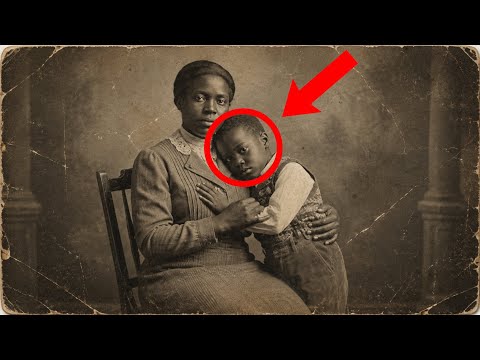
Dr. Evelyn Chase had examined thousands of photographs in her career as a medical historian at Johns Hopkins University, but she never expected to make a diagnosis from an image taken 93 years ago. The photograph arrived on a Tuesday morning in March 2024, part of a collection donated by the estate of a retired postal worker in Baltimore. It was a simple portrait: a black woman seated in a wooden chair, her arms wrapped protectively around a boy who stood beside her, his head resting against her shoulder. The image measured 5 by 7 inches, printed on thick paper stock that had yellowed at the edges. A photographer’s stamp on the back read, “Morrison Sons Photography, Baltimore, Maryland, July 1931.”
Evelyn handled it carefully, noting the formal composition typical of Depression-era portraits. The woman appeared to be in her mid-30s, wearing a dark dress with a white collar. Her expression was serene but watchful, her eyes gazing directly at the camera with quiet dignity. The boy looked about 9 years old, dressed in knee-length pants, a white shirt, and suspenders. His mother’s embrace was tender but firm, one hand resting on his chest, the other on his shoulder, holding him close as if she could protect him from the world through sheer force of love.
Evelyn set up her high-resolution scanner, a piece of equipment that had revolutionized historical medical research by revealing details invisible to the naked eye. She had used it to identify smallpox scars in Civil War photographs, detect signs of tuberculosis in Victorian family portraits, and document the physical toll of industrial labor on early 20th-century workers. The scanner could capture skin conditions, bone deformities, dental problems—anything that left a visible mark.
She placed the photograph face down on the glass surface and initiated the scan. The machine hummed softly as light swept across the image. Evelyn turned to her computer expecting nothing more than a clearer version of what she had already seen—another anonymous family, their names lost to time, their story limited to this single frozen moment.
The digital image appeared on her screen. Evelyn began her routine examination, adjusting the contrast and brightness, zooming in to examine details. She studied the woman’s hands first, looking for signs of manual labor. Then she examined the boy’s posture, his height relative to his mother, his general health indicators. Then she zoomed in on his face.
Her breath caught. She leaned closer to the screen, certain she was seeing an optical illusion or flaw in the scan. But as she increased the magnification, the detail only became clearer. The boy’s eyes—there was something profoundly unusual about them.
Evelyn reached for her phone and dialed her colleague, Dr. Marcus Webb at the Atlanta Historical Society. “Marcus,” she said, her voice tight with urgency. “I need you to look at something. I think I just found a child with aniridia in a 1931 photograph.”
Marcus arrived at Johns Hopkins the next morning, driving through early rush hour traffic from Washington, D.C., where he had been consulting on another project. He found Evelyn in her office, the photograph displayed on her large monitor, zoomed in to show the boy’s face in startling detail.
“Look at his eyes,” Evelyn said without preamble. “Look closely.”
Marcus leaned in, studying the image. The high-resolution scan had captured extraordinary detail—the texture of the boy’s skin, individual strands of hair, the weave of his shirt fabric. But it was the eyes that commanded attention. Where there should have been a colored iris surrounding the pupil, there was almost nothing. The pupils appeared enormous, dark pools that dominated his eyes, with only the faintest ring of tissue visible around them.
“Jesus,” Marcus whispered. “That’s aniridia.”
“Complete or nearly complete absence of the iris,” Evelyn confirmed. “One of the rarest congenital eye conditions. I’ve only seen it once in person, in a patient at a medical conference. But this—this is 1931. This child would have been almost blind in bright light. The iris controls how much light enters the eye. Without it, he would have been severely photosensitive, probably had nystagmus, possibly glaucoma.”
Marcus sat down heavily in the chair beside her desk. In 1931 Baltimore, a black child with a severe visual impairment during the Great Depression. They both understood the implications. This was a time when even basic medical care was largely unavailable to black families. Hospitals were segregated. Many doctors refused to treat black patients. Specialized ophthalmological care for a rare condition like aniridia would have been nearly impossible to access even if the family had known what was wrong.
“Look at how his mother is holding him,” Marcus said softly. “That’s not just affection. That’s protection. She’s shielding him.”
Evelyn zoomed out to show the full photograph again. The mother’s embrace took on new meaning now. The way she held the boy wasn’t casual. It was deliberate—positioning him slightly behind her, her body a barrier between him and the camera’s flash, which would have been painfully bright for eyes without irises to regulate the light.
“She knew,” Evelyn said. “She understood that bright light hurt him. Look at his posture. He’s leaning into her. His eyes are slightly downcast. He’s avoiding looking directly at the camera.”
“Can you tell if he’s squinting?”
Evelyn increased the magnification again, focusing on the boy’s face. His eyelids were indeed slightly narrowed—not in a smile, but in what appeared to be a protective reflex against the photographer’s lights. “He’s definitely uncomfortable with the light,” she confirmed. “But he’s holding still for the photograph. He’s being brave for his mother.”
They spent the next hour examining every detail of the image. The boy’s hands resting on his mother’s arm showed no signs of injury or scarring, suggesting he had been carefully supervised and protected from the accidents that befell many visually impaired children. His clothing was clean and well maintained. His hair was neatly trimmed. Despite what must have been significant challenges, his mother had clearly devoted herself to his care.
“We need to find out who they were,” Marcus said finally. “This photograph tells an incredible story, but we’re only seeing part of it. Who was this woman? What was her son’s name? How did they manage? Did he survive?”
Evelyn nodded, already opening her database of historical records. “The photographer’s stamp says Morrison Sons, Baltimore, July 1931. That’s our starting point.”
Morrison Sons Photography had operated in Baltimore’s Pennsylvania Avenue district from 1928 to 1957, serving the city’s black community during an era when most white-owned studios refused to photograph black clients—or relegated them to separate, inferior facilities. The studio had been owned by Isaac Morrison, a free black man who had learned photography as an apprentice in the 1890s and passed the trade to his three sons.
Evelyn contacted the Maryland Historical Society and learned that Isaac Morrison’s grandson, now 86 years old, still lived in Baltimore and had donated his grandfather’s business records to the society’s archives in 2003. His name was Thomas Morrison, and when Evelyn called to explain her research, his voice brightened with interest.
“My grandfather photographed thousands of families,” Thomas said. “He believed that black families deserved beautiful portraits just like anyone else. During the Depression, he sometimes worked for barter—food, clothing, services—because he understood how important it was for people to have a record of themselves. To prove they existed and mattered.”
“I’m looking for a photograph from July 1931,” Evelyn explained. “A mother and son. The boy would have been about nine years old, with a very distinctive eye condition.”
Thomas was silent for a moment. “A boy with unusual eyes? I think I might remember a story about that. Can you send me the photograph?”
Evelyn emailed the image. Ten minutes later, her phone rang.
“That’s Sarah and William,” Thomas said, his voice thick with emotion. “Sarah Johnson and her son William. My grandfather talked about them. He said William was one of the bravest children he’d ever photographed.”
Evelyn’s hands trembled as she took notes. After ninety-three years, the anonymous faces finally had names. “What else did your grandfather say about them?”
“William couldn’t tolerate bright light. My grandfather usually used flash powder for indoor portraits—it created a bright, sudden light that illuminated the subject. But for William, he used natural light from the window instead, even though it meant a longer exposure time. He said the boy had to hold very still for almost thirty seconds, and he never complained once. And Sarah—Mrs. Johnson—she held her son the entire time, keeping him steady and calm.”
Marcus, listening on speakerphone, leaned forward. “Do you know what was wrong with William’s eyes?”
“My grandfather didn’t know the medical term. He just knew the boy was nearly blind in daylight but could see better at dusk. People in the neighborhood called him ‘Night Eyes’ because he could navigate in the dark better than most sighted people.”
Evelyn felt her throat tighten. That detail confirmed the aniridia diagnosis. Without irises to constrict in bright light, William’s eyes would have been overwhelmed during the day—but in low-light conditions, when other people’s irises would dilate to let in more light, William’s permanently dilated pupils would have given him an advantage.
“Do you know what happened to them?” Marcus asked.
“I don’t know details, but I know Mrs. Johnson cleaned houses for white families in Roland Park. My grandfather said she was saving money for something important, but he didn’t know what. The photograph—he charged her fifty cents, which was a lot of money in 1931. She paid in nickels and dimes she’d been saving. He said she told him she needed a picture of her son while he could still see well enough to remember being photographed.”
The room fell silent. The implication was devastating. Sarah had known her son’s vision was deteriorating. She had scrimped and saved during the Depression to capture this one image—this proof that she had a son, that he had existed, that they had loved each other.
“We need to find out more,” Evelyn said quietly.
The search for Sarah Johnson proved harder than finding the photograph. Census records from 1930 and 1940 listed hundreds of Sarah Johnsons in Baltimore, many with children. Evelyn narrowed the possibilities: a black woman, likely widowed, working as a domestic servant, with a son named William born around 1922.
She found them in the 1930 census, enumerated in April—just fifteen months before the photograph. “Johnson, William, black, male, age eight, son, unable to attend school.” That notation struck Evelyn hard. For William, it almost certainly meant his visual impairment was too severe for the segregated, under-resourced black schools of Baltimore to accommodate.
Marcus arrived from Atlanta three days later with records from Baltimore’s Board of Education archive. Among them was a letter written by Sarah Johnson to the principal of Public School 112, dated September 1929.
“Dear Mr. Patterson, I am writing to ask if my son William can attend your school. He is seven years old and very smart. His eyes are not like other children’s eyes and he cannot see well in bright light, but he can learn. Please give him a chance. Respectfully, Sarah Johnson.”
Clipped to it was the principal’s response: “I regret to inform you that Public School 112 cannot accommodate a child with your son’s condition… I recommend you contact the Maryland School for the Blind.”
But that school was segregated too, and William’s vision was too poor for regular school yet too functional for the blind school. He fell through every gap in the system.
So Sarah taught him herself. Marcus found her name in the records of the Enoch Pratt Free Library—a borrowing card issued in 1928, followed by hundreds of children’s educational books over the next decade. Sarah, exhausted from long days cleaning wealthy white families’ homes, spent her evenings reading to William by lamplight, teaching him everything the schools had refused to provide.
Evelyn sent the scan to Dr. Patricia Chen, chief of pediatric ophthalmology at the Wilmer Eye Institute. Chen confirmed complete aniridia in both eyes. “Without treatment for the glaucoma that almost always develops, he would have experienced progressive vision loss. By his late teens, he likely would have been completely blind.”
Marcus found William’s name in Baltimore City Hospital ledgers: “Johnson, William, colored, age 18, admitted March 15, 1940. Diagnosis, acute glaucoma, both eyes.” The attending physician, Dr. Samuel Winters, had kept a journal. His entry from April 2, 1940, read: “Surgery was refused. Hospital board stated that experimental procedures should not be performed on colored patients… William is now completely blind. I’m ashamed of my profession today.”
But the trail didn’t end there. The Maryland Workshop for the Blind listed him in May 1940—“exceptionally intelligent student, reads braille fluently, self-taught.” By November he was hired at the Reliable Broom Company, with a placement note that read: “Mother Sarah accompanies him to and from work daily.”
Then came Grace Patterson, ninety-one years old, blind since childhood, who had known William at the workshop. “He was determined to live a full life, and he encouraged everyone around him to do the same.” William moved to New York in 1946 to train as a music teacher. He graduated in 1949, taught for thirty-six years, married, and raised two daughters. Sarah joined him in 1950 and died in 1968, surrounded by family.
“He always said his mother taught him that disability was just a different way of being in the world, not a limitation on what he could achieve,” Grace said. William died in 1992 at seventy.
Six months later, Evelyn stood in the National Museum of African American History and Culture as visitors gathered around the 1931 photograph, now enormously enlarged. Beside it hung a 1960 image: William at a piano, Sarah’s hand resting on his shoulder—an echo of that first embrace.
The exhibition text read: This photograph is an act of resistance, a black mother’s refusal to accept that her disabled child was disposable.
That evening, Evelyn returned to her office and opened the file of unexamined photographs waiting for her attention. Somewhere in those images, other families were waiting to be found. Other mothers had fought battles no one recorded.
She intended to find them—one photograph at a time—until every forgotten face had a name and every act of love had a witness.
So here is the question I leave with you: how many Sarah Johnsons are still hiding in our archives, and whose story will you help bring into the light?
Report this article
Select a reason for reporting:






