The transport truck rumbled to a stop on a dirt road that seemed to lead nowhere and everywhere at once. Alfreda Hartman pressed her face against the canvas, desperate for her first glimpse of the prisoner-of-war camp where she and 47 other German women would spend an uncertain future. What she saw instead made her forget to breathe.
Wheat. An ocean of golden wheat stretching to a horizon so distant it seemed to curve with the earth itself. No bomb craters scarred the fields. No burned villages dotted the landscape. Just grain rippling in waves under a sky so vast and blue it felt like drowning in reverse.
“Is this still North America?” Greta Lindemann whispered beside her, her voice carrying the disbelief that had seized them all.
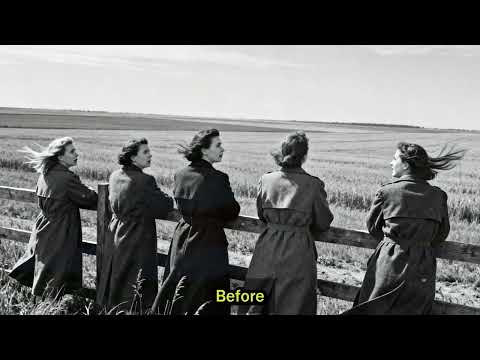
The young communication specialist from Dresden had spent the last two years in underground bunkers, coordinating messages as Allied bombs reduced her city to rubble. She had not seen an intact field since 1943.
The truck’s canvas flap pulled back fully, revealing their destination. Prairie Vista Camp sat like a small collection of wooden buildings against the incomprehensible vastness of the Saskatchewan landscape. But it was not the camp that captured their attention. It was everything around it.
Fields that seemed to have never known war. Farmhouses with intact roofs. Grain silos that stood tall and full instead of collapsed and empty.
Sigrun Wolf, the youngest at twenty, began to cry silently. The administrative clerk from Hamburg had processed food ration cards for the last year of the war, watching allocations shrink from inadequate to impossible. She knew exactly how many grams of bread each German citizen was supposed to receive. She could calculate in her head how many people could be fed by a single one of those distant silos.
The numbers made her weep.
Lieutenant Myrtle Kensington stood waiting as the women climbed down. Her Canadian uniform crisp despite the prairie wind. She was younger than Alfreda had expected, perhaps thirty, with sharp eyes that seemed to take in everything at once.
“Welcome to Prairie Vista Camp. I know this must be overwhelming, but you are safe here. You will be treated according to the Geneva Convention and with the dignity that all persons deserve.”
Alfreda heard the words, but she could not stop staring past the lieutenant at the fields beyond. In Berlin, she had picked through rubble for bits of coal. She had watched neighbors trade family heirlooms for half a loaf of bread. She had believed the propaganda that told her America and its allies were starving, desperate, on the verge of collapse.
But this land had never known hunger. This earth had never been poisoned by war. And standing on its soil, Alfreda Hartman felt the first crack in everything she had been taught to believe.
Inside the barracks, the smell of fresh pine lumber and soap replaced the damp concrete of Berlin’s bunkers. Greta sat on her assigned bunk, staring at the clean wool blanket as if it might disappear. In Dresden, she had slept under a coat and newspapers for the last six months before her capture.
“They told us the Canadians were rationing worse than we were,” Hedwig Bäumler said quietly. The medical auxiliary from Munich had treated soldiers dying not just from wounds, but from malnutrition. She had watched men waste away on 500 calories a day. “They said the Allied nations were on the verge of collapse.”
Ingeborg Schwarz moved to the window, looking out at the impossible landscape. At twenty-eight, she was one of the oldest. A supply coordinator from Stuttgart, she had spent years trying to stretch inadequate resources across desperate needs.
“I calculated supply chains,” she said, her voice hollow. “I knew exactly how little food we had, but I believed we were all suffering equally. I thought their people were starving, too.”
The view from the window contradicted every calculation, every report, every propaganda broadcast they had ever heard. In the distance, a farmer drove a tractor across his field, the machine moving easily across land that showed no signs of the total war economy they had lived under. Cattle grazed in green pastures. A farmhouse stood intact, smoke rising from its chimney in a peaceful curl.
Krimhild Nömann, the nurse from Cologne, joined Ingeborg at the window. “My hospital ran out of morphine in 1944,” she said softly. “We performed amputations with whatever we could find. I held down screaming boys while surgeons cut off their legs with alcohol as the only anesthetic.” She pressed her palm against the glass. “And they have cattle grazing. Just grazing like there is no war at all.”
Rosa Engel, the mechanic from Frankfurt, sat on her bunk with her head in her hands. She had spent the last two years cannibalizing broken vehicles to keep a few operational, scavenging for parts, making do with scraps.
“I rebuilt engines with pieces held together by wire and prayer,” she said. “And I saw that tractor. It is newer than anything we had even before the war started.”
Adelheid Klene, the youngest at nineteen, spoke for the first time since their arrival. The telegraph operator from Nuremberg had transmitted countless messages about victories that never came, about resources that did not exist, about an enemy supposedly on the verge of defeat.
“They lied to us,” she whispered. “About everything.”
The silence that followed was not peaceful. It was the sound of forty-eight women beginning to understand that they had fought for a cause built on deception, that their sacrifices had been based on lies, and that the enemy they had been taught to hate had never suffered the way they had been told.
Then the dining hall doors opened, and the truth became edible.
The long wooden tables were arranged in neat rows, and Sergeant Angus McTavish, a broad-shouldered Scot with a thick accent, directed the women to their seats with gestures more than words. His demeanor was neither cruel nor friendly, simply professional. But it was what appeared on the tables that made Alfreda feel she had stepped into a propaganda film.
Except this was real.
Fresh bread. Not the gray sawdust-extended loaves they had choked down in Germany, but actual bread with a golden crust and soft white interior. Butter—real butter, not the synthetic substitute made from coal derivatives. Portions of meat that would have fed a German family for three days. Vegetables that looked like they had been harvested that morning.
Hedwig stared at her plate as if it might be poisoned. As a medical auxiliary, she had calculated nutritional values for dying patients, deciding who might survive on minimal calories. This single meal contained more nutrition than most German civilians saw in a week.
“This cannot be standard rations,” she said quietly. “This must be special. For show.”
Lieutenant Kensington overheard her from the doorway and approached, her expression unreadable. “This is standard prisoner rations, according to Geneva Convention requirements,” she said in perfect German, startling several of the women. “You will receive three meals like this every day.”
Greta picked up the slice of bread with trembling fingers. She had not seen bread this white since childhood, before the war, when Germany still imported wheat from abroad. She bit into it and immediately began to cry. It tasted like bread was supposed to taste—like something made to nourish rather than merely to fill a stomach before hunger returned.
Similar reactions rippled around the table. Sigrun ate slowly, methodically, as if trying to memorize every flavor. Ingeborg simply sat with her fork in her hand, unable to begin. Krimhild ate quickly, then felt sick—her stomach unused to real food after years of deprivation. Private Merl Jacobson, a young guard with a farm background, noticed her distress and brought a glass of water.
“Slow. Eat slow. Body needs time,” he said in halting English. His kindness, simple and unasked for, made her cry harder.
Rosa finally spoke what they were all thinking. “Our families are starving right now in Germany. People are eating grass and tree bark, and we are sitting here with butter. Real butter.” The guilt in her voice was suffocating.
Alfreda set down her fork, unable to continue. She thought of her mother in Berlin, her sister, her nephew—who would be six now, if he had survived. She thought of the ration cards that promised two hundred grams of bread per person per day, when bread was available at all.
“They did not just lie about the enemy,” she said quietly. “They lied about everything.”
The next morning, Lieutenant Kensington stood before the assembled prisoners, her posture military but her expression thoughtful. When she began to speak, it was not in English, but in fluent, unaccented German that could have come from any street in Hamburg or Berlin.
“My name is Lieutenant Myrtle Kensington. My parents immigrated to Canada from Bavaria in 1922. I grew up speaking German at home and English everywhere else.” She paused, letting the words settle. “I understand that you are confused and frightened. I want you to know that while you are prisoners of war, you will be treated with dignity and respect, according to international law.”
Alfreda felt something shift in her chest. This woman—their captor, their enemy—spoke German like a native, with the care of someone who understood not just the language but the culture behind it. There was no mockery in her tone, no condescension. Just clear, direct communication.
Greta raised her hand hesitantly, as if still in school. “May I ask a question, Lieutenant? Why did your parents leave Germany?”
Myrtle’s expression softened slightly. “They saw what was coming. My father was a university professor who lost his position for refusing to join the party. They left before leaving became impossible. They chose Canada because of its openness, its land, its promise of a new beginning.”
The implications hung heavy in the air. Her parents had seen the danger before most Germans even recognized it existed. They had escaped what these women had lived through.
Sigrun spoke next, her voice barely above a whisper. “Do you hate us for what Germany became?”
Myrtle considered the question carefully. “I hate what was done in Germany’s name. I hate the ideology that led to this war. But you are individual women who made choices based on limited information in impossible circumstances. My job is not to judge you. My job is to ensure your safety and well-being while you are in our custody.”
Hedwig stood slowly. “Lieutenant, may I ask about your medical facilities? I am trained as a medical auxiliary. If there is work I can do, I would prefer to be useful.”
“We have a camp physician, but he could use assistance. I will arrange for you to meet with him.” Myrtle made a note on her clipboard. “Anyone else with specialized skills who wishes to work may submit a request. Productive activity makes the time pass more easily.”
Rosa raised her hand. “I am a mechanic. If you have equipment that needs maintenance—”
“We do. I will arrange that as well.”
Ingeborg watched this exchange with growing wonder. In German camps, captured Russians had been worked to death. Captured British and Americans had been treated marginally better, but still as enemies deserving only the minimum required by law. Yet here was this Canadian officer of German descent, offering them work not as punishment but as opportunity.
After the assembly, Alfreda approached Myrtle cautiously. “Lieutenant, your German is remarkable. Better than mine, and I was born in Berlin.”
Myrtle smiled slightly. “My mother insisted we maintain our language and culture even here. She said that Germany and its government were not the same thing, and that someday the government would fall but the culture would remain.”
“Your mother was very wise,” Alfreda said quietly.
“She was,” Myrtle replied. “And she would want me to tell you that what you were is not what you must remain.”
Three weeks later, the mail arrived on a Thursday afternoon. Corporal Marguerite Lefèvre distributed letters to those fortunate enough to receive them, her French-accented English soft with sympathy. Only twelve of the forty-eight women received correspondence. The rest sat quietly, pretending not to watch.
Ingeborg held her letter from Stuttgart with shaking hands. It was from her younger sister, Monika, written on paper so thin it was nearly transparent, the ink pale and diluted to make it last longer. She read it once quickly, then again more slowly, her expression growing more troubled with each line.
“Everything is fine here,” her sister had written. “We are managing well. Do not worry about us.” Ingeborg set the letter down. “She is lying,” she said flatly. “Every word is a lie designed to spare me worry.”
But the lies could not survive the wheat. The harvest brought the truth home—grain trucks, full silos, families who had never known hunger. By December, the war was six months over. The administrative machinery of peace caught up: transport to Hamburg would leave on the fifteenth. Those who wished to return should submit their names.
That evening, Creamhild received a letter from a neighbor. Her brother had died in October—not from his wounds, but from hunger. “If I return, what am I returning to?” she whispered. “A grave I cannot even locate.”
Alfreda looked around the common room at the women who had become her family. “They lied to us about everything,” she said. “But this land never learned how. I choose to stay.”
Thirty-two women stayed. Sixteen boarded the truck for Germany, and the wheat closed behind them like a door.
Years later, Alfreda stood in her own kitchen, watching her daughter wash mason jars. “I chose to plant seeds in fertile soil,” she said, “rather than scatter them on poisoned ground.”
So here is the question left standing at the fence line, under that impossible sky: if you had been on that truck in 1945, which road would you have taken—and could you have forgiven yourself for either?
Report this article
Select a reason for reporting:






