On a quiet summer morning in rural Wisconsin, 1914, smoke rose from Frank Lloyd Wright’s Taliesin while breakfast plates cooled and seven people were hunted inside their own home. But why? This was not an accident. The eruption of jealousy, secrecy, and negligence tied to a forbidden household, an isolated estate, and an architect who believed he could design a private world beyond consequence. Tonight we trace how Taliesin rose as a masterpiece, burned as a crime scene, and survived as a legend, asking whether genius can ever outrun the human cost built into its walls.
Frank Lloyd Wright did not believe in compromise. By 1909, he had already reshaped American architecture. His prairie houses sat low to the earth, horizontal lines extending into landscapes, rooms flowing into one another without Victorian walls boxing families into separate chambers. He called it organic architecture. Critics called it radical, clients called it brilliant, but brilliance in public does not guarantee peace in private.
Wright was 42 years old, married to Catherine Tobin for 20 years, father to six children. The marriage had become a structure he could no longer inhabit. He felt trapped by domesticity, suffocated by Oak Park’s suburban rhythms, restless inside the very houses he had designed to liberate others. The prairie style freed space. It could not free him.
Then came Mamah Borthwick. She arrived at his studio in 1903 as a client alongside her husband, Edwin Cheney. They wanted Wright to design their home. Mamah was 30 years old, university educated, fluent in multiple languages, translating Swedish feminist texts that argued women deserved intellectual lives beyond motherhood. She read Ibsen. She questioned convention. She saw marriage not as destiny, but as negotiation. Wright saw her and recognized something he had been designing toward his entire life.
Their affair began quietly. Meetings extended beyond architecture. Conversations deepened past floor plans. By 1909, the secret had become unsustainable. That autumn, Wright abandoned his family and left for Europe with Mamah. She left her husband and two young children. Both walked away from everything respectable society demanded they protect.
The scandal detonated. Newspapers called Wright a deserter, a home wrecker, an egomaniac who seduced a married woman and destroyed two families for selfish desire. Mamah was branded worse, an adulteress, an unnatural mother, a woman who chose passion over her own children. The condemnation was relentless, public, and unforgiving.
They spent over a year abroad, traveling through Germany and Italy while Wright worked and Mamah translated. But exile, however romantic, could not be permanent. By 1911, they returned to America, unmarried, unwelcome in polite society, and determined to build a life together anyway.
Wright chose the landscape of his childhood. He had been raised in the valleys outside Spring Green, Wisconsin, among Welsh farmers and rolling hills that turned golden in autumn. His mother’s family, the Lloyd Joneses, had settled there decades earlier, establishing a tight religious community built on land, labor, and Unitarian conviction. Wright had spent summers working those fields as a boy, learning to see how buildings could grow from the earth rather than sit upon it.
Now, he would return not as the prodigal son, but as the defiant architect. He purchased land on a hillside his family owned, overlooking the Wisconsin River Valley. The site offered everything he needed: isolation, beauty, distance from judgment. Here, he would design a home for himself and Mamah, a private world where their love could exist without apology, a masterpiece that answered his critics not with words, but with stone and light.
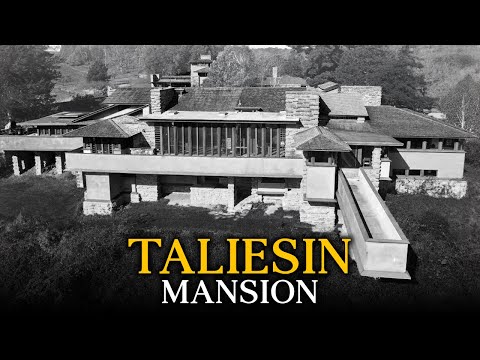
He called it Taliesin, a Welsh word meaning “shining brow.” Construction began in 1911. Wright designed the house to emerge from the hill itself, long and low, hugging the ridgeline as though it had always been there. Limestone walls rose from local quarries, the same golden stone that formed the valley’s bedrock. Cedar shingles covered the roofs, dark and weathered. Windows stretched in continuous bands, bringing the landscape inside. Every room opened to another, space flowing without separation, privacy dissolving into shared intimacy.
This was not a house; it was a manifesto. Wright built Taliesin to prove that beauty could be lived, that architecture could shelter love society refused to recognize, that a man and a woman could create their own world and survive inside it. He designed work spaces for himself, quiet rooms for Mamah’s translations, gardens that terraced down the hillside. He added farm buildings, stables, and staff quarters. Taliesin became more than a residence. It became an estate, a working farm, a creative laboratory.
And it required everything. Wright poured his savings into construction. He borrowed money. He sold property. He worked obsessively, traveling to Chicago and beyond for commissions that could fund his vision. Mamah oversaw the household, managed the staff, and endured the isolation that came with their choice. Local townspeople rarely visited. Former friends kept their distance. The Lloyd Jones family, devout and traditional, offered land but little warmth.
Taliesin rose anyway, stone by stone, room by room. By 1913, the estate was complete. Visitors who braved social disapproval to see it left stunned. Taliesin was unlike anything built in America. The house did not dominate the hillside. It joined it. Rooms glowed with natural light. Fireplaces anchored living spaces with massive stone hearths. Long sight lines carried the eye across valleys toward distant ridges. Inside and outside blurred into a single, continuous experience of shelter and landscape merged.
Wright had done it. He had built paradise on his own terms. But paradise is not self-sustaining.
Taliesin gleamed on its hilltop, serene and self-contained. From the valley below, it looked like a dream made stone. But dreams require labor, maintenance, money, and people willing to sustain them.
The estate operated as a sealed world. Wright designed it that way, isolating his sanctuary from a society that condemned him. But isolation demands infrastructure. Food had to be grown or delivered. Meals had to be cooked. Rooms had to be cleaned. Fireplaces required constant wood. Livestock needed tending. The farm produced some of what Taliesin consumed, but not everything. Supplies arrived from Spring Green, brought up the hill by staff who lived on the estate or nearby.
Wright was rarely there. His architecture practice demanded travel. Commissions across the Midwest and beyond required his presence, his vision, his relentless perfectionism. He would leave Taliesin for days or weeks, chasing projects that funded the estate’s existence, leaving Mamah alone in their refuge. She managed the household in his absence, a role that combined intellectual solitude with domestic supervision, translating feminist theory while coordinating servants and maintaining the rhythms of a working estate.
The household staff lived in separate quarters, a collection of rooms attached to the main residence, but distinctly apart. This was standard for estates of the era, a physical hierarchy that sorted family from labor, intimacy from service. But at Taliesin, that separation carried additional weight. The staff were not merely employees. They were witnesses to a scandal, participants in a household society had declared illegitimate. Most stayed out of loyalty or necessity. A few stayed out of something darker.
In the summer of 1914, a man named Julian Carlton joined the staff as a combination butler and handyman. He was from Barbados originally, had worked in Chicago, and arrived at Taliesin with his wife Gertrude, who took a position as cook. Carlton was educated, well-spoken, and capable. He managed household tasks with precision. He served meals. He maintained the estate’s systems.
But something was wrong. Other staff members noticed it first. Carlton grew increasingly withdrawn. He complained about mistreatment, though accounts differ on what that meant. Some said Wright’s absences left him feeling unsupervised and resentful. Others suggested racial tension simmered beneath Taliesin’s progressive facade, that Carlton faced prejudice from local workers who saw him as an outsider twice over, black and foreign in rural Wisconsin. Still others claimed he simply resented Mamah, that he found her authority illegitimate, a woman giving orders in a household built on sin.
The truth likely contained elements of all three. What is certain is that Carlton felt trapped. He had no family nearby, few friends, no community beyond the estate’s borders. His wife Gertrude depended on their positions for income. Leaving meant unemployment in an economy that offered black workers few options and fewer protections. Staying meant enduring whatever grievances gnawed at him daily, real or perceived, in a house isolated from oversight or intervention.
Taliesin’s beauty had always depended on distance. Now that distance was becoming dangerous.
The estate’s design, so celebrated for its openness, contained hidden vulnerabilities. Nearly every surface was combustible. Cedar shingles covered the roofs. Wood paneling lined interior walls. Furniture was handcrafted from oak and walnut. The heating system relied on massive fireplaces that burned logs throughout Wisconsin’s brutal winters. Kerosene lamps provided light before electricity reached the valley. Wright had chosen these materials for their natural warmth, their connection to the landscape, their organic honesty. But honesty does not fireproof a home.
The layout itself created risks. Taliesin sprawled across the hillside in a long connected series of wings and courtyards. There was no central hallway. Rooms flowed into one another, creating the open spatial experience Wright championed. But that flow also meant fire could travel unimpeded, racing from space to space without barriers to slow its spread. Doors existed, but not many. And some, designed to secure private quarters or storage areas, locked from the outside. Security became confinement with a single turn of the key.
By August 1914, tensions at Taliesin had reached a threshold no one recognized as critical. Wright was away again, working in Chicago on the Midway Gardens project, an ambitious entertainment complex that demanded his attention and drained his energy. Mamah remained at the estate with her two children, John and Martha, visiting for the summer. They were 13 and 11 years old, living in the home their mother had chosen over their father, trying to navigate a childhood fractured by scandal and adult decisions they could not control.
The household staff numbered around a dozen people, including craftsmen working on estate improvements, gardeners maintaining the grounds, and domestic workers managing daily operations. Carlton and Gertrude moved through this ecosystem quietly, performing their duties, revealing little of whatever resentments festered beneath the surface.
August 15th dawned clear and warm. It was a Saturday. The rhythm of the day followed familiar patterns. Breakfast was prepared and served. Mamah worked in her study. The children played outside. Craftsmen continued their projects. Afternoon approached with the slow heat of high summer, the kind of day where time seems to pause and nothing urgent presses against the hours.
Carlton served lunch in the main residence around noon. What happened next unfolded with a speed that still defies comprehension.
Fire does not ask permission.
Shortly after lunch, while Mamah and the children ate, smoke rose from the servants’ quarters. Kerosene and old timber fed a sudden ignition. Flames raced along the cedar shingles, and within minutes the living wing was engulfed.
Mamah grabbed John and Martha and ran. They reached the terrace, gasping in daylight. Julian Carlton was waiting with a hatchet. No warning, no negotiation. He struck down everyone who emerged from the burning house.
Seven people died in less than ten minutes. Carlton fled to the basement, swallowed hydrochloric acid, and survived long enough to be captured. He never explained why. Seven weeks later, he died in jail, taking his motives to the grave.
Wright rebuilt. Taliesin rose again, then burned again in 1925, then rose a third time. He filled its rooms with apprentices and reframed the estate’s history from scandal toward legacy.
But rebuilding is not reckoning. The house still stands, magnificent and flawed, a shining brow over a valley where seven people died because isolation made violence possible.
Beauty does not cancel consequence. It only makes consequence harder to see. What other estates hide similar truths beneath manicured facades—and what should we demand we see before we call a house a masterpiece?
Report this article
Select a reason for reporting:






