For over a hundred years, the photograph sat in a family album, a quiet relic of a Victorian afternoon. It showed a family of five—father, mother, and three children—posed stiffly in a modest parlor, their faces set in the solemn expressions typical of early portraiture. To anyone who glanced at it, the image was unremarkable: just another stiff, formal family portrait from a bygone era.
Then someone zoomed in.
What they saw in the youngest daughter’s hand changed everything.
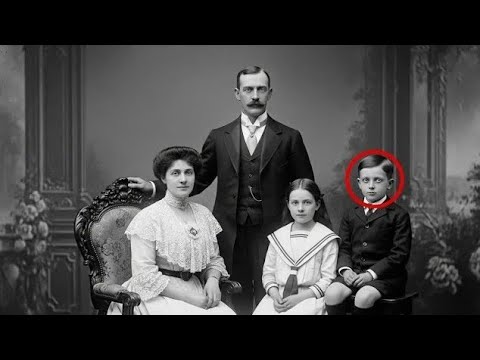
The girl, no older than six, stood at the edge of the group, her dress neat, her hair pulled back. But her right hand was partially hidden in the folds of her skirt, and between her fingers, she clutched something small and dark. It was barely visible—just a few pixels in the high-resolution scan—but once seen, it was impossible to unsee.
At first, experts thought it might be a toy, a trinket, or a piece of jewelry. But as they enhanced the image, comparing it with other photographs from the same period, they realized it didn’t match any known object. It was something else entirely.
The discovery sparked a frenzy of questions. Why was the object hidden? Why did the girl’s posture seem almost protective, her shoulder angled inward as if shielding it from view? And why, in a photograph where every other family member stood empty-handed, was she the only one holding something?
To understand the significance, one must first grasp the reality of Victorian photography. Taking a portrait was not a casual affair. It required preparation, patience, and stillness. Families dressed in their best, children were warned to stay motionless, and the photographer worked under a dark cloth, manipulating a heavy camera. Any movement could blur the image, so expressions were often serious, even grim.
In this context, the girl’s hidden object becomes even more intriguing. If it were merely a toy, why conceal it? Why not hold it openly, as children often did? The fact that it was tucked away suggests intention—either hers or someone else’s.
Some researchers speculated that the object might be a memento of a deceased family member, a common practice in an era of high mortality. Others wondered if it was a religious token, a small book, or a folded note. But without further evidence, these remained theories.
Then came another discovery. Near the girl’s feet, barely visible under the hem of her dress, was a faint shadow. Digitally enhanced, it appeared to connect to the object in her hand—perhaps a string or a ribbon. If so, the object might not have been simply held; it might have been worn or attached.
The mother’s gaze, too, drew attention. While the father and older children looked directly at the camera, the mother’s eyes seemed angled downward, toward the youngest child. Was she aware of the hidden object? Did she approve—or was it a secret between them?
These questions multiply, but answers remain elusive. The photograph, like many from its time, carries no caption, no names, no date. The people in it are unidentified, their stories lost to history. Yet the image preserves a moment—a fleeting, accidental glimpse into a private world.
Perhaps the girl was simply holding a cherished toy, and the folds of her dress happened to cover it. Perhaps the object was placed there deliberately as a symbol. Or perhaps it was something else entirely—something that, even now, we can only guess at.
But one thing is certain: the youngest daughter’s hand has turned a seemingly ordinary photograph into a mystery that continues to captivate all who see it.
Yet the most unsettling detail emerged only after researchers began comparing the girl’s object with the shadows cast across the parlor floor. In Victorian studios, photographers often used hidden braces and stands to keep subjects perfectly still during long exposures. But the shadow near the girl’s feet did not match the angle of any known stand.
Instead, it fell in a direction that suggested a second light source—one that should not have existed in a modest parlor. Some analysts proposed a simple explanation: a window, a mirror, or a reflection from the photographer’s equipment. Others were less certain.
Then a researcher made a quiet observation that shifted the entire investigation. The girl’s left hand, resting at her side, was not empty either. In the earlier scans, it had appeared relaxed, almost invisible against the dark fabric of her dress. But under a different contrast filter, a thin line became visible—a strand of thread, perhaps, or the edge of a folded paper.
Two hands. Two objects. Or one object, held in two places.
The discovery forced experts to reconsider everything. If the girl was holding something in each hand, the gesture was no longer accidental. It was deliberate—a child clutching something so important that she refused to let go, even for a single photograph.
Historians of childhood photography noted that children in the Victorian era were often given small keepsakes to hold during sittings—a practice meant to calm them, but also, occasionally, to commemorate a lost sibling or a family milestone. Sometimes these objects were woven into the composition without explanation, their meaning known only to the family.
One archivist, poring over similar portraits from the same decade, found a striking parallel: a photograph of a young girl in a nearly identical pose, holding what appeared to be a small cloth bundle. On the back, in faded ink, were the words: “For remembrance.”
No such inscription survived on the photograph of the youngest daughter. But the comparison raised a tantalizing possibility. What if the object in her hand was not a toy or a trinket, but a token of grief—something carried into the frame because it could not be left behind?
The mother’s downward gaze suddenly seemed less like coincidence and more like recognition. She knew what her daughter held. She may even have placed it there herself.
And still, the photograph offers no verdict. It preserves the gesture but not the grief, the object but not its name. The girl stares out from across a century, her small hands closed around a secret that the camera captured but never explained.
What happened next was not a breakthrough but a slow accumulation of small, stubborn facts. Researchers began cataloguing every visible detail of the parlor itself—the wallpaper pattern, the chair legs, the framed picture on the wall behind the father’s shoulder. Each element was cross-referenced against surviving catalogues from the 1860s and 1870s. The furniture matched a known manufacturer in Manchester. The wallpaper was a pattern discontinued around 1874.
This narrowed the date of the photograph to a window of roughly five years. It was not much, but it was a start.
The dress the youngest daughter wore proved even more revealing. Its cut and trim suggested it had been altered—perhaps handed down from an older sibling or a cousin. There were faint marks near the hem where a seam had been let out and re-stitched. This was a family of modest means, careful with what they owned.
That detail mattered. A family that carefully altered clothing would not casually allow a child to bring a random object into a formal portrait. Whatever the girl held, it had been considered—if not by the photographer, then by someone in the family.
Then came a discovery that unsettled everyone involved. A conservator examining the original print noticed a series of faint indentations along the lower right edge of the photograph. They looked like pressure marks—the kind left by a hand gripping the image repeatedly over many years.
Someone had held this photograph often. Someone had touched that exact corner, where the girl’s hidden hand appeared. The pattern of wear was not random; it was focused, deliberate, almost reverent.
Who had done this? A mother, decades later, remembering? A sibling, grown old, trying to recall what the little girl had held? Or the girl herself, surviving into old age, holding the only proof of a moment she could no longer explain?
The wear suggested the photograph had been more than a keepsake. It had been a question the owner kept returning to, without ever finding an answer.
That realization shifted the investigation once more. If the owner had touched the image so often, perhaps the photograph had been kept with other items—letters, notes, or a diary that might explain it. Researchers began searching for any record of the family’s identity, tracing the studio’s stamp on the back of the print to a small business that had operated out of a converted townhouse.
The studio’s ledger, if it survived, would list the date of the sitting and the name of the client. It was a long shot, but it was the only thread left to pull.
The studio ledger, it turned out, had survived. Bound in cracked leather and stored in a county archive, its pages listed every sitting from 1868 to 1881. On a yellowed page, in careful copperplate, was an entry that matched the date range, the studio, and the size of the print: “Mr. Alistair Finch, wife, three children. One sitting. Payment received.” The family finally had a name.
Finch. A clerk, according to a later census. Modest income, four surviving children—though the record noted a fifth who had died the winter before the photograph was likely taken. A boy, aged two.
The ledger offered no further explanation. But the census did.
The youngest daughter’s name was Eliza. She was six years old at the time of the sitting. The older siblings were listed by name and age. And beside the deceased child’s entry, a single word had been written by the enumerator: “scarlet fever.”
Researchers now had a date, a name, and a tragedy. But the object in Eliza’s hand remained unidentified. Then a genealogist working on the case found a descendant—a great-granddaughter living in Yorkshire—who still owned a small wooden box that had passed down through the family. Inside were buttons, a thimble, a lock of pale hair, and a tiny cloth bundle, tied with a faded ribbon.
The bundle matched the size and shape of the object in the photograph. It had been sewn shut with careful stitches, the fabric worn smooth from years of handling. The descendant had never opened it. She had been told, as a child, that it belonged to “little Eliza” and was never to be undone.
But the photograph had one last secret to reveal. When the bundle was compared with the enhanced scan, the ribbon’s knot aligned precisely with the faint line researchers had spotted near the girl’s wrist. It was the same object. The same ribbon. The same small, careful knot.
Eliza had carried her dead brother’s keepsake into the photograph. Her mother had likely tied it to her wrist—hidden under the dress, but present. A private memorial inside a public portrait.
The mystery was solved, but the photograph had not lost its power. It had gained something instead: a name, a grief, and a gesture that now made terrible, tender sense.
What would you have done, standing in that parlor, told to hold still—would you have let go?
Report this article
Select a reason for reporting:






