At 30,000 feet, the air outside is thin and deadly. Inside the B-29 Superfortress, crewmen are sealed in pressurized compartments, safe from the hostile sky—until they need to move between sections. Then, they must crawl through a narrow tunnel barely wide enough for a man, knowing that a single breach could turn them into a human cannonball.
The B-29 was a marvel of engineering, the first bomber with pressurized, heated, and insulated crew compartments. But that innovation came with a terrifying catch: the forward and aft compartments were connected only by a 35-foot-long communications tunnel that ran through the unpressurized bomb bay. To get from the cockpit to the rear gunner’s position, a man had to belly-crawl through this claustrophobic tube, exposed to the elements and to a gruesome fate if the pressure failed.
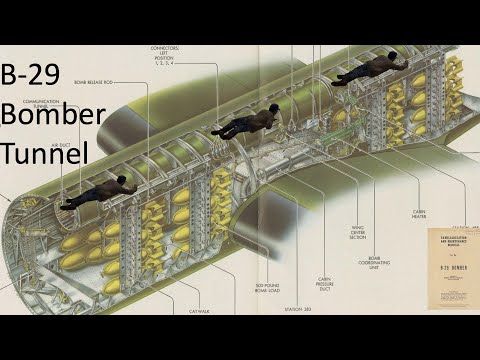
Imagine the scene: the drone of four engines, the bitter cold seeping through the tunnel’s cloth-covered walls, and the knowledge that at any moment, a German fighter’s cannon shell could shatter a gunner’s blister. If that happened, the compartment would explosively decompress, and the tunnel would become a wind tunnel of death. Air rushing through at 145 miles per hour—enough to hurl a man against the bulkhead like a rag doll. The official report called it bluntly: any crew member in the tunnel would likely be injured or killed.
But the B-29 crews were not reckless. Standard procedure dictated that before entering combat, they depressurized the cabin and donned oxygen masks. This not only reduced the risk of catastrophic decompression but also allowed access to the tail gunner, who was otherwise isolated in his own pressurized compartment. The tunnel was a necessary evil, a passage between worlds that could become a death trap in an instant.
In this video, we take you inside that tunnel. You’ll see rare footage of a crewman crawling through the narrow passage, camera in hand, as he navigates over the bomb bay and radar stations. The journey takes about 50 seconds—an eternity when you’re on your knees and elbows, knowing that a single puncture could turn the tunnel into a high-velocity wind tunnel. The walls are lined with thick cloth matting, a small comfort against the metal skin that separates life from the frozen void.
But the B-29 was not the only bomber with such a design. The massive B-36 Peacemaker later adopted a similar tunnel, though with a bizarre twist: crewmen rode on a wheeled cart pulled along a track by a hanging rope. The cart would lock in place at bends, and a brake secured it during maneuvers. It was an improvement, but the principle remained the same—a fragile link between pressurized islands.
As we delve deeper into the B-29’s tunnel, you’ll discover the chilling details of decompression, the ingenious solutions, and the stories of the men who crawled through that tube of terror. The tunnel was more than a passage; it was a test of nerve, a reminder that in war, even the safest havens can become deadly in a heartbeat.
Stay with us as we explore the B-29’s pressurized compartments, the tunnel’s critical role, and the harrowing accounts of those who survived—and those who didn’t. The story of the B-29’s tunnel is one of innovation and risk, a microcosm of the air war itself.
To understand why the tunnel existed at all, you have to picture the B-29’s circular fuselage cross-section. That shape gave the bomber its strength and kept aerodynamic drag low, but it also dictated that the pressurized sections be stacked nose-to-tail with the bomb bay sandwiched between them. The forward crew compartment housed six men—bombardier, co-pilot, flight engineer, radio operator, navigator, and pilot—while the aft compartment held the radar operator, electronic countermeasures operator, and the gunners for the blister and central fire control positions.
The tunnel’s entry cutout sat in the pressure bulkhead at body station 218, just above the forward bomb bay door. From there, the tube ran straight back over the bomb racks, past the mid-bay radar station, and ended at the aft bulkhead at station 646. Thirty-five feet of narrow passage, wide enough for a man on his knees and elbows, and nothing more.
In the footage, an iPhone camera is held in one hand as the cameraman crawls forward. The view is tight and disorienting—metal ribs, cloth matting, the occasional plexiglass astrodome protruding through the fuselage crown. The navigator used that astrodome with a sextant for celestial navigation, estimating the bomber’s position by the stars. Now it serves as a reminder that even in this tunnel, the crew was still navigating a hostile world.
The crawl takes about fifty seconds. Fifty seconds of shuffling over the bomb bay, past the radar station, through the aft bomb bay, until the aft gunner’s compartment comes into view with the central fire control barbette station ahead. Fifty seconds where a man’s life depended on the integrity of a gunner’s blister far behind him.
The May 1945 air intelligence report spelled out the danger in cold, clinical language. If a side gunner’s blister failed during pressurized flight, the compartment would rapidly decompress. The tunnel would become the path of a high-velocity airflow, air rushing through at speeds up to 145 miles per hour. Any crew member caught in that tunnel would become a human cannonball.
But the report also noted a saving grace: this should not be an issue while in combat. The B-29’s standard operating procedure required the crew to start reducing cabin pressure or increasing cabin altitude thirty minutes before reaching the combat area. All crew members would don oxygen masks at that point. A depressurized plane also allowed access to the tail gunner’s compartment for rendering assistance if needed—the tail gunner, isolated in his own pressurized section, could not be reached while the plane was pressurized.
The B-36 Peacemaker later adopted a similar tunnel between its pressurized sections, but with a curious refinement. According to a 1948 Bureau of Aeronautics handbook, crewmen rode on a tube cart with rollers that traveled along a tunnel track. The crewman pulled himself along by a hanging rope, and the cart would lock in place at bends, with a brake to secure it during maneuvers. It was an improvement, but the principle remained the same—a fragile link between pressurized islands in the sky.
In the next segment, we’ll examine the exact procedures crews followed when moving through the tunnel, the equipment they carried, and what happened when things went wrong. The B-29’s communications tunnel was more than an engineering footnote—it was a passage where every crawl could be a man’s last.
The crawl itself was only half the story. Before a crewman even entered the tunnel, he had to coordinate with the pilot and the other compartments. Radio silence was often maintained, so hand signals and a quick nod were all that passed between men. You didn’t just crawl back to the aft compartment on a whim—you went because someone was needed, or because something had gone wrong.
The tunnel’s cloth matting served a practical purpose beyond comfort. It insulated bare skin from metal that, at altitude, could freeze flesh on contact. The B-29’s heating system kept the pressurized compartments livable, but the tunnel ran through the unpressurized bomb bay, where temperatures routinely plunged far below zero. A man crawling through in summer flight gear could still feel the cold biting through his gloves and knees.
Veteran crewmen learned to move fast and keep their heads low. The astrodome at the forward end was a particular hazard—protruding from the fuselage crown, it left only a narrow gap to squeeze past. Navigators had been known to crack their skulls on it during turbulence, and in the tunnel, a moment of carelessness could mean a torn flight suit or a gashed scalp.
Then there was the equipment. Crewmen carried oxygen masks, portable oxygen bottles, and sometimes a survival kit or a tool bag. Crawling with a bag slung over one shoulder was an exercise in contortion, the tunnel walls pressing in on both sides. The lucky ones made the trip empty-handed; the unlucky ones hauled gear for the gunners or the radar operator.
The aft compartment itself was a different world. The radar operator and electronic countermeasures operator worked in near-darkness, their scopes glowing faintly. The gunners for the blister and central fire control positions sat in cramped seats, eyes scanning the sky for fighters. When a crewman emerged from the tunnel, he often found himself in a space that felt even tighter than the tube he’d just left.
And always, in the back of every mind, was the tail gunner. Isolated in his own pressurized compartment at the very end of the fuselage, he could not be reached while the plane was pressurized. If he were wounded or his compartment lost pressure, the only way to help him was to depressurize the entire aircraft and crawl back through the tunnel—or, in extreme cases, to blow the hatch and go outside.
The B-29’s design was a compromise between speed, altitude, and survivability. The tunnel was the price of that compromise, a narrow throat connecting the bomber’s vital organs. Every crawl through it was a gamble, and every crewman who made the trip knew the odds.
In the next part, we’ll hear from the men who flew these missions—their recollections of the tunnel, the cold, the fear, and the strange camaraderie that grew in those fifty seconds of shuffling through the dark.
Those recollections paint a picture that no technical manual can capture. Veterans described the tunnel as a place of strange intimacy—men who barely spoke on the ground found themselves bound by the shared memory of that crawl. The cold metal, the cloth matting worn smooth by countless knees, the faint glow of instrument panels ahead: these details stayed with them for decades.
Some crewmen admitted they never used the tunnel at all. If the mission didn’t demand it, they stayed put, preferring the familiar hum of their own station to the claustrophobic passage. “You only went back there if you had to,” one gunner recalled. “Otherwise, you prayed the tail gunner was all right and kept your eyes on the sky.”
But when the call came—a wounded comrade, a failed oxygen line, a radar scope gone dark—someone always crawled. They crawled with a portable oxygen bottle clutched to their chest, counting the ribs of the fuselage as they passed, feeling the bomb bay’s frozen air seep through the matting. Fifty seconds of shuffling, and then the aft compartment’s dim light and the faces of men who were suddenly very glad to see you.
The B-29’s tunnel was never glamorous. It won no medals and appeared in no recruitment posters. Yet it embodied something essential about the air war: the quiet, unglamorous courage of men who did what was needed, in a space barely wide enough to fit them, because someone on the other side was counting on it.
Today, the few surviving B-29s still have their tunnels. Crawl through one at a museum, and you’ll feel it—the narrowness, the cold, the weight of history pressing in from all sides. It’s the closest most of us will ever come to understanding what those crews endured.
So the next time you see a Superfortress in a photograph or a film, look closely at the fuselage between the wings. Somewhere in there is a tube of cloth and metal, a passage between worlds, a place where men gambled their lives on fifty seconds of crawling. What would you have done, faced with that tunnel and the choice to crawl or stay behind?
Report this article
Select a reason for reporting:






