April 1912. The RMS Titanic glides through the icy Atlantic on its maiden voyage, a floating palace of luxury and promise. Among the 2,224 souls aboard, the Morrison family—Charles, his wife Eleanor, and their two children, Margaret and Thomas—occupy a second-class cabin. They are bound for New York, where Charles has secured a promising job. The family is hopeful, excited about their new beginning in America.
On April 12th, two days before disaster strikes, a ship photographer captures their portrait in the second-class lounge. The image seems ordinary: Charles stands tall in his best suit, Eleanor sits gracefully in a velvet chair, Margaret and Thomas beside them. Behind them, an ornate mirror hangs on the wood-paneled wall. The flash ignites, and the moment is frozen in silver and glass.
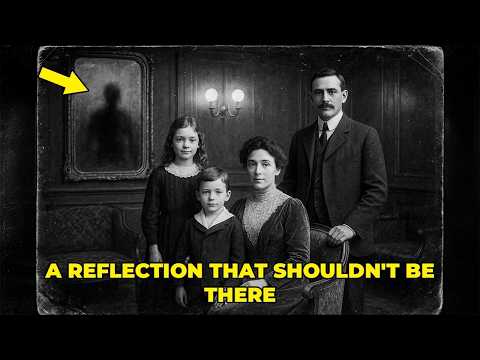
But this photograph, seemingly innocent, would become one of the most unsettling mysteries in maritime history. For decades, it sat forgotten in a museum archive, just another relic of the doomed voyage. Then, in 2003, digital archivist Dr. Rebecca Chen made a discovery that would send shivers down her spine.
In the mirror, there was a reflection that didn’t match the scene. A figure stood where no one should have been—a tall, shadowy presence that defied explanation. The glass negative was authentic, the image captured at the moment the photo was taken. Yet the figure’s position, according to experts, was impossible: it would have been standing inside a solid oak wall.
Dr. Chen’s discovery sparked a frenzy of investigation. Photography historians confirmed the figure was not a scratch or artifact. Maritime architects pored over Titanic’s blueprints and found no hidden doorways. Genealogists unearthed Eleanor Morrison’s diary, which revealed a chilling entry from that day: “I felt a coldness, a presence, as if someone stood behind me who I could not see. Margaret complained of feeling watched.”
Psychologists suggested the family’s trauma might have influenced their perception, but the photograph remained—a physical anomaly that no conventional theory could explain. Skeptics like James Randi argued it was a trick of light, but even he admitted, “I don’t know what created that image.”
As the years passed, new technologies only deepened the mystery. In 2015, MIT researchers used AI to analyze the figure, which was identified as human-shaped with 73% confidence. A 3D reconstruction revealed that the figure would have been standing in the center of the room, yet no one reported seeing anyone there. “The figure existed optically in an impossible position,” the lead researcher concluded.
Then, in 2024, a hidden album belonging to Eleanor Morrison was discovered. It contained an earlier photograph of Charles standing before the same mirror, with a subtle second shadow that shouldn’t have been there. Was the mirror itself cursed? Or was Charles’s trauma over a workplace accident—where a coworker died—somehow manifesting in the images?
The Morrison family’s story ended in tragedy. Charles and Thomas perished on the Titanic; Eleanor and Margaret survived but never spoke of the photograph. Yet their image endures, a haunting testament to a moment when the impossible was captured on film.
Today, the photograph remains in the Southampton Maritime Museum, still unexplained. As one researcher put it, “Sometimes the most compelling mysteries are the ones that refuse to be solved.”
But the discovery of the album in 2024 did more than deepen the mystery—it cracked open a door that no one had thought to look behind. Among the brittle pages, tucked into a pocket at the back of the album, was a folded slip of paper in Eleanor’s handwriting. It was not a letter. It was a list.
Sarah Morrison Fletcher recognized the paper immediately. “She called it her inventory of small things,” Sarah told the consortium researchers. “Great-grandmother wrote down everything she carried off the ship. She said it helped her feel less like she’d lost everything, to name what she still had.”
The list was mundane at first—clothing, a sewing kit, Thomas’s tin soldier, Margaret’s hair ribbon. But near the bottom, in a shakier hand, one line stood apart from the rest: “The mirror. Wrapped in my shawl. Do not hang it where the children sleep.”
That single sentence changed the direction of the investigation entirely. Eleanor had not merely saved the mirror—she had given it a warning. Why would a wedding gift from her mother, the one beautiful thing she owned, require such a caution? Dr. Yuki Tanaka, who had joined the consortium the previous year, argued that the instruction suggested Eleanor had come to associate the mirror with the presence she felt that day in the lounge. “She did not fear the mirror,” he wrote in a preliminary memo. “She feared what the mirror might show.”
Tracking the mirror itself became the consortium’s new obsession. Records from rural Pennsylvania were sparse, but a probate filing from 1954, the year Eleanor died, listed her estate in painful detail. The mirror was bequeathed to Margaret, along with the family photographs and a small wooden chest. Margaret’s own estate, settled in 1987, divided her possessions among her three children. The mirror was not mentioned.
For months, the trail went cold. Then a researcher named Owen Pryce, working through a box of uncatalogued auction records from a 1991 estate sale in Allentown, found an entry that made his hands tremble. “Antique gilt-framed mirror, Victorian, some water damage to frame. Sold to anonymous buyer, lot 114.” The provenance note beside it read simply: “From the estate of Margaret Morrison Hale, formerly of Boston.”
Margaret had sold her great-grandmother’s mirror. Or someone in her family had. The buyer was anonymous, the trail vanished into the faceless world of private collectors. But the consortium now had something it had never possessed before: proof that the mirror had survived into the 1990s, and a paper trail that might yet lead to its current owner.
Dr. Amanda Price, the museum curator, was cautious but visibly moved when she addressed the press. “If that mirror still exists, and if we can examine it, we may finally have a chance to understand what the Morrisons experienced. Not through a glass negative, but through the object itself.”
Yet even as the search for the mirror intensified, a quieter and more troubling question began to surface among the researchers. The earlier photograph of Charles, taken in Manchester three weeks before departure, showed a shadow behind his reflection. Eleanor’s diary from late 1911 spoke of Charles seeing shadows and feeling followed. The timeline no longer pointed to the Titanic as the source of the anomaly.
Whatever had attached itself to the Morrison family—if anything had—it had been with them before they ever stepped aboard the ship. The Titanic may not have been the beginning of the story at all. It may simply have been the place where the story was finally captured on film.
And if that were true, the consortium’s researchers realized with a chill, then the figure in the mirror might have nothing to do with the disaster to come. It might have been following the Morrisons all along—waiting, patient and silent, for the moment a camera’s flash would make it visible.
Owen Pryce’s discovery of the 1991 auction record ignited a fresh urgency within the consortium. If the mirror had survived into the modern era, it might still be hanging on a stranger’s wall somewhere, quietly reflecting a room that had no idea what it held. Dr. Tanaka proposed a bold strategy: a public appeal, circulated through antique dealers, auction houses, and collector networks across three continents.
The appeal described the mirror in careful, clinical terms—Victorian gilt frame, water damage to the lower left corner, approximately thirty inches tall. It made no mention of ghosts or photographs. “We framed it as a historical artifact of Titanic provenance,” Pryce later explained. “Which was true. We simply omitted the part that would have made every tabloid in Britain call us lunatics.”
For eleven months, nothing. Then, in the spring of 2025, an email arrived at the consortium’s general inbox. It came from a retired schoolteacher in upstate New York named Helen Marsh, and its subject line read: I think I own your mirror.
Helen Marsh had inherited the piece from her late husband, who had purchased it at the Allentown sale in 1991 without knowing its history. It had hung in their dining room for over thirty years. She described it as “a lovely old thing, a bit gloomy,” and admitted she had never liked the way it made the room feel at dusk. “My husband used to joke that it was haunted,” she wrote. “I stopped laughing about it years ago.”
The consortium arranged for the mirror to be transported to a secure conservation facility in Philadelphia, where a team of physicists, photographers, and metallurgists waited. Dr. Gomez flew in from London. Dr. Jang arrived from MIT with portable imaging equipment. Even James Randi, now elderly and frail but still sharp, sent a written statement urging the team to “check the obvious things first, and check them twice.”
The mirror arrived in a custom crate, its frame chipped and darkened with age. When the conservators lifted it free, the room fell quiet. The glass was clouded at the edges, but the center remained clear—clear enough to reflect the faces gathered around it.
The first round of tests was disappointingly ordinary. X-ray fluorescence confirmed the frame’s gilt was genuine Victorian work. The glass was period-appropriate, with the slight waviness typical of nineteenth-century manufacturing. There were no hidden compartments, no inscriptions, no residue of anything unusual. “For three days, it was just a mirror,” Dr. Jang recalled. “A beautiful, old, entirely normal mirror. I began to wonder if we had wasted everyone’s time.”
Then came the controlled photography trials. Following protocols designed after the Morrison investigation, the team photographed the mirror under dozens of lighting conditions, with and without human subjects, using both modern digital cameras and a replica 1912 glass-plate setup. Most images were unremarkable. But on the forty-seventh exposure—a glass-plate photograph taken at dusk, with a single researcher standing before the mirror—something appeared.
Behind the researcher’s reflection, faint but unmistakable, was a second shadow. It had no source. The lighting rig had been positioned to eliminate exactly this kind of artifact, and the digital backup camera, shooting simultaneously, captured nothing at all.
Dr. Gomez stared at the developed plate for a long moment before speaking. “The digital sensor saw nothing,” she said slowly. “The silver halide saw something. Whatever this is, it responds to the chemistry—not the light.”
The room erupted. Randi’s written protocol had anticipated this possibility and demanded a control: the same exposure, same lighting, same researcher, but with a different mirror of comparable age. That control was run the following morning. The plate came back clean.
The Morrison mirror, it seemed, was not merely a witness to the anomaly. It was a participant.
News of the Philadelphia trials leaked within weeks, and the consortium found itself facing a dilemma it had spent two decades avoiding. The evidence was no longer confined to a single century-old negative. It was reproducible, in a laboratory, under controlled conditions. “We are past the point of speculation,” Dr. Price told a hastily convened press briefing. “Something is happening in the presence of that object. We do not know what. But we can no longer pretend it is a photographic accident.”
Helen Marsh, the mirror’s unlikely custodian, was asked whether she wished to reclaim it. She declined. “I’ve had thirty years of that thing watching my dinner parties,” she said. “Let the scientists have it. I sleep better already.”
But as the consortium prepared for a new phase of research—one that would bring the mirror into contact with the original Morrison negative for the first time in over a century—a quieter question haunted the team. If the mirror could produce the anomaly on demand, what had it been doing in Helen Marsh’s dining room for three decades? And what, exactly, had it been reflecting when no one was looking?
The consortium scheduled the joint exposure for a Tuesday morning, the mirror positioned three feet from the original Morrison negative. Dr. Jang sealed the room. “Whatever happens,” she told the team, “we document it exactly as it occurs.”
The plate developed slowly. When the image emerged, every researcher went silent. The figure was there—but it had moved. It now stood behind the mirror itself, facing outward, as though observing the observers.
Dr. Tanaka studied the plate for a long moment. “It has never been following the family,” he said quietly. “It has been following the glass.”
Helen Marsh was contacted that evening. She listened, then laughed softly. “Thirty years,” she murmured. “I always thought it was watching me. Maybe it was only ever waiting for the right room.”
The mirror remains in Philadelphia, under constant observation. The figure has not appeared again. But the team checks the plates every morning.
What do you think the mirror is truly waiting for—and would you hang it in your own home to find out?
Report this article
Select a reason for reporting:






