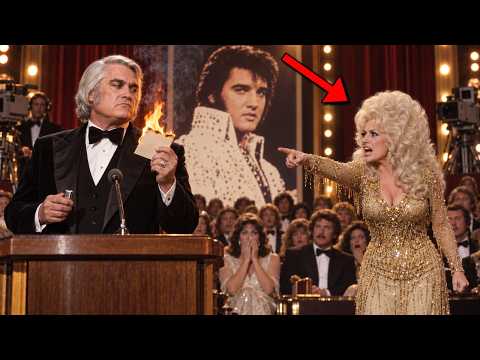
The card bearing Elvis Presley’s name was already burning when Dolly Parton rose from her seat. For one terrible second, nobody inside the Country Music Awards auditorium moved. Charlie Rich stood behind a polished wooden podium, holding a silver cigarette lighter in one hand and the flaming tribute card in the other. Orange fire climbed across Elvis’s name. Black smoke twisted toward the stage lights.
Behind Charlie, an enormous portrait of Elvis in his iconic white jeweled jumpsuit towered above the silent crowd. Millions were watching live. Charlie stared into the main camera. “This man abandoned country music,” he declared, “and country music should abandon him.” A few nervous laughs escaped from the audience. Most people remained silent. Some were shocked. Others were afraid of challenging one of the evening’s most respected performers.
Executives near the stage watched carefully, already calculating whether outrage would damage the broadcast or improve its ratings. Then Charlie dropped the burning card onto the podium. That was when Dolly stepped into the aisle. Her golden dress glittered beneath the lights, but the famous warmth had vanished from her face. Her eyes were wet, her hands were steady. She pointed directly at Charlie. “Put out that fire.” A gasp swept through the auditorium.
Charlie slowly looked toward her. “Sit down, Dolly.” She did not. Instead, she walked toward the stage while every camera followed her. “You can burn that paper,” she said. “But you will not burn the truth about Elvis Presley.” Charlie smirked. “And what truth would that be?” Dolly reached the foot of the stage and looked up at the enormous portrait. “That before many of us were welcome in rooms like this, Elvis kicked the doors open.”
The auditorium became completely silent. Charlie believed he was attacking a distant superstar who was not present to answer him. He had no idea he had awakened something deeply personal inside Dolly. And before the night ended, she would reveal the promise Elvis had once made to a frightened young singer. A promise that explained why she was prepared to risk her entire career to defend him.
Several hours earlier, Nashville had been glowing beneath a cool autumn sky. Limousines filled the entrance. Reporters shouted questions from behind velvet ropes. Inside the auditorium, musicians tuned their instruments while producers raced between dressing rooms. The ceremony included a special tribute honoring Elvis Presley’s influence on American music. But backstage, the tribute had already divided the industry. Some performers believed Elvis deserved recognition for carrying southern music across the world. Others argued that his Las Vegas shows, jeweled costumes, and enormous fame had carried him too far from country tradition.
Charlie Rich arrived exhausted and angry. For months, executives had told him that audiences wanted younger faces, larger spectacles, and artists who could cross between country, pop, and rock. Each conversation sounded like another warning that the world he had helped build was moving forward without him. A producer named Raymond Cole recognized that fear. He found Charlie alone backstage staring at Elvis’s portrait through a gap in the curtain. “That man represents everything replacing performers like you,” Raymond whispered. Charlie said nothing. “He used country music to become famous. Then he covered himself in diamonds and forgot the people who put him there.”
The accusation entered Charlie’s wounded pride like poison. Raymond placed the tribute card on the dressing table. Beside it, he set down a silver lighter. “If you want Nashville to remember your name,” he said, “give them a moment they will never forget.”
Dolly had overheard Raymond’s final words. She entered the room. “What exactly are you asking him to do?” Raymond turned with a polite smile. “This is a private conversation.” “Then you should have closed the door.” Charlie slipped the lighter into his pocket. Dolly noticed his trembling hand. “Whatever he told you, don’t let bitterness make a decision you can’t undo.” Charlie laughed. “You always defend Elvis.” Dolly’s expression softened. “Because I remember who he was before the world decided what he represented.”
The public saw Graceland. Expensive cars, screaming crowds, and rhinestones blazing beneath Las Vegas lights. Dolly remembered another Elvis. Years earlier, when her own name held little power, she had attended a private music industry gathering. She stood alone near the back of the room while several executives discussed her as though she were invisible. One mocked her accent. Another laughed at her appearance and said nobody would ever take her seriously. Dolly tried to smile with them, but humiliation tightened around her throat.
Then Elvis walked across the room. He did not offer quiet sympathy. He looked directly at the executives. “One day,” he told them, “you’ll brag that you knew her.” The laughter stopped. Elvis turned toward Dolly. “Never make yourself smaller so insecure people can feel taller.” Before leaving, he asked her to promise him something. “When your voice becomes powerful, use it for somebody standing alone.” Dolly never forgot those words.
Now Elvis was the one standing alone. He was not backstage. He could not step onto the CMA stage and defend the poor boy from Tupelo beneath the mansion, fame, and costumes. And Raymond had chosen that absence deliberately. Dolly stepped closer to Charlie. “Elvis came from a tiny Mississippi home where gospel, blues, and country music passed through walls too thin to keep any sound out. He carried all of it with him.” Charlie’s face remained cold. “He carried it straight to Las Vegas.” “Fame changed the size of the room,” Dolly replied. “It did not erase where his voice came from.”
Charlie removed the lighter from his pocket and turned it in his hand. “Maybe America needs reminding that rhinestones don’t make a country singer.” “Neither does cruelty.” The stage manager appeared in the doorway. “Mr. Rich, you’re on in one minute.” The orchestra began playing beyond the curtain. Charlie picked up the tribute card. Dolly blocked his path. “If you walk onto that stage with anger in your heart, whatever burns out there will follow you home.” For a moment, Charlie hesitated. Then Raymond appeared behind Dolly. “Let him pass.”
Charlie moved toward the curtain. Dolly followed several steps behind as the announcer introduced the tribute. The enormous curtain opened, revealing Elvis’s portrait beneath a golden spotlight. The audience applauded. Charlie reached the podium and delivered several harmless remarks. People relaxed. Dolly almost believed her warning had reached him. Then Charlie removed the tribute card from its envelope. His other hand disappeared into his pocket. Dolly saw the silver lighter again. Her stomach dropped. “Charlie.” He looked toward Elvis’s portrait. His thumb rolled across the metal wheel. The lighter sparked.
Charlie Rich pressed the flame against the corner of the tribute card. At first, only a thin line of smoke appeared. Then the paper caught fire. Orange light crawled across Elvis Presley’s name as Charlie held the card above the podium. The audience continued applauding for another heartbeat, unaware that the tribute had become an attack.
Dolly understood immediately. “Charlie, put it out.” He ignored her. The flames climbed higher. Charlie leaned toward the microphone. “We are supposed to honor a man who abandoned country music the moment the world offered him something bigger.” The applause died. Musicians lowered their hands. A camera operator pushed closer, uncertain whether the moment had been rehearsed. Producers inside the control room shouted contradictory instructions. One demanded an immediate commercial. Another insisted they remain live.
Charlie raised the burning card. “Elvis Presley took our music, covered it in rhinestones, and turned it into a spectacle.” A few nervous laughs escaped from the crowd. Most people stared in disbelief. Behind Charlie, Elvis’s enormous portrait glowed beneath a golden spotlight. The smiling face made the flames appear even crueler. Elvis seemed to be watching silently as another artist tried to reduce an entire life to costumes and controversy.
Dolly looked around the auditorium. Nobody stood. Famous singers lowered their eyes. Executives waited to see which side would protect their careers. Some disagreed with Charlie, but feared challenging him on national television. Raymond Cole sat several seats away. He was smiling. Dolly suddenly understood everything. He had known Charlie was vulnerable. He had placed the lighter in his hand, fed his fear, and sent him toward the stage because scandal created headlines. Elvis was not the target. He was the fuel.
Charlie dropped the burning card onto the podium. The flame spread across the paper. Dolly’s chair scraped loudly against the floor. Every face turned toward her. Raymond grabbed her wrist. “Don’t make this your fight.” Dolly pulled free. “It became my fight when everyone else chose silence.”
She stepped into the aisle. Her golden gown caught the stage lights as she walked toward Charlie. She did not rush. She did not look toward the executives for permission. Each step carried her closer to the man with the flame and farther from the safety of remaining seated. Charlie saw her approaching. “Sit down, Dolly.” She continued walking. “I said sit down.” Dolly reached the stage steps. “You don’t get to give me orders while you’re burning the name of a man who isn’t here to answer you.”
The audience gasped. Charlie stared at her. “This has nothing to do with you.” “You made it everybody’s business when you brought cruelty onto a public stage.” Dolly climbed the steps. A stage manager hurried toward her, but the director raised one hand from the control booth. The cameras remained live. Millions of viewers watched Dolly cross the stage.
She reached the podium and seized a glass of water. Charlie moved in front of the card. “Don’t touch it.” Dolly looked directly into his eyes. Then she poured the water over the flames. Steam and smoke exploded beneath the lights. Charlie jumped backward. The audience cried out as water ran across the podium and dripped onto the polished floor. The card lay blackened and soaked, but a portion of Elvis’s name remained visible. Dolly picked it up carefully.
Charlie slammed his hand against the podium. “How dare you interrupt me?” Dolly held the scorched tribute toward the cameras. “How dare you confuse humiliation with courage?” Applause began somewhere near the back. At first, it came from only one pair of hands. Then another person joined. Within seconds, a wave of approval moved through the auditorium.
Charlie’s face reddened. “You think putting out a flame makes you brave?” “No. Standing when everyone expects me to sit does.” Charlie moved closer. “You’re protecting him because you want his approval.” Dolly’s eyes flashed. “Elvis isn’t here. He cannot give me anything tonight.” She pointed toward Raymond and the executives watching from the wings. “But the men who can punish me are standing right there.”
The applause stopped. Everyone understood what she had exposed. Defending Elvis offered her no advantage. It could cost her radio support, television appearances, awards, and contracts. The most powerful people in Nashville were watching her challenge the spectacle they had allowed to happen. Raymond stood from his seat. “Cut her microphone.” A technician reached toward the controls. The director hesitated.
Dolly’s voice continued traveling through the auditorium. “I once stood alone in a room while men with power laughed at me. They mocked my accent. They mocked the way I looked. Elvis walked across that room when silence would have been easier.” Charlie shook his head. “This is not about some private memory.” “It is about the promise he made me.” The room grew quiet. “He told me never to make myself smaller so insecure people could feel taller. Then he said that if my voice ever became powerful, I should use it for someone standing alone.” Dolly looked toward Elvis’s portrait. “Tonight that person is him.”
Several audience members rose. Charlie laughed bitterly. “So you built your courage from something Elvis once whispered to you.” “No, he reminded me that courage means nothing if we use it only when it is safe.” Charlie took the scorched card from her hand. “You speak as if he created everyone in this room.” “He did not create us, but he changed what many of us believed was possible.”
Charlie turned toward the audience. “Elvis left country music behind. He took what he needed, became the biggest star in the world, and never looked back.” Dolly stepped beside him. “You see the mansion and the cars. I see the poor boy who grew up listening to country radio, gospel hymns, and blues passing through thin walls.” “Everyone has a poor childhood story.” “Not everyone carries that story onto stages the world never expected them to reach.”
Charlie pointed toward Elvis’s jeweled suit in the portrait. “That is what you call roots.” Dolly looked down at her own glittering dress. “A person wearing black is not automatically honest, Charlie. And a person wearing jewels is not automatically false.” The audience erupted. Charlie’s jaw tightened. He had expected Dolly to become emotional and retreat. Instead, every insult sharpened her answer.
“Rhinestones do not make a country singer,” he said. “No,” Dolly replied. “Neither does bitterness.” The words struck him. For one brief moment, something vulnerable appeared behind his anger. Then Raymond shouted from the aisle. “Tell her what Presley did to the music.” Charlie seized the microphone. Dolly noticed the direction of his glance. He was no longer speaking from conviction. He was following Raymond’s command because surrendering now would mean admitting that another man had manipulated him.
Charlie raised the scorched card again. “Elvis turned struggle into a costume. He transformed honest music into flashing lights, screaming crowds, and a traveling circus.” Several people protested from their seats. Dolly moved between Charlie and Elvis’s portrait. “You are not angry about costumes.” “Move.” “You are not angry about Las Vegas.” “Get out of my way.” “You are afraid.” The word silenced him. Dolly lowered her voice. “You are afraid that every cheer for Elvis means one fewer person remembers Charlie Rich.”
His expression changed. The attack had reached the wound beneath his anger. Charlie gripped the microphone so tightly that his knuckles turned white. Dolly stepped closer. “This was never about what Elvis abandoned. It is about what you believe the world is taking from you.” Charlie’s eyes burned with shame and fury. Raymond rushed toward the stage, signaling desperately for the broadcast to cut away.
But before he reached the podium, Charlie pointed past Dolly toward the enormous portrait. “That man turned music into a circus.” Dolly turned back toward him, her eyes filled with tears, and when she answered, the first words came from a place Charlie had never expected to reach. “That man taught poor southern children that the world might hear them.”
Dolly’s voice cracked. “You see rhinestones. I see a child born into a family that had almost nothing. I see a small Mississippi house where gospel, country, and blues passed through walls too thin to separate one sound from another.” Charlie lowered the microphone slightly.
“Elvis was imperfect,” she continued. “But if you reduce his entire life to jewels and Las Vegas lights, you are not defending truth. You are hiding from it.” A musician in the orchestra rose. Then another.
Charlie’s anger finally appeared exhausted. “They don’t play us like they used to,” he whispered. Dolly’s expression softened. “Someone else’s light does not extinguish yours, Charlie.” For one fragile moment, it seemed he might lower the scorched card.
Then Raymond climbed onto the stage. “Cut to a commercial.” But a young stage assistant stepped forward, pale and trembling. “I saw you. You put the silver lighter beside the card. I heard you promise this would revive his career.” The auditorium erupted.
Charlie stared at Raymond. “You used me.” Dolly faced the producer. “You gave a wounded man a target and called his pain courage.” One by one, performers rose and gathered behind her.
Charlie opened his hand. The scorched card lay across his palm. “How can I undo this?” “You cannot,” Dolly said. “But you can decide whether the worst thing you did becomes the truest thing about you.”
The broadcast light returned. Charlie leaned toward the microphone. “I was wrong. Elvis Presley did not abandon the music that made him. He carried it farther than most of us ever dreamed possible.” The entire auditorium rose.
Later, Dolly sat beneath Elvis’s portrait with a single acoustic guitar and sang about a poor southern boy who carried his mother’s prayers beyond a tiny home. When the final chord faded, she looked into the main camera. “You once told me to use my voice for somebody standing alone. Tonight that person was you.”
The flame lasted only seconds, but courage became the part nobody could extinguish. So tell us—if silence felt safer, would you still have stood?
Report this article
Select a reason for reporting:






