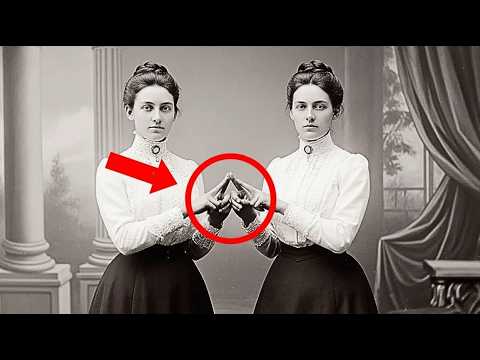
Dr. Emily Carson had spent twenty years restoring damaged photographs at the Smithsonian, but the image that arrived on her desk in March 2024 was unlike anything she had ever seen. The photograph, donated from an estate in rural Pennsylvania, showed two young women standing side by side in a Victorian studio, their faces serious and composed in the manner typical of the 1890s. The image was severely damaged—water stains obscured the background, and a long crack ran diagonally across the surface, splitting the photograph into uneven fragments. But what caught Emily’s attention immediately was not the damage, but something about the women themselves.
They appeared to be sisters, perhaps twins, with the same sharp jawline and penetrating dark eyes that seemed to stare directly through the camera lens. Both wore high-collared white blouses with intricate lace details and dark skirts that reached the floor in the modest style of the era. Their hair was pulled back severely into tight buns, and neither wore jewelry or any kind of adornment that might suggest vanity. But there was something else—something that made Emily lean closer to examine the photograph under her magnifying lamp with growing curiosity.
The women’s hands were positioned strangely between them, meeting in the narrow space where their bodies almost touched. At first glance, it appeared they were simply holding hands in a gesture of sisterly affection. Nothing unusual for Victorian photography. But as Emily studied the image more carefully, adjusting the light and angle, she realized their fingers were arranged in a specific, deliberate pattern—not clasped together in a normal grip, but interlaced in an unusual configuration that seemed purposeful and symbolic, as if conveying a message.
Emily began the painstaking restoration process, carefully scanning the photograph at the highest resolution available with the Smithsonian’s advanced equipment. Modern digital technology allowed her to separate the image into layers, removing damage while preserving every original detail beneath the deterioration. She worked for hours meticulously repairing the water damage pixel by pixel, reconstructing portions of the background that had been destroyed by time, moisture, and neglect. The studio backdrop gradually emerged from beneath the stains—painted columns and draped curtains meant to suggest wealth and sophistication, the standard props of Victorian portrait photography.
As the image became clearer with each pass of her restoration tools, Emily zoomed in on the hands with increasing fascination. The gesture was now unmistakable. Their fingers were positioned in a specific sign, a deliberate symbol that meant something to someone who knew how to read it. She had seen similar hand gestures in historical photographs before, usually associated with secret societies or fraternal organizations like the Freemasons or Oddfellows—but those were typically men’s organizations, documented and studied extensively by historians. This was something different, something she had never encountered in her two decades of professional work.
The women’s faces held no emotion, their expressions carefully neutral as was expected in formal portraits. But their eyes seemed to burn with an intensity that transcended the limitations of old photography, as if they were sending a message across time itself to anyone who might understand.
Emily printed the restored photograph on high-quality archival paper and spread it across her desk alongside several reference books on Victorian-era symbols, secret societies, and women’s organizations. She had contacted a colleague at Georgetown University the previous evening—Professor Margaret Walsh, who specialized in women’s history of the late 19th century and had published extensively on reform movements. Margaret arrived at Emily’s office the following afternoon, her arms loaded with books and research materials, her eyes bright with curiosity behind wire-rimmed glasses that gave her a scholarly appearance.
“Show me,” Margaret said without preamble, setting her materials down on the desk with a thump that suggested excitement. Emily handed her the photograph, and Margaret studied it in silence for several long moments, her eyes moving systematically across every detail. Her expression shifted from curiosity to surprise, then to something approaching excitement as she recognized what she was seeing.
“Do you see this?” she said, pointing to the hand gesture with a trembling finger. “This isn’t random. This is deliberate communication. These women are making a specific sign.” Margaret pulled out one of her books, a thick volume with a worn cover, flipping through pages until she found what she was looking for. The book was titled Women’s Reform Movements in Gilded Age America, and it contained a comprehensive chapter on the Women’s Christian Temperance Union.
The WCTU was the largest women’s organization in American history up to that point, Margaret explained, her voice taking on the tone of a professor delivering a lecture she was passionate about. By 1890, they had over 150,000 members nationwide. They advocated for temperance—the prohibition of alcohol—but also for women’s suffrage, prison reform, workplace protections, and dozens of other social causes that challenged male authority. She showed Emily a passage describing how WCTU members used secret signs and symbols to identify each other, especially in communities where their activism made them targets of violence and intimidation from those who profited from alcohol sales.
“The alcohol industry was incredibly powerful,” Margaret continued, her voice growing more intense. “Distilleries, breweries, saloon owners—they had politicians in their pockets, police chiefs on their payroll, and they didn’t hesitate to use violence against women who threatened their profits. WCTU members needed ways to recognize allies without revealing themselves publicly to enemies.” Emily felt a chill run down her spine as the implications became clear.
“So this gesture in the photograph is almost certainly a WCTU recognition sign,” Margaret finished, nodding with certainty. “These women weren’t just posing for a family photograph. They were documenting their membership in one of the most radical women’s organizations of their time.” She paused, studying the women’s faces more closely with renewed interest. “In 1890, advocating for temperance and women’s rights could get you ostracized from your community, attacked in the streets, lose your job—or worse.”
Margaret spent the next week researching possible identities for the two women in the photograph, working long hours in archives and online databases. The only information they had was the donor’s name: the estate of Helen Pritchard, who had died at 93 in a small town called Millbrook, Pennsylvania. Margaret traveled to Millbrook—a town of fewer than 3,000 people nestled in the Appalachian Mountains two hours north of Philadelphia—to search local historical society records and interview anyone who might remember old family stories.
The Millbrook Historical Society occupied a converted church building on Main Street, its rooms filled with dusty boxes of documents, old newspapers yellowed with age, and photograph albums with crumbling bindings. The director, an elderly woman named Ruth Coleman, who had volunteered there for thirty years, greeted Margaret warmly and led her to a cramped research room. “We don’t get many visitors interested in our history,” Ruth said with a mixture of pleasure and sadness. “Most young people leave Millbrook and never look back. What are you looking for?”
Margaret showed her the restored photograph, watching Ruth’s face carefully for any sign of recognition. Ruth’s eyes widened immediately. “Oh my goodness,” she breathed, reaching out to touch the image with a trembling hand. “That’s the Hartley sisters—Clara and Rose Hartley.” She walked to a filing cabinet with surprising speed for her age and pulled out a worn folder labeled Prominent Families. “Their family was very prominent in Millbrook in the 1880s and 1890s. Their father, William Hartley, owned the general store—one of the most successful businesses in town. He also owned farmland and rental properties.”
Inside the folder were several documents: property deeds with official seals, business records written in elegant script, and a few newspaper clippings from the Millbrook Gazette, the town’s weekly newspaper. One clipping from November 1891 caught Margaret’s attention immediately, and her heart began to race as she read it. The headline read, “Local Woman Missing, Sister Distraught.” The article was brief—only three paragraphs—describing how Rose Hartley, aged 24, had disappeared without a trace in the early morning hours of November 15th, 1891. Her sister Clara had reported her missing to Sheriff Thomas Burke, claiming Rose had left their home the previous evening around 7:00 to attend a meeting and never returned. A search of the surrounding area had yielded nothing.
“What kind of meeting?” Margaret asked, looking up at Ruth with growing suspicion about what the answer might be. Ruth shook her head slowly, her expression troubled. “The article doesn’t say specifically, but there were rumors in the family. My grandmother knew the Hartleys well. She said Rose was involved in something the town didn’t approve of—something that made powerful people very angry.”
Margaret returned to Washington with copies of everything the Millbrook Historical Society had on the Hartley sisters, her mind racing with possibilities and questions. Back in her office at Georgetown, she began cross-referencing the names with national WCTU records housed at the Library of Congress, one of the most comprehensive collections of women’s organizational documents in the country. The WCTU had been meticulous about documenting its membership, and Frances Willard, who had led the organization from 1879 until her death in 1898, had insisted on keeping detailed records of every local chapter, every significant member, and every major activity.
After three days of searching through archived membership rolls, correspondence files, and meeting minutes stored in acid-free boxes, Margaret found what she was looking for. A ledger from 1890, its pages filled with careful handwriting, listed both Clara and Rose Hartley as members of the Millbrook chapter of the WCTU. The chapter had been founded in 1887 with twelve members—all women from respectable families in the community who had the social standing to risk controversy. The chapter president was listed as Mrs. Elizabeth Morrison, the wife of the town’s Presbyterian minister, giving the group a veneer of religious respectability.
But there was more. Margaret discovered extensive correspondence between the Millbrook chapter and the Pennsylvania State WCTU office in Harrisburg. The letters—written in careful script on letterhead bearing the WCTU motto For God and Home and Native Land—described increasing hostility from local business owners, particularly those who profited from alcohol sales. Millbrook had three saloons and a small brewery, all owned by members of a single extended family: the Kerneys. According to the letters, the Kerneys had significant political influence in the town and had openly threatened WCTU members on multiple occasions.
One letter, dated October 1891—just one month before Rose Hartley’s disappearance—was particularly alarming. It was written by Elizabeth Morrison to Frances Willard herself and marked Confidential. Margaret’s hands trembled slightly as she read it. “Dear Miss Willard,” it began, “I write to you with grave concern for the safety of our members. The Kerney family has escalated their campaign of intimidation. Last week, rocks were thrown through the windows of two of our members’ homes. Yesterday, my husband received a letter threatening violence if we continue our petition campaign for a local prohibition ordinance. Most troubling, several of our younger members—including Miss Rose Hartley—have received anonymous notes suggesting they should cease their activities or face consequences. I fear we are approaching a crisis.”
Margaret sat back in her chair, her mind working through the implications. Rose Hartley had disappeared exactly one month after this letter was written. The timing could not be coincidental.
Margaret contacted the Pennsylvania State Archives in Harrisburg, requesting any police records or court documents related to Rose Hartley’s disappearance. What arrived two weeks later was disappointingly thin: a single folder containing Sheriff Thomas Burke’s official report, just three pages long. The report was perfunctory and clearly designed to close the case quickly. Burke had interviewed Clara Hartley, who stated her sister had left their home at approximately 7 p.m. on November 14th, 1891, saying she was attending a meeting but not specifying where or with whom. Burke had also interviewed William Hartley, the sisters’ father, who described Rose as headstrong and involved with radical women’s groups that caused trouble in town. He suggested she might have run away with a suitor, though he could name no such person.
Most tellingly, Burke had interviewed Patrick Kerney, owner of Millbrook’s largest saloon, who stated he had been at home all evening and knew nothing about Rose’s disappearance. The investigation was closed on November 18th, 1891—just three days after Rose vanished—with Burke concluding there was no evidence of foul play and suggesting Rose had likely left town of her own accord. Margaret knew from her research that such quick closures were common when victims were women involved in controversial causes, but this case seemed especially rushed.
She decided to dig deeper into Sheriff Burke’s background. Using newspaper archives, she discovered that Burke had business connections to the Kerney family. He had taken out a substantial loan from Patrick Kerney’s brother to purchase farmland in 1889—just two years before Rose’s disappearance. The conflict of interest was obvious. Yet no one had questioned Burke’s investigation at the time.
Emily, meanwhile, had been examining other photographs from the Pritchard estate donation. Among them was another image that made her heart skip a beat: a group photograph of approximately twenty women, all wearing white ribbons pinned to their dresses. The white ribbon was the symbol of the WCTU, representing purity and the protection of the home. Margaret identified this as almost certainly a photograph of the Millbrook WCTU chapter, taken sometime in the late 1880s or early 1890s. Both Clara and Rose Hartley were in the photograph, standing in the back row.
But Emily noticed something else. Several of the women’s faces had been deliberately scratched out—the emulsion scraped away to obliterate their features. Four women had been erased this way. Emily felt a chill. Someone had wanted to remove these women from history, to erase their existence from the photographic record. Why?
Margaret counted the remaining identifiable faces. There were sixteen women whose features could still be seen. The Millbrook chapter had started with twelve members. Had it grown—or had some members been replaced after disappearing?
Margaret’s next step was to research the Kerney family, whose opposition to the WCTU had been documented in the letters she’d found. Using property records, business directories, and newspaper archives, she built a comprehensive picture of one of Millbrook’s most powerful families. The Kerneys had immigrated from Ireland in the 1840s, and by 1890 they controlled a significant portion of the town’s economy. Patrick Kerney owned the Silver Dollar Saloon, the largest drinking establishment in Millbrook. His brother James owned the Millbrook Brewery, which supplied beer to establishments throughout the region. A third brother, Michael, owned two smaller saloons and had been elected to the town council in 1888.
The Kerneys were not subtle about their opposition to temperance advocates. Margaret found numerous articles in the Millbrook Gazette where Patrick Kerney was quoted attacking the WCTU as “interfering busybodies” and “women who should mind their own households instead of other people’s business.” In an 1890 editorial, he wrote: “These temperance women threaten the livelihoods of honest businessmen and working people who enjoy a drink after a hard day’s labor. They would destroy our economy and impose their narrow morality on everyone. This town must stand firm against their radical agenda.”
But the most disturbing discovery came from court records. In 1889, a woman named Sarah Bennett had filed assault charges against Patrick Kerney, claiming he had attacked her outside her home after she signed a temperance petition. The case had been dismissed by Judge Harold Morrison—Elizabeth Morrison’s husband, the same man who had received threatening letters. According to the WCTU correspondence Margaret found, the dismissal was suspicious. Why would a minister’s husband, whose wife led the WCTU chapter, dismiss charges against the temperance movement’s primary enemy?
Further research provided the answer. Judge Morrison had significant debts, and Patrick Kerney had purchased those debts from the bank in 1888—effectively giving him financial control over the judge. The corruption went deeper than Margaret had initially suspected. The Kerneys didn’t just have political influence; they owned the town’s legal system.
Margaret found two more cases of assaults on women involved in temperance activities, both dismissed by Judge Morrison. She also discovered that Sheriff Burke’s loan from the Kerney family had been interest-free—an unusual arrangement that suggested either friendship or obligation. The pattern was clear: the Kerneys had systematically neutralized anyone in authority who might have protected the WCTU members from retaliation.
Then Margaret found something that made her blood run cold. A property deed from 1892 showed that William Hartley had sold his general store to Patrick Kerney for a sum far below market value. The date was January 1892—just two months after Rose’s disappearance. Why would a successful businessman sell his livelihood for a fraction of its worth, unless he was under extreme pressure?
Margaret needed to know what had happened to Clara Hartley after her sister’s disappearance. Using census records, she traced Clara’s life through the decades. Clara never married—unusual for a woman of her class and era. She had lived with her father until his death in 1903, then alone in the family house until 1920, when she moved to Philadelphia. She had died in 1952 at the age of 85 and was buried in Philadelphia—not in Millbrook, where her family had been prominent for generations. The choice to be buried away from her hometown seemed significant: a final rejection of the place where her sister had vanished.
Margaret discovered that Clara had donated papers to the Historical Society of Pennsylvania before her death. With growing excitement, she traveled to Philadelphia to examine them. The collection was small—three boxes of letters, a diary, and some photographs—but what Margaret found there was explosive. Clara’s diary, kept meticulously from 1889 to 1920, contained detailed accounts of the Millbrook WCTU’s activities and the escalating conflict with the Kerney family. The entries from October and November 1891 were particularly revealing.
On October 20th, Clara wrote: “Rose received another threatening note today—the third this month. This one was pushed under our door during the night. It said, ‘Stop your temperance activities or you will regret it. This is your final warning.’ Rose wanted to show it to Sheriff Burke, but I convinced her it would be useless. Burke dines at Patrick Kerney’s saloon every Friday. He will do nothing to help us.”
On November 10th—just four days before Rose disappeared—Clara wrote: “Rose has been meeting with a man who claims to have evidence of corruption in the Kerney family’s business dealings. Watered-down liquor sold at full price, bribes to local officials, threats against competitors. She says this evidence could shut down their operations and break their power in Millbrook. I begged her to be careful, but Rose is fearless. She believes this is our chance to finally achieve prohibition here and protect other families from the misery that alcohol brings.”
Then came the entry from November 14th—the night Rose disappeared. “Rose left at 7 o’clock to meet her informant. He had promised to give her documents proving the Kerneys have been systematically bribing officials and threatening anyone who opposes them. She said if she didn’t return by midnight, I should assume something had gone wrong and should go to Mrs. Morrison. It is now past midnight. Rose has not returned. I am terrified.”
Margaret read through the subsequent entries with mounting horror. Clara had gone to Sheriff Burke the next morning, as required by law. Burke had been dismissive, suggesting Rose had probably run off with the informant. When Clara insisted something terrible had happened, Burke told her to stop making wild accusations or she would face charges of slander. Clara went to Mrs. Morrison, who promised to contact the state WCTU office. But before any outside help could arrive, Burke had closed the case.
The final box of Clara’s papers contained something Margaret hadn’t expected: a sealed envelope marked To Be Opened Only in the Event of My Death, by Someone Investigating Rose’s Disappearance. Inside was a letter written in Clara’s elderly hand, dated 1951—one year before her death. Margaret’s hands shook as she read it.
“To whoever finds this letter,” Clara had written, “I have carried the truth about my sister’s death for sixty years, too afraid to speak while those responsible—or their descendants—might retaliate. But I am old now, and soon I will join Rose. The truth must be known.”
On November 14th, 1891, Rose went to meet a man named Thomas Sullivan, who worked at the Millbrook Brewery. Sullivan had been skimming documents that proved the Kerneys were systematically defrauding customers and bribing officials. He wanted to give these documents to Rose because he knew the WCTU would use them to shut down the Kerney operations. But someone warned the Kerneys about the meeting—Clara believed it was Judge Morrison, who, despite his wife’s involvement in the WCTU, was deeply in debt to Patrick Kerney. Rose never arrived at the meeting place, an abandoned mill on the edge of town.
Two days after her disappearance, Thomas Sullivan was found dead in the river. Sheriff Burke ruled it an accidental drowning, but Sullivan’s widow told Clara privately that her husband couldn’t swim and would never have gone near the water. She believed he was murdered to keep him silent.
“I tried to investigate on my own,” Clara wrote, “but the Kerneys’ power was absolute. My father received visits from Patrick Kerney, who made it clear that if I continued asking questions, our family would be destroyed financially and socially. Father sold his store under duress and forbade me from any further WCTU involvement. I lived in fear for decades, watching as the Kerneys prospered while Rose and Thomas Sullivan were forgotten. Three other WCTU members from our chapter disappeared between 1889 and 1893. No investigations were ever conducted properly. We were considered troublemakers, not victims worth protecting.”
Clara had enclosed copies of documents she had managed to obtain: letters from Patrick Kerney to Judge Morrison discussing how to handle the temperance problem, pages from Sullivan’s account book showing systematic fraud, and a letter she received anonymously in 1892 from someone claiming to have witnessed Rose’s abduction. She never knew who sent it, but they described seeing Rose being forced into a carriage by two men near the old mill. Clara had given this information to Sheriff Burke. He told her the witness was unreliable and refused to investigate further.
“If you are reading this, you are investigating Rose’s disappearance,” Clara concluded. “Please know that my sister was brave and good. She died fighting for a cause she believed would protect families and make our community better. She deserves to be remembered as a hero—not as a woman who ran away, as the official story claims.”
Margaret spent the next month verifying every detail in Clara’s letter using historical records. She confirmed that Thomas Sullivan had indeed died in November 1891, just two days after Rose disappeared. She found his widow’s statement to Sheriff Burke, in which she insisted her husband’s death was suspicious. Burke had ignored her concerns. Margaret also discovered that three other Millbrook WCTU members had disappeared between 1889 and 1893, just as Clara claimed: Sarah Bennett, the woman who had filed assault charges against Patrick Kerney; Mary O’Connor; and Elizabeth Morrison’s own daughter, Catherine.
The pattern was unmistakable. Women who actively opposed the Kerney family’s alcohol business had disappeared, and no serious investigations had been conducted. The corruption extended so deep that even women whose husbands held positions of authority weren’t safe. Judge Morrison, despite his wife’s leadership in the WCTU, had been compromised by debt. His daughter had paid the price for her mother’s activism.
Margaret obtained court records showing that after Catherine Morrison’s disappearance in 1893, Judge Morrison had suddenly resigned from the bench, citing health reasons. He and his wife had moved to Pittsburgh, leaving Millbrook forever. The resignation came just one week after Catherine vanished—suggesting Morrison had finally realized his financial entanglement with the Kerneys had cost him his daughter’s life.
Using the documents Clara had preserved, Margaret confirmed the extent of the Kerney family’s corruption. Account books showed they had systematically watered down their beer while charging full price, defrauding thousands of customers over the years. Correspondence revealed bribes paid to town council members, the sheriff, and even the mayor. The Kerneys had essentially purchased control of Millbrook’s government, using it to protect their profitable but morally destructive business.
But the most damning evidence was the letter from the anonymous witness. Handwriting analysis Margaret commissioned suggested it had been written by someone educated and male—possibly a business associate of the Kerneys who had developed a conscience. The letter described in detail how two men identified as employees of Patrick Kerney had forced Rose Hartley into a closed carriage near the old Riverside Mill on the night of November 14th, 1891. The witness claimed he had been too afraid to come forward publicly, knowing the Kerneys would destroy him financially if he testified against them.
Margaret traced what happened to the Kerney family after Rose’s death. They had continued to prosper throughout the 1890s and early 1900s. But when national prohibition was enacted in 1920, their empire collapsed. The brewery closed, the saloons were shuttered by federal agents, and the family’s political influence evaporated. By 1925, the surviving Kerney brothers had moved away from Millbrook, their fortune and power gone.
Eight months after Emily first examined the damaged photograph, she and Margaret stood in the Smithsonian’s exhibition hall for the opening of Courage and Consequence: The Untold Story of the Millbrook WCTU. The restored photograph of Clara and Rose Hartley—their hands making the secret WCTU recognition sign—hung at the center of the exhibition under special lighting that made every detail visible to the hundreds of visitors who had come to the opening.
Surrounding the photograph was the evidence of their story: Clara’s diary entries, the WCTU correspondence documenting threats against members, the letters proving the Kerney family’s corruption, Sheriff Burke’s perfunctory investigation report, and—most powerfully—Clara’s final letter revealing the truth she had carried for sixty years. Margaret had also included photographs of the other disappeared women—Sarah Bennett, Mary O’Connor, Catherine Morrison—whose stories had been forgotten until now.
The exhibition told a story that had been deliberately buried by powerful men who valued profit over human life and who had used violence to silence women demanding social reform. It honored women who had risked everything to fight for temperance—not because they were prudish or controlling, but because they had witnessed the devastation that alcohol abuse caused in families where women had no economic or legal power to protect themselves and their children.
Descendants of the Hartley family had traveled to Washington for the opening, including Helen Pritchard’s great-granddaughter, who wept as she saw the photograph of her ancestors and learned the truth about Rose’s fate. The family had been told for generations that Rose had run away, bringing shame to the Hartley name. Now they understood: she had been murdered for her courage, and Clara had spent her life carrying the trauma of losing her sister while being powerless to obtain justice.
Representatives from the National WCTU attended the exhibition, along with historians, women’s rights advocates, and members of the public drawn by the story’s power. Dr. Virginia Hammond, a historian who had written extensively about violence against women reformers, spoke at the opening ceremony. “Rose Hartley and the other women who disappeared from Millbrook represent hundreds—perhaps thousands—of women whose activism for temperance, suffrage, and social reform made them targets of violence in the late 19th and early 20th centuries,” she said. “Their stories were suppressed, their deaths were uninvestigated, and their courage was forgotten. This exhibition begins the process of restoring their rightful place in history—as pioneers who fought for human dignity despite knowing the terrible price they might pay.”
Emily stood before the photograph of the two sisters, studying their faces one more time. The hand gesture that had seemed so mysterious now told a complete story: two women pledging themselves to a dangerous cause, documenting their commitment in case they didn’t survive to tell their own story. Rose had been proven right to fear for her safety. But through Clara’s determination to preserve the truth and Emily’s restoration of their photograph, their message had finally reached across 133 years to be heard and understood.
The photograph would no longer be just an artifact of Victorian portraiture. It was evidence of courage, a memorial to murdered activists, and a reminder that women’s progress toward equality and social reform had always been paid for with individual acts of bravery that often went unrecognized. Rose Hartley had died fighting for a world where alcohol would not destroy families and where women would have power to protect themselves and their communities. Clara had lived with grief and fear—but she had also ensured the truth would eventually emerge.
As visitors studied the exhibition throughout that first day, many paused longest before the photograph of the two sisters with their hands joined in a secret sign of solidarity. Their faces were serious, their eyes defiant—sending a message that had finally been received.
What other silenced stories might be waiting in forgotten photographs and dusty archives, hoping someone will finally look closely enough to listen?
Report this article
Select a reason for reporting:






