In 2022, a genetics lab processed ancient DNA from three pre-contact skeletal remains pulled from burial sites in the Southern Appalachian Highlands—the heart of what has always been called Cherokee ancestral territory. The haplogroup results came back and they did not match. Not slightly off, not within the margin of expected drift. The biological signature in those three individuals pointed toward population origins with no equivalent in the surrounding regions’ known burial record.
A signal that, if it holds, does not just complicate Cherokee origin history. It puts a question mark over every ancestry test result that ever told an American family they had Cherokee blood. Millions of those results exist. They are sitting in accounts right now.
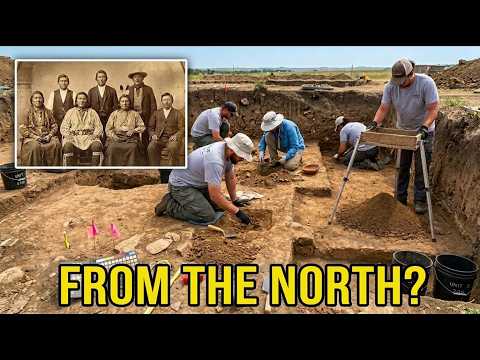
The Cherokee Nation is one of the most documented indigenous peoples in North America. Their connection to the Southern Appalachians has been treated for decades as one of the more settled questions in American prehistory. Federal recognition frameworks rest on it. Academic origin narratives rest on it. The consumer genealogy industry, worth over $4 billion, built its Native American ancestry detection products on it.
The Cherokee as ancient Appalachian isolate model—the idea that Cherokee people developed continuously in those mountains over millennia—stopped being treated as a hypothesis somewhere in the mid-20th century. It became a foundation. And foundations don’t get re-examined unless something forces the question.
Ancient DNA forced the question.
The accepted model was never built on biology. It was built on archaeology—pottery continuity, overlapping settlement patterns, artifact sequences running in an unbroken cultural line through several pre-contact phases. That is real evidence, but it describes behavior, not ancestry. Pottery traditions can be adopted. Settlement patterns can be inherited by a new population that arrives and displaces an earlier one.
For most of the 20th century, there was no biological test that could tell you whether the people making that pottery in 800 CE were the direct biological ancestors of the people making it in 1400 CE. Scholars assumed continuity because the material culture suggested it. Nobody had asked the bones.
The 2022 extraction was not designed to challenge anything. A research team conducting routine population genetics work submitted pre-contact remains for haplogroup sequencing—the kind of study that maps maternal lineage signatures across a reference panel of known populations. The remains dated to between approximately 900 and 1400 Common Era, squarely within the cultural period the accepted model assigns to Cherokee development in the region.
Nobody flagged it as unusual, not at first. Then the results came in.
The haplogroup frequencies recovered from all three individuals showed an admixture component inconsistent with long-term in-place Appalachian development. The signal pointed toward population affiliations more consistent with groups from the Great Lakes corridor and St. Lawrence region—the geographic heartland of Iroquoian-speaking peoples whose entire known history places them hundreds of miles to the north.
The bones in a southern Appalachian burial site were carrying a north genetic signature, and it was not one individual. One anomalous result is an outlier. Three individuals from the same burial context with the same anomalous signal is a pattern. Patterns demand explanation.
What does a haplogroup actually tell you? Direct answer: it is a branch on the human family tree that travels through maternal lineages across generations, and its geographic distribution is mapped well enough that researchers can use it to identify where a population’s ancestors most likely came from. It is not a precise address, but it is a direction. And the direction in these three individuals pointed north.
Three individuals, same site, same signal. Contamination explanation stopped working at three.
This finding does not stand alone. It arrives at the intersection of two other lines of evidence that have been in plain sight for over a century.
The first is linguistic. Cherokee is an Iroquoian language—the only Iroquoian language spoken anywhere in the American South. Every other Iroquoian language belongs to peoples whose historical record places them in the northeast: the Haudenosaunee nations, the Huron-Wendat, the Erie. An Iroquoian language in the Southern Appalachians has always been a geographic anomaly, 800 miles from the nearest related tongue. Historical linguists studying the distribution of the language family have never found a fully satisfying explanation for how it ended up there.
The second line is older. In 1900, ethnographer James Mooney documented Cherokee oral traditions describing a migration—a memory of coming from somewhere to the north or northwest. A collective sense of having arrived rather than always having been. Mooney noted it. The dominant origin model absorbed it as metaphor and moved on.
The linguists noted the Iroquoian anomaly in the 1950s. Skeletal morphologists flagged population discontinuity in the Southern Appalachian burial record in the 1980s. Three independent lines of evidence across three disciplines pointing in the same direction—and nobody connected them until the DNA gave the convergence a biological foundation.
Now, consider what that means for the person who once paid $99 to find out if their grandmother’s story was true. The consumer ancestry industry built its Cherokee reference panels on the same foundational assumption the academic model used: that the Cherokee were an ancient Appalachian population with a stable, long-established genetic signature. When 23andMe or AncestryDNA told you whether you carried Cherokee ancestry, that result was calculated against a model of what that population’s genetic profile looks like.
That model is now under direct empirical pressure. The reference panel used to define Cherokee genetic identity was constructed on a population history the physical evidence is beginning to contradict. And those results have not been updated. The science moved. The products did not. Millions of ancestry results telling real people real things about who they are were generated by a map that may be drawn wrong.
To be precise, this does not invalidate every Cherokee ancestry claim. The gap between ancient population genetics and consumer product resolution is large and well documented. But it does mean the foundational reference point those products used was built on an assumption, not a biological measurement—and that assumption is now being tested for the first time.
Pull back further and the anomaly widens. Population discontinuity signals—breaks in burial record patterns, skeletal morphology shifts, and ceramic tradition disruptions—appear across a broader stretch of the Eastern Woodlands in the period between roughly 1,000 and 1,500 CE. The Iroquoian-speaking peoples of the Great Lakes show archaeological records placing their ancestors firmly in the Northeast. The Cherokee are the one southern outlier in mountains that show signs of population-level change precisely within the window a migration hypothesis would predict.
A single anomalous DNA result becomes a regional pattern. A regional pattern becomes a hypothesis about one of the largest pre-contact population movements in North American history. And that movement raises a question the evidence does not yet answer: What happened to the people already living in those mountains?
This is not the first time the physical record has overturned a settled model. In 1996, ancient remains found near Kennewick, Washington dated to approximately 9,000 years old and showed morphological features inconsistent with expected regional populations. What followed was nearly two decades of contested science, legal battles, and institutional resistance—and ultimately a revised understanding of early American migration that is now standard in physical anthropology.
The anomaly survived every attempt to dismiss it. The textbooks eventually caught up. Kennewick Man took 19 years. The Cherokee DNA result is 3 years old. The process is the same. The timeline is just beginning.
The criticism of the current findings is legitimate and worth stating honestly. Researchers have raised real concerns. The reference panel has documented gaps in its coverage of ancient Eastern Woodlands populations, introducing uncertainty into directional migration claims. The sample size of three individuals is small for population-scale conclusions. And the inferential distance between an anomalous haplogroup signal and a specific southward migration involves steps the current evidence cannot fully bridge alone.
These are not fringe objections. They are the normal friction of science working through a contested result. But notice what the criticism did not say. It did not say the signal was wrong. The haplogroup frequencies in those three individuals have not been challenged on their measured results. The anomalous admixture component is in the data. What remains contested is interpretation—the direction, timing, and cause of whatever population movement produced that signal.
The critics want more samples. The researchers agree. They have formally requested expanded excavation access to sites that would allow direct biological comparison between population layers before and after the anomaly appears. That request has been pending for over a year. The science is not waiting. The access is.
If the migration hypothesis holds, linguistic, genetic, oral historical, and morphological lines all pointing toward the same event—what it describes is not a footnote correction. It describes a continent-scale displacement: a southward movement of Iroquoian-speaking peoples from the Great Lakes corridor into the Southern Appalachians during the late pre-contact period, arriving into mountains that were already occupied and leaving a biological and linguistic signature durable enough to survive everything that followed.
One migration, six related languages, 40 million acres of territory restructured, no agreed-upon cause. And an earlier population—the people who were there before the signal changes—whose story has not yet been told.
There were people in those mountains before the Cherokee. The stratigraphic layers in the oldest pre-contact burial sites contain a different biological record, a quieter one, a population that was present and then was not. That record is currently sealed under federal and tribal preservation protections that make aDNA sampling legally inaccessible without negotiated consent.
Those protections exist for serious historical reasons. The exploitation of indigenous ancestral remains is a documented harm that American law now directly addresses. The framework is legitimate. What it also means is that the most critical physical comparison—the population record from the generations immediately before the anomaly appears—is locked in the ground in sites that cannot currently be opened.
The debate cannot be resolved without that data. The data cannot be accessed without a negotiation that has not yet begun.
If you have ever taken an ancestry test and seen Native American in your results, if you have ever been told your family’s Cherokee story was confirmed or denied by an algorithm, the answer to whether that result reflects biological truth may be sitting in a sealed burial layer in the Southern Appalachians—waiting for a conversation that nobody has yet found a way to start.
Three skeletons, one anomalous signal, no agreed source population. The admixture component in those pre-contact remains does not cleanly resolve to any reference population currently in the comparison panel—not to any documented Great Lakes group, not to any characterized Iroquoian-speaking population whose ancient DNA has been mapped. That means either the source population hasn’t been sampled yet or it no longer exists as a distinct lineage, absorbed, displaced, or gone before the modern genetic record was compiled.
And that absence is its own kind of evidence. A population can vanish from the genetic map while its descendants carry fragments of its signature forward. The three individuals in those Appalachian graves were not Iroquoian in the strict sense—they carried a signal that points toward a source population that may have been ancestral to, or related to, the peoples who would later be called Cherokee. The direction is clear. The identity is not.
What the bones do not say is who those people were. What they do say is that someone came from the north, and someone was already there.
The Cherokee Nation has not issued a formal response to the 2022 findings. Tribal historians have, for decades, maintained that oral tradition and sovereignty—not genetics—define belonging. “We are not a question to be answered by a lab,” one elder told a local paper. That position is not anti-science. It is a boundary.
Meanwhile, the consumer databases keep selling certainty. Your $99 result still says what it said last year. The reference panel still rests on the old model. No company has announced a recalculation.
The bones from those Appalachian graves are reburied now, or waiting to be. The comparison layer beneath them stays sealed. The negotiation stays unstarted.
So the question sits where the evidence left it: if the map you paid for was drawn on a foundation now cracking—do you want the truth, or do you want the confirmation?
Report this article
Select a reason for reporting:






