Fanny Kelly knew that death was near. The Sioux chief’s eyes burned with fury as he pointed at her, his voice thundering across the camp. She was to die at dawn. The broken pipe—a sacred symbol of peace—lay in pieces at her feet, and the chief demanded her life as payment. Surrounded by warriors with raised tomahawks, Fanny stood trembling, her heart pounding against her ribs. She had survived the grueling journey through the wilderness, the treacherous river crossings, and the heartbreak of losing her companions. But now, as the chief’s warriors prepared to tie her to a wild horse and use her for target practice, she realized that her luck had run out.
Just hours earlier, Fanny had been riding through the arid hills, her body aching with exhaustion and thirst. She had been forced to carry the chief’s belongings, including his precious pipe, which she had accidentally broken and discarded. She had no idea that this simple act would seal her fate. Now, as the warriors danced around the roaring fire, their faces painted with war cries, Fanny’s mind raced. She thought of her husband, her child, and the home she might never see again. She prayed for a miracle, but the chief’s rage seemed absolute.
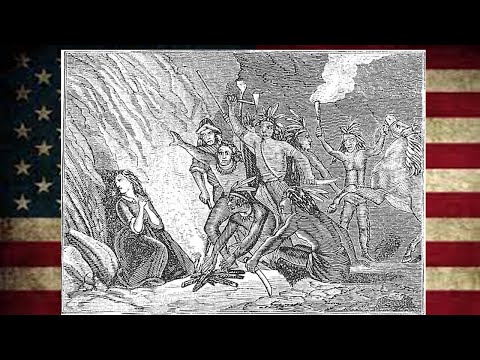
As the warriors closed in, Fanny’s trembling hands reached into her pocket. She pulled out a small bag of money—$120 in cash—and held it up to the firelight. “This is all I have,” she pleaded, her voice barely a whisper. “Take it, but spare my life.” The warriors paused, their eyes fixed on the money. The chief stepped forward, his expression unreadable. For a moment, Fanny dared to hope. But then the chief’s lips curled into a sneer, and he gestured to his men to continue. Fanny’s legs gave way, and she collapsed onto the rocky ground, her vision fading to black.
When she awoke, the camp was silent. The fire had burned down to embers, and the warriors lay asleep around her. She was still alive. But as she struggled to sit up, she saw that the chief was watching her from across the fire, his eyes glinting in the darkness. “You will not escape,” he hissed. “Your life belongs to me now.” Fanny knew then that her ordeal was far from over. The chief had spared her, but only to make her suffer. And as the first light of dawn crept over the horizon, she realized that her fight for survival had only just begun.
At sunrise, the camp stirred with quiet efficiency. The chief’s warriors packed their stolen goods, coiled their ropes, and mounted their horses without a word to her. Fanny was given a wild, unbroken horse to ride and another to lead—a task that nearly cost her life a dozen times before noon. Every stumble brought a blow from the chief’s hand, and every slip of the reins unleashed a stream of English curses from his lips. She understood then, with bitter clarity, how the white man’s vices had been taught to his captors.
The land grew crueler as they pressed north. Dry, sandy hills stretched endlessly beneath a sun that seemed determined to drain the last drop of moisture from her body. Sagebrush and thorny cactus were the only companions to her suffering. Her thirst became a living thing, clawing at her throat and clouding her vision. She began to imagine cool streams and shaded groves, only to have the visions dissolve into the scorching dust.
By late afternoon, Fanny could barely hold herself upright in the saddle. Her voice had shrunk to a whisper, and she turned her desperate eyes toward her captors. “Mini,” she croaked—the Sioux word for water. “Mini, mini.” The warriors glanced at her, then urged their horses faster. She was fading, she knew, slipping toward a death that would leave her body in the wilderness with no one to mark her grave.
Then, just as the sun touched the western hills, they crested a rise and saw it below them: a green valley, and through it, a river. The warriors dismounted and carried her limp body to a shallow stream that fed into the larger water. They laid her in the cold current, and the shock of it pulled her back from the edge of death. At first she could not swallow, but slowly, painfully, her strength returned. The water tasted sweeter than anything she had ever known.
That night they camped beside the Powder River. Fanny lay wrapped in a blanket, too weak to move, listening to the warriors talk among themselves. She did not know it yet, but a new danger was already taking shape—one that would test her in ways the chief’s rage had not. One of the younger warriors was watching her with a look she had not seen before, and it frightened her more than the tomahawks ever had.
The young warrior’s name was White Hawk, and he was not much older than Fanny herself. He brought her a strip of dried buffalo meat and a small pouch of water, kneeling beside her without a word. She did not trust the kindness—kindness had become the most dangerous thing in her world. But she ate, and she drank, and she watched him through narrowed eyes.
Two days later, the camp broke apart. The chief divided his warriors into smaller bands, each riding in a different direction to confuse any pursuers. Fanny was placed in White Hawk’s group of six, and they rode west toward the mountains. The chief’s parting words to her were spoken in halting English: “You run, you die. You stay, maybe you live.” Then he was gone, and she was left with strangers.
White Hawk spoke little, but his eyes followed her constantly. One evening, as the others slept, he crouched beside her and drew a crude map in the dirt. He pointed to a line of hills, then to a spot marked with a small circle. “Soldiers,” he whispered. “Two days. Maybe three.” Fanny stared at him, her heart hammering. Was this a trick? A test of her loyalty? She did not dare believe him.
But the next morning, White Hawk deliberately lagged behind the others, and Fanny found herself riding beside him with no one watching. He nudged his horse closer and pressed something into her hand—a small knife, its blade dull but sharp enough. “Tonight,” he said. “When moon goes down.” Then he kicked his horse forward and did not look back.
Fanny spent the day in agony, torn between hope and terror. If this was a trap, she would be killed the moment she moved. But if it was real—if White Hawk truly meant to help her—then this was the chance she had prayed for. She thought of Mary, of her husband, of the home she had nearly given up on ever seeing again. She would take the risk.
That night, she waited until the moon sank behind the western peaks. The warriors slept in a loose circle, and White Hawk had positioned himself at the edge, his back to her. He did not turn as she rose, did not react as she crept past him into the darkness. She moved on bare feet, her breath shallow, her heart a wild drum in her chest. Behind her, a horse snorted—but no one woke.
She walked for hours, guided by the stars and the crude map she had memorized. Her legs bled from the rocks, and her throat burned with thirst, but she did not stop. When dawn broke, she saw them: a column of blue-coated soldiers riding north along a dusty trail. She stumbled toward them, waving her arms, her voice a ragged scream. The soldiers reined in their horses, rifles raised—then lowered as they saw the woman in tattered clothing, her face streaked with dirt and tears.
“I am Fanny Kelly,” she gasped. “I was taken by the Sioux. Please—please help me.” The sergeant dismounted and wrapped a blanket around her shoulders. “You’re safe now, ma’am,” he said. “You’re safe.” Fanny collapsed against him, sobbing, as the sun rose over the plains. She had survived.
But as they rode toward the fort, she could not stop thinking of White Hawk, who had risked everything to set her free. She never learned what became of him. And she could not forget the chief’s final words, or the look in his eyes as he rode away. Somewhere out there, the war between the white man and the Sioux raged on—and Fanny Kelly knew, with a certainty that chilled her to the bone, that her story was only one small chapter in a much longer, bloodier tale.
What would you have done in Fanny’s place—trusted the young warrior, or waited for a safer chance?
Report this article
Select a reason for reporting:






