Sarah Chen had scanned thousands of old photographs in her years as a digital archivist, but none had ever made her breath catch like this one. The wedding portrait from 1912 was flawless—too flawless. The bride’s smile radiated hope, the groom’s hand rested gently on hers, and the image was so perfectly preserved it seemed to defy time itself. But as the high-resolution scanner hummed, Sarah noticed something that would shatter the silence of the archive room: the groom’s eyes didn’t match his smile.
She zoomed in, her pulse quickening. There, on Thomas Aldridge’s right hand, half-hidden by the formal pose, were markings—deliberate, ritualistic symbols carved into the skin. They weren’t random scratches. They were a message.
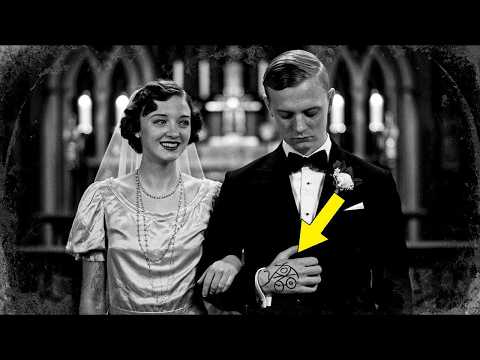
Sarah called over her supervisor, Dr. James Morrison, a man who had spent forty years studying New England history. He peered at the screen, his bushy eyebrows furrowing. “Enhance it further,” he said quietly. As the magnification increased, the symbols became unmistakable: three intersecting lines forming a star, with smaller glyphs radiating outward. The precision was unsettling. Whoever had made these marks had done so with careful intention.
“I’ve never seen anything quite like this,” Dr. Morrison admitted. “The positioning suggests he was trying to hide them, but why have them at all? And why wear them to your wedding?”
Sarah was already pulling up the donation records. The photograph came from the estate of Elellanena Whitmore, who had passed away at 103. She was Margaret’s daughter—born in 1916, four years after the wedding. But Thomas Aldridge had no death record. No burial. After 1913, he simply vanished.
The next morning, Sarah arrived at the archive before dawn, finding Dr. Morrison already surrounded by old newspapers. “I’ve been going through the Milbrook Gazette,” he said. “Thomas was a respected banker. Then after February 1913—nothing.”
Sarah pulled up a sketch from an 1889 journal kept by a traveling preacher named Reverend Josiah Blackwood. He had documented “devil’s marks” seen during his travels through New England—symbols remarkably similar to those on Thomas’s hand. “The similarity is undeniable,” Dr. Morrison said. “But Blackwood was dismissed as a fanatic.”
“What if he actually saw something?” Sarah countered. “What if these markings were more common than we thought—just hidden?”
Their research was interrupted by Martha Hendris, the society’s eldest volunteer, who possessed an encyclopedic knowledge of local lore. “I heard you two were looking into the Aldridge family,” she said, settling into a chair. “My grandmother knew Margaret. Said she was a lovely woman, but there was always a sadness about her. Never remarried after Thomas disappeared.”
“Disappeared?” Sarah leaned forward. “So it was known?”
“Oh yes. The official story was that he went west for business and never returned. But my grandmother said Margaret would sometimes talk in her sleep, calling out for Thomas to come back from the dark.” Martha paused. “There was talk, too. Some said he’d been seen at strange hours, walking the woods beyond Milbrook. Others claimed he’d been visiting a woman who lived alone at the edge of town—Constance Gray. She was what polite folks would term eccentric.”
After Martha left, Sarah and Dr. Morrison pieced together a timeline. Thomas had arrived in 1910, charming and ambitious. His courtship of Margaret Whitmore had been the social event of 1911. But by autumn 1912, just months after the wedding, he began missing work, claiming illness. Witnesses reported seeing him entering the woods at dusk. Bank records showed strange symbols doodled in the margins of ledgers, appointments canceled without explanation.
Then Sarah found it: a police report from January 1913. Someone had carved symbols into the wooden pews of St. Augustine’s Church—the same church where Thomas and Margaret were married. The attached sketch bore a striking resemblance to the marks on Thomas’s hand.
“He went back to the church,” Dr. Morrison said quietly. “But why?”
Martha, who had returned with a coat, paused at the door. “If you want to know more about Thomas Aldridge, you might want to visit the church. Father O’Brien is young, but he has access to all the old records. And,” she added, “you might ask him about the sealed crypt beneath the sanctuary—the one they found during renovations in the 1960s.”
After she left, Sarah sat in silence, the wedding photograph still glowing on her monitor. The happy couple frozen in time, unaware that in less than a year the groom would vanish without a trace. She made one last search in the genealogical database. Thomas and Margaret had no children recorded in 1913 or 1914. Elellanena, Margaret’s daughter, wasn’t born until 1916—three years after Thomas disappeared. The marriage certificate listed no father.
“Jim,” she called out as Dr. Morrison was putting on his coat. “There’s something else. Elellanena Whitmore wasn’t Thomas’s daughter.”
Dr. Morrison stopped in the doorway, his face grave. “Then we have to ask ourselves: what happened in those missing years? And why did Margaret keep his photograph all her life?”
As they locked up the historical society, neither noticed the figure watching from across the street—someone who had been waiting over a century for this photograph to surface again.
The morning sun struggled through heavy clouds as Sarah and Dr. Morrison stood before St. Augustine’s Church. The Gothic revival structure loomed against the gray sky, its weathered stones holding over a century and a half of secrets. Father O’Brien, a surprisingly young priest with keen eyes and a firm handshake, met them at the heavy wooden doors.
“Martha Hendris called ahead,” he said, leading them inside. “She said you were investigating something about the Aldridge family. I’ve pulled the records you might find interesting.”
The church interior was dimly lit, shafts of colored light filtering through stained glass windows depicting scenes of redemption and damnation in equal measure. Their footsteps echoed on the stone floor as Father O’Brien led them to a small office behind the sanctuary.
“The church maintains extensive records,” he explained, producing several leather-bound volumes—marriages, baptisms, deaths, and occasionally more unusual entries. Sarah showed him the enhanced photograph, pointing out the markings on Thomas’s hand. Father O’Brien’s expression shifted, becoming guarded.
“You’ve seen these symbols before,” Dr. Morrison observed.
The priest nodded slowly. “During the 1960s renovation, workers discovered a sealed crypt beneath the sanctuary. Inside, they found similar markings carved into the walls. The church ordered it resealed, but not before photographs were taken.” He retrieved a manila folder from a locked drawer, extracting several black and white photographs. The images showed a small stone chamber, its walls covered in symbols that matched those on Thomas’s hand—along with others even more complex and disturbing.
“There’s more,” Father O’Brien continued. “The workers also found remains—not in any coffin or proper burial, but scattered, as if someone had been trying to prevent something from being found intact.”
Sarah felt a chill run down her spine. “Whose remains?”
“Unknown, but they dated to the early 1900s. The church quietly had them cremated and interred in the cemetery.” He paused. “There was also a journal—partially destroyed. Only fragments remained legible.”
He produced a photocopy of the journal pages. The handwriting was cramped, desperate, but Sarah recognized it immediately from the bank ledgers they’d examined. “This is Thomas’s handwriting,” she breathed.
The legible fragments were disturbing. The bargain cannot be undone. She promises power beyond measure, but the cost—Margaret must never know. The marks burn even now. Tried to break free, but the roots run too deep. Constance says there is a way, but I fear—Darkness calls and I answer. Forgive me, my love. By the time you read this, I will be beyond. The church may hold me, but it cannot contain what I’ve become.
Dr. Morrison studied the pages intently. “He was trying to stop something—or stop himself from becoming something.”
“There’s a local legend,” Father O’Brien said quietly, “about a group that met in the woods beyond Milbrook in the early 1900s. They called themselves ‘Seekers of Hidden Knowledge,’ but others had different names for them.”
“Constance Gray was part of this group?” Sarah asked.
“According to the stories, she led it. They were said to practice rituals—seeking power through bargains with, well, with things better left unnamed.”
The priest led them back into the sanctuary, to a section of pews near the back. “This is where the vandalism was found in 1913. The symbols were carved deep into the wood. We had to replace the entire pew.” Sarah ran her fingers along the smooth wood of the replacement, imagining Thomas here in the dark, carving desperately—trying to what? Warn others? Break free? The journal fragment suggested both.
“Can we see the sealed crypt?” Dr. Morrison asked.
Father O’Brien shook his head. “The bishop’s orders were clear. It remains sealed.” But he glanced around as if checking they were alone. “I can tell you what else the workers found. There were scratches on the inside of the ceiling stones—as if something had tried to claw its way out.”
After leaving the church, Sarah and Dr. Morrison drove in silence to the outskirts of town. The old post road had long been abandoned in favor of the newer highway, and nature had begun reclaiming it. They parked where the road became impossible and continued on foot. Constance Gray’s cottage appeared through the trees like something from a nightmare—what remained of the structure overgrown with vines, the roof collapsed, walls crumbling, but the stone foundation remained solid. Carved into the cornerstone were symbols now familiar to both historians.
“She marked her territory,” Sarah said, photographing the symbols.
They explored carefully, aware of the unstable structure. In what had once been the main room, they found evidence of a stone circle set into the floor—its purpose unclear, but its deliberate construction evident.
“Look at this,” Dr. Morrison called from what remained of a back room. Sarah joined him, finding him staring at the remnants of a wall where someone had carved words, barely visible beneath decades of decay. Thomas—the compact is sealed. Payment comes due at the turning of the season. What is given cannot be returned. Below, in what appeared to be different handwriting: He thinks love will save him. He is wrong. The old ones do not forgive broken promises.
Sarah photographed everything, her hands trembling slightly. The rational explanation—that Thomas had become involved with a cult, that guilt and possibly mental illness had driven him to disappear—seemed less and less adequate to explain what they were finding.
As they prepared to leave, Dr. Morrison stopped suddenly. “Do you hear that?” Sarah listened. Beyond the normal forest sounds, there was something else—a rhythmic creaking, like old wood swaying in the wind. But there was no wind.
They followed the sound to a cluster of ancient oaks behind the cottage. Hanging from one massive branch was what remained of a wooden sign, weathered beyond reading—but carved into the tree itself were more symbols and a date. February 13th, 1913.
“The day before Valentine’s Day,” Sarah noted. “The day Thomas disappeared.”
As they made their way back to the car, Sarah’s phone buzzed. She had a message from Martha Hendris: Found something you need to see. Elellanena Whitmore’s diary. Come quickly.
Back at the historical society, Martha was waiting with a small leather journal. “Ellanena gave this to me years ago,” she explained. “Asked me to keep it safe, but never said why.”
Sarah opened it carefully. One entry, dated October 31st, 1962, stood out: Mother is dying. In her delirium, she speaks of father—not the man who raised me, but Thomas. She says he came back once in 1916, the night I was conceived. She says he wasn’t human anymore, but she loved him still. She says I have his eyes.
Dr. Morrison sat down heavily. “This suggests Thomas returned three years after disappearing. But returned as what?”
Martha spoke quietly. “My grandmother said Margaret never removed her wedding ring. Said she was waiting for her husband to come home. Maybe he did—just not in the way anyone expected.”
As night fell over Milbrook, the wedding photograph still glowed on Sarah’s monitor. But now she saw it differently. The markings on Thomas’s hand weren’t just symbols—they were a warning. And somewhere in the darkness beyond the windows, something watched and waited, just as it had for over a century.
What do you think really happened to Thomas Aldridge? Share your theories in the comments below.
Report this article
Select a reason for reporting:






