The clock was already ticking when Elvis Presley slid $1,000 across the table. “Ten minutes, Bob. Write me something I’ll remember tomorrow.” Bob Dylan didn’t touch the money. He just lifted his eyes, calm as still water, and asked, “You want a song you’ll remember, or a song you won’t be able to forget?” The room went cold. This wasn’t a game anymore.
It was past midnight in a private recording studio, early 1970s. The city outside was silent. Inside, only an engineer behind glass, empty coffee cups, and two men who had reshaped American music in opposite ways. Elvis, the poor boy from Mississippi turned global icon. Dylan, the cryptic poet who heard words before they existed. They respected each other, but disagreed on one fundamental truth: Elvis believed a song had to live through the voice. Dylan believed it had to survive without one. That disagreement started everything.
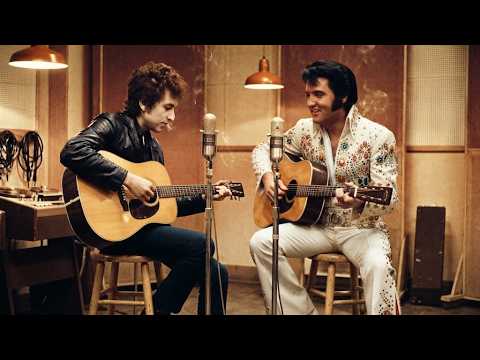
Elvis had laughed at Dylan’s description of songwriting. “You make it sound easy.” Dylan shrugged. “I never said it was easy.” That’s when Elvis pulled out the money. The engineer stopped moving. Dylan stared at the bills. “Let’s find out,” Elvis said, pointing at the clock. “Ten minutes. Write a song that makes me feel something.” Dylan picked up the blank paper. The engineer started the clock. The second hand began moving.
One minute. Nothing. Two minutes. Still blank. Elvis crossed his arms. “Having trouble?” Dylan ignored him. Three minutes. Four. “You’re halfway to losing, my friend.” Dylan finally looked up. “You’re talking too much.” But then he did something strange. He put the pencil down. Elvis’s laughter faded. “What are you doing?” Dylan didn’t answer. Instead, he looked directly into Elvis’s eyes and asked, “What did you want before you were famous?”
Elvis frowned. “What?” “Before the records. Before Hollywood. Before anybody screamed your name.” Elvis glanced at the clock. “You’re supposed to be writing.” “I am.” A pause. Then Elvis answered slowly: “A better life for my family.” Dylan nodded. “What did your mother want?” Everything changed. The amusement vanished from Elvis’s face. The studio seemed to shrink. “She wanted me to be happy.” Dylan picked up the pencil for the first time. He wrote one line, then stopped.
“What do you miss?” Elvis didn’t answer. The clock kept ticking. Dylan waited. Finally, Elvis whispered one word: “Home.” Dylan wrote another line. “What scares you?” Elvis smiled. “Not much.” Dylan didn’t smile back. He just stared. Elvis’s confident expression slowly disappeared. Five minutes remained. “What scares you?” Elvis looked through the glass toward the dark recording booth. Seconds passed. Then, barely audible: “Being surrounded by people and still ending up alone.” Nobody moved. The engineer slowly lowered his hand from the console.
Dylan began writing. Four minutes. “When 20,000 people scream your name, what do you hear?” Elvis frowned. “Them.” Dylan shook his head. “No. When you’re alone afterwards.” Elvis’s eyes lowered. The concerts, the lights, the applause—then the dressing room, the hallway, the hotel, the closed door. Finally, he whispered: “Silence.” Dylan wrote. Three minutes. “What would you tell the kid you used to be if he was sitting here?” Elvis froze. He saw Tupelo, a tiny house, his mother, his father—a boy with nothing. “I’d tell him not to hurry. I’d tell him the things he’s trying so hard to escape are going to become the things he misses most.” Dylan’s pencil moved immediately.
Two minutes. One minute. Dylan reached for his acoustic guitar. Elvis looked at him in disbelief. “You’re done?” Dylan said nothing. He adjusted the tuning. Thirty seconds. Elvis pointed at the clock. “You’ve still got time.” Dylan looked directly at him. “The song doesn’t.” The final seconds disappeared. Five. Four. Three. Two. One. Silence. Elvis stared at the handwritten page. Dylan folded it, then pushed every dollar back across the table. “You lost.” Dylan shook his head. “You can’t buy this one.” He placed the guitar against his body. Elvis stopped breathing.
Dylan’s fingers moved across the strings. The first chord was painfully simple. Then he began to sing—and within moments, Elvis realized the song wasn’t about a stranger. It was about a young man running from a small house, chasing lights and applause, who finally got everything he dreamed of—only to discover the home he’d been running from was the one place he desperately wanted to see again. Elvis’s smile vanished. Then came the mother’s voice, a quiet kitchen, old floors, an ordinary morning. Elvis lowered his head. His eyes filled with tears.
Dylan kept playing. The verse about thousands knowing your name while almost nobody truly knows you. Elvis looked up. Because in less than ten minutes, Bob Dylan had written down something Elvis had spent his entire life trying not to say. And Dylan still hadn’t reached the final verse. The $1,000 sat untouched. The clock had stopped. The challenge was over. Yet somehow, the real test had only begun.
Dylan’s voice stayed low and rough as the song moved into another verse. It told of a man who had spent years climbing toward everything he once believed would save him—money, recognition, bright lights, crowds chanting his name. But after the last concert ended, after the doors closed and the voices disappeared, the man discovered something waiting for him that success had never managed to defeat: loneliness. Thousands could know his name while almost nobody knew the person answering to it.
Elvis slowly lowered his eyes. Dylan noticed, but he didn’t stop. His fingers moved gently across the acoustic guitar. Then came the final verse. The successful man was older now, looking backward across the years, speaking to the poor young boy he had once been. But he wasn’t telling that boy how to become famous. He wasn’t warning him about failure. He wasn’t telling him to work harder. Instead, the message was painfully simple: Don’t rush through the days you think don’t matter. Because one day, those ordinary days might become the ones you’d give everything to live again.
Dylan played the final chord. The strings vibrated beneath his fingers, then faded. Silence. Elvis remained completely motionless. Nobody behind the glass moved. The engineer stared into the studio. The money still sat between the two men. Finally, Elvis lifted one hand and wiped beneath his eye. He looked at Dylan, then at the handwritten page. “You wrote that in ten minutes.” Dylan slowly shook his head. “What do you mean?” Dylan placed his guitar down, then looked directly at him. “It took your whole life to write it.” Elvis stared. Dylan pointed toward the folded page. “I just listened.”
That sentence hit Elvis harder than the song. He stood, not quickly, not angrily. He simply needed to move. Elvis walked toward the recording booth window and stared through the glass. His reflection floated across the dark surface. For years, people had looked at that face and seen everything they wanted Elvis Presley to represent: confidence, power, fame. But Dylan had looked at him for less than ten minutes and found the frightened boy beneath all of it. Elvis finally spoke. “How did you know?” Dylan frowned. “What?” “That part about being alone.” Dylan watched him, then gave an answer Elvis hadn’t expected. “Because loneliness doesn’t care how famous you are.”
Elvis slowly turned. Neither man smiled. For the first time that night, they weren’t Elvis Presley and Bob Dylan. They were simply two men who understood something most people outside that room could never imagine: the strange price of being known by everyone, and perhaps truly known by almost nobody. Elvis returned to his chair. He picked up the $1,000, then held it toward Dylan. “You won.” Dylan didn’t take it. “Take it.” Dylan shook his head. “That wasn’t the bet.” “Yes, it was.” “No. You told me to make you feel something. You never said I had to sell it to you.” Elvis stared at him, then suddenly laughed—not the polished laugh he gave interviewers, not the laugh fans expected. This one came through tears. “You’re a difficult man, Dylan.” Bob almost smiled. “I’ve heard that.”
Elvis looked at the $1,000, then placed it back on the table. “Fine.” Dylan leaned backward. Elvis reached toward the second acoustic guitar. “Then I’ve got another challenge.” Dylan raised an eyebrow. “What?” Elvis picked up the guitar. He looked at the handwritten page. “You wrote it. Let me find out if I can make it live.” Dylan’s expression changed. For several seconds, he said nothing. Then he handed Elvis the page. Elvis unfolded it carefully. He read the first line, then the second. The words were different now. When Dylan had sung them, Elvis had heard somebody else’s voice describing his life. Now the page was in Elvis’s hands. There was nowhere to hide.
He adjusted the guitar. Dylan watched. The engineer leaned toward the console. Elvis played the opening chord. Immediately, Dylan knew it would sound different. His version had felt like a lonely road after midnight—empty, cold, a man walking away from everything he once knew. But Elvis’s first notes felt like someone standing at the end of that road, finally turning around and realizing home was too far away to reach. Elvis began singing quietly. No performance voice, no theatrical movement, no attempt to impress anybody—just the words.
Dylan stopped moving. The song reached the image of the small house. Elvis’s voice softened. Then the mother’s voice, the kitchen, the old floors, the ordinary mornings. Elvis closed his eyes. His voice became heavier. The engineer behind the glass slowly removed his headphones. He didn’t need them. He could feel what was happening through the window. The words Dylan had pulled from Elvis were now returning through Elvis’s own voice. And somehow they hurt more. Dylan had written the wound. Elvis was opening it.
The song continued. Elvis reached the verse about crowds—thousands of voices, thousands of hands, thousands of people calling one man’s name. His voice grew. For a few seconds, the small studio seemed too narrow to contain it. Then came the silence after the crowd. Elvis suddenly pulled everything back. His voice became almost a whisper. Dylan looked down. He understood. This wasn’t technique. It wasn’t volume. Elvis wasn’t merely singing the song. He knew exactly where the silence lived.
The final verse approached. Elvis looked at the handwritten page. The older man speaking to his younger self. Don’t hurry. Don’t treat ordinary days as though they don’t matter. Don’t spend your entire life racing toward tomorrow without noticing what today contains. Elvis’s voice cracked. He could have stopped. He could have repeated the line. He could have corrected it. He didn’t. He allowed the crack to remain because perfection would have ruined the truth. Elvis reached the final words, then played the last chord. Silence returned.
Dylan stared at the floor. Elvis waited. Nothing. Finally, Elvis smiled faintly. “What’s wrong?” Dylan slowly raised his head. His expression was different now. The challenge had changed him, too. “Now I understand something.” Elvis lowered the guitar. “What?” Dylan pointed toward Elvis’s chest. “I can write where the wound is.” A pause. Then Dylan finished, “But you know how to make everybody else feel it.” Elvis said nothing. For several seconds, the two men simply stared at each other.
The argument that had started the bet suddenly seemed ridiculous. Was the writer more important? Was the singer? Did the words matter more than the voice? That song had just answered the question. Neither was enough alone. Elvis looked toward the $1,000, then suddenly reached for it. Dylan watched. Elvis counted the bills. He divided the money into two equal piles. Dylan laughed. “What are you doing?” Elvis pushed one pile toward him. “Five hundred for the writer.” Then Elvis pulled the second pile toward himself. “And five hundred for the singer.” Dylan looked at the money, then at Elvis. For several seconds, he remained completely serious. Finally, he smiled. “What about the song?” Elvis’s expression changed. He looked toward the microphone, then toward the handwritten page. He slowly shook his head. “That belongs to neither of us.” Dylan leaned forward. “Then who does it belong to?” Elvis didn’t answer immediately. He stared at the microphone as though imagining somebody somewhere hearing those words years from now. Then he said, “Anybody who’s ever gotten what they wanted and discovered they still missed what they lost.”
The room became silent again. But Dylan wasn’t finished. He looked at Elvis. “You know what your problem is?” Elvis raised an eyebrow. “I’ve got a feeling you’re going to tell me.” Dylan nodded toward the handwritten song. “You thought tonight was about whether I could write something in ten minutes.” Elvis smiled faintly. “Wasn’t it?” Dylan shook his head. “No. It was about whether you’d tell me the truth quickly enough.” Elvis’s smile disappeared. Dylan pointed toward him. “The song was already there.” Elvis stared at the page. Dylan continued. “Your mother. Home. The crowds. The silence. The kid you used to be. I didn’t invent any of it.” Elvis slowly looked up, and then Dylan asked one final question. “So, why did it take a $1,000 bet for you to finally say it?”
Elvis froze. The engineer behind the glass stopped moving. Because suddenly Elvis understood that Bob Dylan had uncovered something far more important than a song. And his answer would reveal why the man who seemed to have everything still couldn’t stop looking backward. Bob Dylan’s question remained unanswered. Why did it take a $1,000 bet for you to finally say it? Elvis Presley stared at him. The recording studio was silent. The engineer behind the glass didn’t move. The two piles of money sat forgotten on the table, and beside them lay the handwritten song that had somehow turned a playful challenge into something neither man had expected.
Elvis slowly placed his guitar down. “Maybe because nobody asks.” Dylan frowned. “Nobody asks what?” Elvis leaned back. “The right questions.” Dylan watched him. “People ask about records, movies, concerts, cars.” Elvis smiled faintly. “They ask what it’s like hearing thousands of people scream your name.” Then the smile disappeared. “Nobody asks what happens when they stop.” Dylan looked toward the handwritten page. “Maybe because they don’t want to know.” Elvis raised his eyes. Dylan continued. “People like the dream. The poor kid becomes rich. The unknown singer becomes famous. The whole world knows his name. That’s where people want the story to end.” Elvis nodded slowly. “But it doesn’t.” “No. That’s usually where the complicated part starts.”
Elvis laughed quietly. There was no joy in it. He looked through the dark studio glass. “When I was a kid, I thought money would fix everything. If my family had enough money, nobody would have to worry. If I could buy my mother a house—” Elvis stopped. His expression changed. “Then I’d done something.” He looked down. “And I did.” Dylan remained silent. “But nobody tells you money can solve one problem and leave ten others sitting right where they were.” Elvis touched the handwritten page. “You wrote about that little house.” Dylan nodded. “I didn’t tell you much about it.” “You didn’t have to. You told me you missed home. That was enough.” Elvis shook his head. “How?” Dylan thought for a moment. “Because people don’t usually miss walls. They miss what happened between them.”
That sentence landed hard. Elvis looked away. Suddenly, the tiny house in Tupelo wasn’t a building. It was his mother’s voice. His father’s footsteps. Meals that seemed ordinary. Rooms that once felt too small. Days when nobody outside the neighborhood cared who Elvis Presley was. And Dylan had understood all of it from one word: home. Elvis quietly asked, “You ever miss who you were before all this?” Dylan’s expression changed for the first time. Elvis had turned the questions around. Dylan looked toward his guitar. “Sometimes.” “Which part?” Dylan smiled faintly. “The part that didn’t have to explain himself.” Elvis nodded. He understood immediately.
Two men from different worlds. Two different kinds of fame. Two completely different approaches to music. Yet both had discovered the same strange truth: once the world decided who you were, it became difficult to simply be yourself. Elvis leaned forward. “That’s what nobody tells you.” “What?” “You spend years begging people to notice you. Then one day you’d give anything to disappear for an afternoon.” Dylan smiled. “That’s a song.” Elvis laughed. “You’re not getting another $1,000.” For the first time in several minutes, laughter entered the studio. Even the engineer behind the glass smiled, but it disappeared quickly.
Dylan looked toward the page. “You know why that song hurt?” Elvis raised an eyebrow. “Because it was about me.” “No. Because it wasn’t only about you.” Elvis waited. Dylan continued. “Everybody runs towards something—a better job, a bigger house, more money, someplace they think they’re supposed to reach. And sometimes they get there.” Elvis slowly nodded. “Then they look backward and realize they weren’t paying attention while their life was happening.” Elvis stared at him. The line about not rushing through ordinary days returned to him. The days that felt unimportant. The meals, the conversations, the quiet mornings, the people you assume will still be there tomorrow. Elvis looked toward the microphone. “That’s who the song belongs to.” Dylan nodded. “Now you understand.” “Anybody who looked backward too late.” “Exactly.”
Neither man spoke. The engineer’s clock continued moving, but time itself seemed irrelevant now. Ten minutes had created the song, but the emotions inside it had taken years to accumulate. Elvis picked up the handwritten page again. He read several lines silently, then asked, “What happens to it?” Dylan shrugged. “Maybe nothing.” Elvis looked surprised. “Nothing?” “Songs don’t always need a destination.” Elvis shook his head. “This one does.” “Why?” “Because somebody needs to hear it before they make the same mistake.” Dylan studied Elvis carefully. “What mistake?” Elvis looked down, thinking. “Tomorrow is more valuable than today. When you’re poor, tomorrow feels like salvation. Tomorrow you’ll have money. Tomorrow you’ll get out. Tomorrow people will respect you. So you run toward it.” He paused. “And then you finally reach some of those tomorrows and start wishing for yesterday. That’s a cruel joke.” Dylan replied quietly. “Maybe. Or maybe that’s why songs exist.” Elvis looked up. “To do what?” “To remind somebody before it’s too late.”
That thought stayed between them. The handwritten page no longer seemed like evidence that Dylan had won a challenge. It felt like a warning. Elvis slowly folded it, then unfolded it again. He couldn’t put it away. Dylan noticed. “You want to keep it?” Elvis smiled. “I thought you said it belonged to everybody.” “It can belong to everybody and still sit in your pocket.” Elvis laughed, then became serious. “I want to record it.” Dylan’s expression didn’t change. “Why?” Elvis looked surprised. “You just heard me sing it.” “I did. So why do you want to record it?” Elvis opened his mouth, then stopped. The obvious answer would have been because it was good. Because people would listen. Because it could become a record. But after everything that had happened, those answers felt too small. Finally, “Because I need to hear myself say it again. Maybe more than once. Maybe until I believe it.” Dylan slowly nodded. Now he understood. Elvis didn’t want another song. He wanted a reminder.
The studio became quiet again. Then Elvis suddenly reached for the $1,000. Dylan watched. Elvis pushed both piles back together. $1,000 exactly where the night had begun. Dylan raised an eyebrow. “What now?” Elvis smiled. “The bet isn’t finished. I wrote the song and I sang it. We still haven’t decided who won.” Dylan laughed. “I don’t care.” “I do.” Dylan leaned backward. “Fine. Who won?” Elvis looked at the money, then at the handwritten page, then toward the engineer behind the glass. Finally, he said, “Neither of us.” Dylan’s smile disappeared. Elvis continued, “I challenged you because I wanted to prove something—that songwriting wasn’t as easy as people thought. And you wanted to prove it wasn’t about speed. But somewhere along the way, we stopped proving things.” Dylan stared at him. Elvis smiled faintly. “Maybe that’s when we actually started making music.”
For the first time that night, Dylan had no immediate answer, because Elvis was right. The competition had disappeared the moment Dylan began listening, and the ego had disappeared the moment Elvis began singing. One man had found the wound. The other had given it a voice. Neither had become smaller because the other was brilliant. Something larger had appeared between them. The engineer finally switched on the studio microphone. His voice came through the speaker. “Gentlemen, what am I supposed to do with that?” Elvis looked at Dylan. Dylan looked at Elvis. For a second, neither spoke. Then Elvis smiled, but before he answered, Dylan reached toward the handwritten page. “Wait.” Elvis frowned. “What?” Dylan stared at the lyrics. “There’s something missing.” Elvis’s smile vanished. “You’ve already finished it.” Dylan shook his head. “No.” He reached for the pencil again. The engineer leaned toward the glass. Elvis watched Dylan place the page on the table. “What are you changing?” Dylan didn’t answer. He wrote one final line. Slowly, deliberately, then turned the paper around and pushed it toward Elvis.
Elvis read the words. His expression changed immediately. He read them again, then looked at Dylan, and suddenly the $1,000 bet no longer mattered at all. Because the final line wasn’t about music. It wasn’t about fame. It wasn’t even about Elvis Presley. It was about the one thing neither man could ever earn back once it was gone. Elvis Presley stared at the final line. Time. The recording studio had become completely silent. Bob Dylan sat across from him with the pencil still between his fingers. The engineer behind the glass watched without moving, and the $1,000 that had started everything remained untouched on the table. Elvis slowly lifted his eyes. “You added this.” Dylan nodded. Elvis looked back at the page. The line wasn’t clever. It wasn’t complicated. It didn’t need to be. Its meaning was simple. A man could lose money and earn it again. He could lose an audience and find another. He could lose success and rebuild. But there was one thing neither Elvis Presley nor Bob Dylan could ever recover once it disappeared: time.
Elvis lowered the page. For several seconds, he said nothing. Then, “That’s what the whole song was about, wasn’t it?” Dylan leaned backward. “You tell me.” Elvis looked toward the dark recording booth window. “No. It wasn’t about becoming famous. It was about what happens while you’re busy becoming something.” That answer changed Dylan’s expression. Elvis continued, “You think you’re chasing a better life. You tell yourself you’ll slow down later. You’ll call later. You’ll visit later. You’ll sit down and listen later.” His eyes returned to the page. “Then one day, later isn’t available anymore.” Nobody moved. The little house returned to Elvis’s mind. His mother’s voice, the kitchen, the ordinary mornings—things that once seemed insignificant because he believed there would always be another one. That was the truth Dylan’s song had uncovered. Elvis had spent years running toward a larger tomorrow, only to discover that some of yesterday’s smallest moments had become impossible to replace.
Elvis slowly sat down. He looked at Dylan. “You know what’s strange? When you’re poor, money looks like time. You think if you have enough money, you’ll finally control everything. You can go anywhere. Buy anything. Fix things.” He looked toward the $1,000. “But money can’t make somebody wait for you. It can’t make a morning happen twice. It can’t put somebody back in the kitchen. And it can’t make you young enough to realize what you should have appreciated.” Dylan nodded slowly. “That sounds like another verse.” Elvis smiled. “No. I think we’ve done enough damage tonight.” Dylan laughed. The engineer behind the glass laughed, too. For a moment, the heaviness disappeared.
Then Elvis looked at the money—the reason they had been sitting there in the first place. $1,000. Ten minutes. One ridiculous challenge. Elvis picked up the bills. Dylan watched. “You still trying to pay me?” Elvis shook his head. “No.” “Good.” Elvis laughed. “You really don’t like winning, do you?” “I like winning. I just don’t think that’s what happened.” Elvis became serious. Neither did he. The night had started as a competition between two artists who approached music differently. Elvis believed a song had to come alive through the voice. Dylan believed the words had to survive on their own. But somewhere between the blank paper and the final chord, both men had discovered that the argument was meaningless. Dylan had listened deeply enough to find the wound. Elvis had sung honestly enough to make someone else feel it. The song existed because both had stopped trying to prove they were right.
Elvis looked toward Dylan. “You know what you did?” Dylan shrugged. “Wrote a song.” “No. You listened. Most people listen because they’re waiting for their turn to talk. You listened for what I wasn’t saying.” Dylan looked toward the page. “That’s where songs usually are.” Elvis smiled faintly. “Maybe people, too.” Dylan looked back at him. For several seconds, neither man spoke. Then Dylan nodded. “Maybe.”
The engineer’s voice suddenly came through the speaker. “Gentlemen, I still need to know what happens to that.” Elvis looked at Dylan. Dylan looked at Elvis. Then Elvis laughed. He picked up the $1,000. For a second, he seemed ready to put it back into his pocket. Instead, he separated it again. Two equal piles. He pushed one toward Dylan. “Five hundred for the writer.” Then pulled the other toward himself. “Five hundred for the singer.” Dylan stared at him. “You’re serious?” “Completely.” Dylan smiled, then pointed toward the handwritten page. “What about the song?” Elvis looked at it. His smile slowly disappeared. He shook his head. “That belongs to neither of us.” Dylan leaned forward. “Who does it belong to?” Elvis looked toward the microphone. His answer came quietly. “Anybody who’s ever gotten what they wanted and discovered they still missed what they lost.”
Dylan didn’t respond. He didn’t need to, because that was the real reason the song mattered. It wasn’t only Elvis’s story. Somewhere somebody had spent years working for a bigger house while missing dinners with their children. Somebody had left home desperate to escape it, then spent decades dreaming about returning. Somebody was still angry at a father they hadn’t called. Somebody assumed their mother would always answer the phone. Somebody was postponing an ordinary afternoon with someone they loved because they believed there would always be another. The song belonged to them.
Elvis picked up his guitar again. He looked toward Dylan one more time. Dylan nodded. But this time there was no challenge, no clock, no money at stake. Dylan lifted his guitar. Elvis adjusted his chair. Two acoustic guitars. Two men. One song. Dylan began. Elvis followed. The first time Dylan had played the song, it had sounded like a man looking backward. The first time Elvis had sung it, it had sounded like a man desperately trying to get home. But now the two versions became one. Dylan’s restraint gave the words space. Elvis’s voice filled that space with emotion. Neither tried to overpower the other. Neither needed to. For one brief moment, two of the most recognizable musical figures of their generation weren’t competing. They were listening.
The engineer slowly reached toward the recording controls, then stopped. He wasn’t sure whether he should capture it. Elvis noticed through the glass. He nodded. The engineer pressed the button. Tape began turning. The song continued. When they reached the verse about the young man leaving home, Elvis closed his eyes. When they reached the mother, his voice softened. Then came the crowds, the fame, the silence afterward. And finally, the boy—the younger version of the man—the one who believed ordinary days were obstacles standing between him and the future. Elvis sang the message Dylan had pulled from him. Don’t hurry through those days. Don’t treat them like they don’t matter, because someday they may become the days you’d give everything to live again. The final chord arrived. This time both guitars stopped together. Silence.
Dylan looked toward Elvis. Elvis looked toward Dylan. Then both men smiled. No applause, no audience, no screaming fans—just an engineer sitting behind glass who seemed afraid to move. Elvis finally leaned back. “Ten minutes.” Dylan raised an eyebrow. “What?” Elvis looked toward the original clock. “That’s all I gave you.” Dylan smiled. “And I thought I was testing how fast you could write.” He shook his head. “But you weren’t writing fast. You were listening fast.” Dylan smiled. “Now you’re learning.” Elvis laughed. Then he picked up the $1,000. He stared at it for several seconds. Paper. That was all it was. At the beginning of the night, it had represented the challenge. Winning, losing, proving. Now it looked almost ridiculous sitting beside what the two men had just created.
The engineer switched on his microphone. “So, seriously, what do I do with it?” Elvis and Dylan looked at each other. Dylan began smiling before Elvis even answered. Elvis turned toward the glass, then said, “Give it to somebody who still thinks money is the most valuable thing in this room.” Dylan laughed. The engineer shook his head. Elvis looked down at the handwritten song. His expression softened. Ten minutes earlier, he had challenged Bob Dylan to prove something. He wanted to see whether a legendary songwriter could create emotion against a clock. Instead, Dylan had shown him something much more uncomfortable. The best songs weren’t manufactured from clever rhymes. They were discovered inside truths people had spent years refusing to say aloud. And Elvis had shown Dylan something in return. Words could describe a wound, but the right voice could make a stranger feel as though the wound belonged to them. One was a storyteller. One was a voice unlike almost any other. Two different artists, two different philosophies, but neither needed to diminish the other to prove his own greatness. Because true artists don’t become smaller when another artist shines. They listen, they learn, and sometimes, they create something neither could have created alone.
Elvis stood. He folded the handwritten page carefully, then looked at Dylan. “You know what bothers me?” “What?” Elvis smiled. “You never answered the original question.” Dylan frowned. “What question?” Elvis repeated Dylan’s words from the beginning of the night. “A song I’ll remember—or one I won’t be able to forget.” Dylan smiled. “Well?” Elvis looked at the page, then toward the microphone. “Finally, I think you know.” Dylan picked up his guitar. Elvis walked toward the studio door, then stopped. He looked back once more at the clock. Ten minutes. That was all it had taken. But the truth was the song hadn’t really been written in ten minutes. The mothers, the small house, the poverty, the ambition, the crowds, the loneliness, the success, the regret—those things had taken an entire lifetime. Dylan had simply listened long enough to hear them. Because sometimes the best songs aren’t written in ten minutes. Sometimes they take an entire life to live and only ten minutes to finally say out loud.
Elvis opened the door, then paused. He didn’t turn around. “Bob?” “Yeah?” “You won the bet.” Dylan smiled. “I know.” Elvis laughed softly and walked out into the dark hallway. The door clicked shut. Dylan sat alone with his guitar, the two piles of money, and the faint echo of a song that had already begun to belong to everyone. The engineer leaned into the microphone one last time. “Should I erase the tape?” Dylan looked at the glass. “No. Keep it. Somebody’s going to need it.” He stood, placed his guitar in its case, and left the $500 on the table—untouched, unclaimed, waiting for whoever came next. The studio lights dimmed. The tape kept turning. And somewhere in the silence, a clock that no longer mattered kept ticking toward a tomorrow that would never be promised to anyone.
What would you tell the kid you used to be if he was sitting across from you right now?
Report this article
Select a reason for reporting:






