David Richardson had seen his share of forgotten treasures. As an estate liquidator, he’d salvaged heirlooms from demolished brownstones, pieced together lives from water-stained letters, and watched history crumble into dust. But nothing prepared him for the trunk he found in a Park Slope demolition in November 2024.
Inside, beneath layers of moldering fabric and faded documents, lay a photograph. Its surface was surprisingly intact—a portrait from 1905, the kind of stiff, formal image that once proclaimed middle-class respectability. Richardson almost set it aside. Then he noticed the woman’s hands.
She gripped the chair arms with white-knuckled tension, her shoulders trembling despite the long exposure. Beside her, a man in a three-piece suit stared into the lens with barely controlled fear. Their postures were wrong—too rigid, too desperate. This wasn’t a celebration. It was a hostage situation.
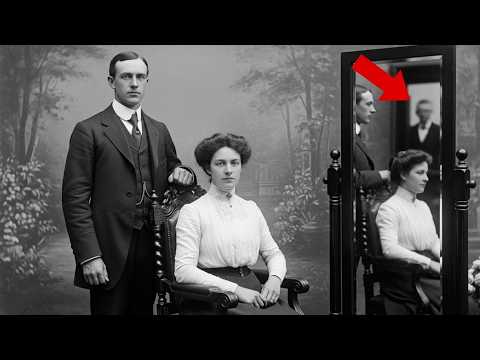
Richardson magnified the image. The backdrop was a painted garden, the furniture ornate Victorian. But behind the photographer’s setup, a large mirror reflected the studio’s entrance—and in that reflection, a third figure stood. A man. Holding a revolver. Aimed directly at the couple.
“The gunman’s reflection showed him blocking any escape route,” Richardson later recalled. “His stance was calm, professional. This wasn’t a random holdup—it was a calculated robbery.”
The back of the photo bore faded ink: Mr. and Mrs. Harrison, April 18th, 1905. Steinberg Studio, Manhattan. Richardson knew the name. Friedrich Steinberg was one of New York’s premier portrait photographers, serving the affluent middle class. But in 1905, his studio was also a target.
Richardson called Dr. Amanda Foster, a Columbia historian who specialized in early 20th-century crime photography. She arrived with magnifiers and a skeptical eye. Within hours, her skepticism turned to fascination.
“The terror in their faces is genuine,” Foster said, studying the couple’s expressions. “Long exposures required absolute stillness. They held that pose for minutes—under threat of death.”
Foster’s research uncovered a police report from April 18, 1905: Armed robbery reported at Steinberg Photography Studio, Fifth Avenue. Multiple victims. No arrests. The crime was real. And it was part of a spree that had terrorized Manhattan’s business district.
But the photograph held more. The gunman’s reflection revealed details never recorded in official files—his weapon, a Colt Police Positive revolver; his positioning, blocking all exits; his calm demeanor, suggesting experience. “This is the only known image of the gentleman bandit,” Foster realized. “A criminal who was never identified—until now.”
As Foster delved deeper, she uncovered the Harrisons’ story: Henry, a Consolidated Edison manager, and Margaret, a former bookkeeper. They had commissioned the portrait to celebrate Henry’s promotion. Instead, they became witnesses to a violent crime—and accidental archivists of a century-old mystery.
The trunk also held Steinberg’s business records, including a letter from March 1905 expressing his fear of robbery. Weeks later, his worst nightmare unfolded in front of his camera. But the story didn’t end there. Police records showed the robbery spree ended in July 1905 when the gunman was killed during a bank heist. His identity remained unknown—until the mirror’s reflection gave him a face.
Foster stood in Richardson’s workshop, holding the photograph under a magnifying glass. The gunman’s eyes seemed to stare back at her, frozen in time. “We’re looking at a ghost,” she whispered. “And he’s been waiting over a century to be seen.”
The exhibition was set for March 2025. But before the world learned the truth, Foster had one more question: What happened to the Harrisons after that day? The answer would lead her to a forgotten act of courage—and a secret the family had kept for generations.
Foster’s search through city directories and church registries led her to a modest graveyard in Queens, where a weathered headstone bore the names Henry and Margaret Harrison. The dates were unremarkable—Henry had died in 1942, Margaret in 1958—but the inscription beneath them stopped her cold: “Witnesses to the storm. Keepers of the light.” It was an epitaph that made no sense for an ordinary Edison manager and his wife.
She traced the couple’s surviving descendants through genealogical forums and a stroke of luck: a great-granddaughter named Claire Donovan, a retired schoolteacher living in Vermont. Donovan answered Foster’s email with a single line: “I’ve been waiting for someone to ask about the photograph.”
A week later, Foster sat in Donovan’s sunlit kitchen, a box of family papers between them. Donovan poured tea and then, without preamble, slid a brittle envelope across the table. “My grandmother wrote this in 1955,” she said. “She never mailed it. I think she was afraid of what it would stir up.”
The letter was in Margaret Harrison’s careful hand, addressed to the New York Police Department’s cold case bureau. It began simply: I am writing to unburden myself of a secret I have carried for fifty years.
Foster read on, her pulse quickening. Margaret described the April afternoon in vivid, trembling detail—the gunman’s calm voice, the way he ordered Steinberg to keep shooting, the click of the revolver’s hammer as the minutes stretched. But then the letter took a turn she hadn’t expected.
“The bandit made a mistake,” Margaret had written. “He called my husband by name. ‘Henry, isn’t it? From the Edison office.’ He knew us. He had been watching us for weeks.”
Foster set the letter down. “The gunman wasn’t a stranger,” she murmured. “He was someone in their social circle.”
Donovan nodded slowly. “Grandmother spent years trying to identify him. She kept a diary of every man who crossed their path that spring—colleagues, neighbors, even the church organist. She never got a name. But she got something else.”
From the box, Donovan withdrew a small leather notebook. Its pages were filled with Margaret’s cramped handwriting, listing dates, locations, and descriptions. On the final page, she had drawn a rough sketch of the gunman’s face—and beside it, a single word: Confession.
Foster turned the page. There, in faded ink, was a name. “Arthur Vance,” she read aloud. “Who was Arthur Vance?”
Donovan’s expression darkened. “My grandmother never told anyone. But my mother let it slip once, years ago. Arthur Vance was Henry’s supervisor at Consolidated Edison. A man everyone trusted. And according to family legend, he died in a bank robbery in July 1905—shot by a guard while trying to escape.”
The pieces snapped together in Foster’s mind. The well-dressed gentleman bandit who knew police patrols, who targeted businesses with precision, who carried notes about Steinberg’s studio—he wasn’t a career criminal. He was a respected utility executive living a double life. “The police never identified him,” Foster said. “Because no one thought to look at Henry’s own boss.”
Margaret’s letter continued: I saw his face in the mirror that day. I knew him. But who would believe a woman’s word against a dead man’s reputation? I chose silence. God forgive me.
Foster sat back, the weight of the revelation settling over her. The photograph had captured more than a crime—it had preserved the moment a trusted friend became a predator. And Margaret Harrison, terrified and powerless, had spent half a century guarding a truth that could have shattered her husband’s career and their hard-won respectability.
“She wasn’t just a witness,” Foster said softly. “She was the only one who knew the whole story.”
Donovan wiped her eyes. “What happens now? Do we tell the world?”
Foster looked at the photograph lying on the table—the trembling couple, the painted garden, the gunman’s cold reflection. “We tell the truth,” she said. “But we also tell Margaret’s part. She survived. She kept her family safe. And she left us a map.”
As Foster gathered the papers, a final detail caught her eye. On the back of Margaret’s sketch, nearly invisible beneath a coffee stain, was a second name—written in a different hand. Friedrich Steinberg, 1921. He knew too.
Foster’s breath caught. The photographer had lived until 1920. If he had known the gunman’s identity, why had he never spoken? And what had he done with that knowledge before he died?
The question gnawed at Foster for the rest of the week. Steinberg had retired in 1920, sold his studio, and vanished from the public record. But a man who had stared down a revolver and kept photographing—who had preserved the bandit’s face in silver and glass—would not have gone quietly into old age without leaving something behind.
She returned to the New York Historical Society archives and pulled Steinberg’s business ledgers for the final year of his operation. The entries were meticulous, each session logged with client name, fee, and date. But in November 1920, the neat columns stopped. On the last page, in a shaking hand, Steinberg had written a single line: Sold to A.V.’s estate. God forgive me.
“A.V.,” Foster whispered. “Arthur Vance. Steinberg sold his studio to the dead man’s estate.”
It made a grim kind of sense. After Vance was killed in the bank robbery, his widow would have inherited his affairs—and perhaps his secrets. If Steinberg had recognized the gunman in the mirror that day, he had said nothing for fifteen years. Then, near the end of his life, he had handed his life’s work to the very family that harbored the truth.
Foster tracked down the probate records for Arthur Vance’s estate. The file was thin, but one document stood out: a deed transfer dated December 1920, listing the purchaser of Steinberg’s studio equipment and client negatives as Eleanor Vance, widow. Attached to the deed was a handwritten inventory. At the bottom, in different ink, someone had added: One trunk of personal effects, unopened, stored in basement.
Foster stared at the line until the words blurred. A trunk of personal effects, unopened, stored in a basement. The same trunk Richardson had pulled from the rubble in Park Slope a century later. The same trunk that had held the photograph, the letter, the sketch.
But that meant the trunk had never belonged to the Harrisons. It had belonged to Eleanor Vance—the widow of the man who had terrorized them. And she had kept it. For decades. Unopened.
“She knew,” Foster said aloud, startling a nearby archivist. “Eleanor Vance knew what her husband was. And she hid the evidence.”
Donovan, when Foster called her that evening, was silent for a long moment. “Or she was afraid,” she finally said. “If people found out Arthur Vance was the gentleman bandit, what would happen to her? To her children? She’d be ruined. They’d all be ruined.”
Foster nodded, though Donovan couldn’t see her. The same calculus that had silenced Margaret Harrison had silenced Eleanor Vance—two women on opposite sides of a crime, bound by the same fear of disgrace. One had written a confession she never mailed. The other had locked a trunk in a basement and hoped the world would forget.
But the world had not forgotten. The brownstone had been demolished, the trunk had surfaced, and the photograph had found its way into David Richardson’s careful hands. The truth, buried for over a century, was finally climbing into the light.
There was one more thread to pull. Foster returned to the Vance estate records and found a name she hadn’t expected: Eleanor Vance, nee Steinberg. The photographer’s daughter had married the man who robbed him.
Foster’s hands trembled as she cross-referenced the names. Eleanor Steinberg, born 1878, daughter of Friedrich Steinberg, married Arthur Vance in 1902. The photographer’s own daughter had wed the gentleman bandit—and after Vance’s death, she inherited both his secrets and her father’s studio.
“She wasn’t hiding evidence,” Foster realized. “She was protecting her father. If the truth came out, Steinberg would be seen as the man who let his daughter marry a criminal—or worse, who covered for him.”
Donovan’s voice cracked when Foster called. “So Eleanor kept the trunk as insurance. A reminder of what she’d survived—and what she’d buried.”
The exhibition opened in March 2025. The photograph hung beside Margaret’s letter, Steinberg’s ledger, and a single line from Eleanor’s diary: I chose silence. May God forgive us all.
Richardson stood before the display, watching visitors lean in to study the gunman’s reflection. “History isn’t just what happened,” he murmured. “It’s what people decided to hide.”
But one question remained: Why had Eleanor kept the trunk unopened for fifty years—and what would she have done if it had been found while she was still alive?
Report this article
Select a reason for reporting:






