Dr. James Mitchell had spent fifteen years examining forgotten photographs, but nothing prepared him for the glass plate negative that arrived on an ordinary Tuesday. As he lifted it to the light, three women stared back—a mother and her two daughters, dressed in their Sunday best, their faces composed with quiet dignity. It was a beautiful portrait, but it was their hands that made his breath catch.
The mother’s fingers were arranged in a precise, unnatural configuration—right thumb crossed over left, index and middle fingers extended, the rest curled inward. Her daughters’ hands rested on her shoulders, but their fingers, too, were positioned with deliberate angles. This wasn’t a pose. It was a code.
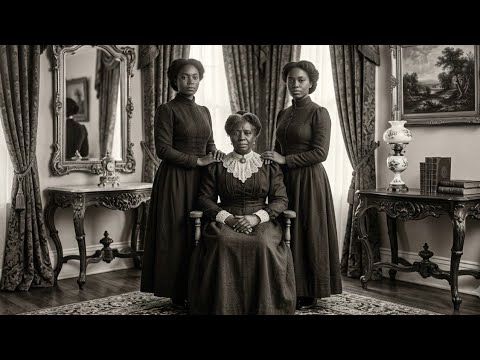
James had spent his career studying Victorian photography. He knew that every element in a 19th-century portrait was carefully orchestrated—exposure times demanded stillness, and photographers directed every tilt of the head and placement of a limb. These hand signals were too specific, too purposeful to be accidental. Then he saw the scratches in the corner of the negative: NY89247. A chill ran down his spine. This was no ordinary family keepsake.
That night, sleep eluded him. He transformed his dining table into a research station, projecting the image onto his wall. The detail was astonishing—he could count the threads in their dresses, see the engraving on the mother’s brooch. But his eyes kept returning to those hands. The mother’s thumb crossing over her left required conscious effort to maintain during the long exposure. Her extended fingers formed a shape almost like a letter. The daughters’ hands mirrored variations of the same deliberate pattern.
James knew that throughout American history, oppressed people had developed ingenious methods of communication—coded quilts, freedom songs, arrangements of household items. But this photograph was dated 1892, nearly three decades after Emancipation. What network could still require such elaborate precautions? What danger still lurked?
He called Dr. Sarah Chen, a scholar of African-American history. “Examine their hands,” he urged when she arrived the next morning. Sarah studied the projection, her eyes narrowing. She pulled out a folder of documents. “After Reconstruction collapsed in 1877, African-American families faced systematic bureaucratic exclusion,” she explained. “Property rights became battlegrounds. Inheritance claims were denied. Even basic proof of identity was weaponized against them.”
She spread legal filings and newspaper clippings across the table. “New York was never the progressive sanctuary people imagine. Families who purchased property legally found themselves unable to prove ownership when challenged by white claimants. No birth certificates existed for people born into bondage. No marriage licenses documented unions performed in secret.”
James retrieved a yellowed clipping from 1891: Property Dispute in Harlem—Family Claims Ownership Without Documentation. “This was everywhere,” Sarah said. “Communities developed sophisticated networks to navigate these hostile systems—pooling resources for attorneys, sharing intelligence about cooperative officials, creating their own verification systems when official channels refused to acknowledge their existence.”
“Secret networks,” James murmured. Sarah shook her head. “Not secret in the sense of hidden—secret in the sense of parallel. Operating alongside official systems, using methods white authorities either failed to recognize or couldn’t comprehend.”
James turned back to the projection. “What if this isn’t simply a family portrait?” he whispered. “What if it’s documentation? What if these hand positions encode information that network members could read and verify?”
The etched numbers proved to be the key. After two days of searching city directories, James found it: Studio 247 belonged to Thomas Wright, a photographer who operated on 8th Avenue from 1888 to 1896. Research revealed something unexpected—Wright was white, but he advertised in African-American newspapers, charged identical rates regardless of race, and spoke passionately about photography as an instrument of dignity. “He was an ally,” Sarah concluded. “A genuine partner in whatever this network was building.”
They called Dr. Marcus Thompson, a cryptography historian. He photographed the hand positions and began digital tracings. “Each distinct position likely represents something specific,” he proposed. “Not individual letters—too complex for a single exposure—but categories, confirmations, status indicators.” Sarah nodded. “What if this system encoded identity verification? These networks desperately needed reliable methods to confirm who people were, whether someone could be trusted with sensitive information.”
They worked into the evening, comparing the portrait to others James had found in the estate sale boxes. Each displayed similar subtle, deliberate hand positioning. “This isn’t a single code,” Marcus concluded. “This is an entire system—multiple signals capable of combination to convey different meanings.”
Then Sarah made the breakthrough. While investigating property rights cases from the 1890s, she identified a striking pattern: dozens of African-American families had successfully defended their claims, obtained identity documentation, established legal proof of marriages—many in cases that should have been hopeless. One attorney’s name appeared again and again: Robert Hayes. His case files frequently included an unusual category of evidence—photographic portraits of the families he represented. “He was using Wright’s photographs as legal evidence,” James realized. “Not merely as proof of physical identity, but as verification of community standing.”
Within Hayes’s archived case files, Sarah uncovered correspondence that illuminated the network’s full scope. A letter dated March 1893 read: We have expanded our photographic documentation to include 73 families. Mr. Wright continues providing his services at minimal cost, understanding the vital importance of this work. The hand positioning system allows us to encode essential information that can be verified by other network members at later dates. Each portrait serves dual purposes—dignified representation for the family and practical identification for our documentation system.
James sat back, overwhelmed. “They constructed an entire parallel documentation infrastructure,” he said quietly. “When official channels failed these families, they created their own mechanisms of protection—and concealed it in plain sight.”
But the story was only beginning. The three women in the portrait had names, descendants, and a legacy that would soon reach across generations. James was about to make a phone call that would change everything.
James dialed the number from the estate sale records with trembling fingers. The voice that answered belonged to Patricia Johnson, seventy-two years old, initially skeptical about a historian’s interest in old family photographs gathering dust in storage.
But when he described the portrait in careful detail—the three women, the ornate chair, the hand positions—her tone transformed entirely. “My great-great-grandmother,” she said quietly, emotion coloring her words. “That’s Eleanor. Eleanor Morrison. The daughters would be my grandmother Ruth and her sister Grace.”
“Please,” James requested gently. “Tell me about them.”
Patricia paused, gathering memories passed down through four generations. Eleanor was born enslaved in Virginia, she began. Came north after the conflict ended, carrying Ruth, just an infant. Grace was born in New York, a free child in a free state. Eleanor worked as a seamstress her entire life, possessing remarkable skill with lace and fine embroidery. That was how she supported the family for decades.
“Did she ever mention being involved with any organizations?” James pressed carefully. “Community groups, anything like that?”
“She was deeply involved in her church,” Patricia responded. “And she helped people. That’s what my grandmother always emphasized. She helped families with paperwork, with finding housing, with connecting to lawyers who would actually represent them. She seemed to know everyone. She understood how to navigate every system, every closed door.”
James’ heart rate accelerated. “Patricia, I believe your great-great-grandmother was part of something truly significant—a network that helped African-American families document their identities and protect their rights during one of the most dangerous periods in American history.”
Silence stretched across the phone line. When Patricia spoke again, her voice was thick with emotion. “She wasn’t trying to conceal. I always knew she was special, but we lost so much history over the years. After Eleanor passed in 1919, the family scattered. My grandmother rarely discussed those early years. Too painful, maybe. Or maybe she was still protecting something even then.”
With Patricia’s blessing, James and Sarah began tracing Eleanor Morrison’s connections throughout the community she had served. Church records from Bethel African Methodist Episcopal Church in Brooklyn documented Eleanor as a member from 1879 until her passing forty years later. She had served on the Ladies’ Aid Society—an organization that officially provided charitable assistance to families in need.
But the society’s meeting minutes revealed something far more structured. The ladies kept meticulous records of every family they assisted—names, ages, circumstances, specific needs. Standard information for any charitable organization. But certain entries included mysterious notations that made no sense in a charitable context: numbers and letter combinations that appeared arbitrary until Sarah recognized the pattern.
“They were cross-referencing,” she explained, excitement building. “The church society identified families requiring documentation. Wright photographed them using the appropriate hand codes for their specific situations. Hayes utilized the photographs in legal proceedings. And the church records maintained the master list of everything—disguised as charity work documentation. It was brilliant, completely invisible to anyone who didn’t know what they were looking for.”
James discovered additional photographs in Wright’s archived collection. The historical society had acquired his entire body of work following his death in 1923, but no one had ever properly examined or cataloged the materials. Dozens of portraits displayed the hand positioning system—families photographed between 1890 and 1896, each image carefully numbered according to the network system, each one documenting people who had been systematically excluded from official records.
They identified other network members through patient research. Samuel Brooks, a teacher who helped families obtain proper school records when administrators refused to acknowledge their children’s enrollment. Mary Chen, a clerk within the city property office who processed deeds and ensured paperwork was properly filed rather than conveniently lost. Reverend James Washington, a minister who performed marriage ceremonies and provided certificates when official channels refused to recognize the legitimacy of black unions.
Each person had taken quiet but genuine risks. Each had used their position within existing systems to help others. Together, they had created something powerful—a shadow archive that preserved dignity and provided protection when official America offered neither recognition nor refuge.
Three months into their research, James and Sarah organized a public exhibition at the historical society. They displayed twenty portraits from Wright’s recovered collection, each showing the hand positioning system, each accompanied by carefully researched stories about the families photographed. Patricia Johnson attended opening night, seeing her great-great-grandmother’s portrait properly honored for the first time in more than a century. She brought her daughter and granddaughter with her. Four generations of Eleanor Morrison’s descendants stood together before the image that had started everything.
But the exhibition’s most powerful moments came when other descendants arrived. James and Sarah had managed to locate families connected to twelve of the photographed individuals. Each brought pieces of the larger story—fragments of oral history passed down through generations, old letters preserved in attic boxes, faded documents that suddenly made sense within the context of the network’s activities.
An elderly man named Thomas Hayes stood before a portrait of his great-grandfather, the lawyer Robert Hayes, photographed with his hands positioned in that same deliberate code used by the families he had served. “I always heard he helped people,” Thomas said quietly, his voice catching. “But I never understood the extent of it. Never realized he was part of something this organized, this sophisticated.”
A woman named Grace Brooks examined a portrait of Samuel Brooks, the teacher who had risked his position to help families document their children’s education. “My family told me he was arrested once back in 1895,” she said. “The charge was helping a family obtain fraudulent documents, but the charges were dropped before trial. Looking at this portrait now, I don’t think those documents were fraudulent at all. I think he was helping people obtain the legitimate documentation they deserved but were deliberately denied.”
The New York Times covered the exhibition extensively. Their article ran with a headline that captured the significance perfectly: Hidden in Plain Sight—How Post-Reconstruction Activists Built a Secret Documentation Network. Within days of publication, historians from across the country began contacting James with their own discoveries. Similar networks had operated in Philadelphia, Boston, Chicago, Baltimore. Throughout the Northeast and Midwest, parallel systems had emerged during the same historical period—all utilizing subtle codes embedded in photographs, all working to document and protect African-American families navigating hostile systems designed to exclude them.
Six months after discovering the portrait, James stood in the conservation laboratory, carefully handling the glass plate negative that had changed everything. They had digitally restored dozens of Wright’s photographs, each now preserved and accessible to descendants and researchers. The Morrison portrait had become iconic, reproduced in textbooks, featured in documentary films, displayed in museums across the country.
But for James, its power remained deeply personal. He thought of Eleanor Morrison—born into bondage, carrying her infant daughter northward toward freedom, building a life of dignity and purpose in Brooklyn, helping countless families navigate systems designed to exclude them, training her daughters in the same work of community protection.
Patricia Johnson had donated Eleanor’s personal papers to the historical society. In one diary entry, Eleanor had written about the photograph: Had our portrait made today. Mr. Wright is a kind man who understands what we are building together. The girls were nervous, but I told them this picture will matter. Someday people will see what we did here. They will understand.
She had been right.
James closed the diary and looked once more at the three women on his screen. Eleanor’s words had crossed 130 years to find him, and he felt the weight of her quiet certainty. “She knew,” he said softly. “She knew someone would eventually look closely enough.”
Sarah traced the network’s final years—dissolving around 1897 as members aged, moved, or died. But its legacy lived on: 63 families with deeds, marriages, and school records that should never have existed. “They couldn’t fix the system,” Sarah said. “So they built their own underneath it.”
James returned the negative to its archival sleeve, but not before one last glance at those hands—still holding their secret in plain sight. The simplest gestures, he thought, could carry the most profound truths.
Now, a question for you: if you discovered a coded message hidden in a family photograph, would you spend years unraveling it—or let it rest?
Report this article
Select a reason for reporting:






