History isn’t just a timeline of dates and names—it’s a kaleidoscope of raw, unfiltered moments that flicker like candlelight in a dark room. Imagine stumbling upon a box of forgotten photographs, each one a portal to a world that feels both alien and achingly familiar. These aren’t your textbook illustrations; they’re the unguarded seconds between heartbeats, where joy and terror, absurdity and grace collide. And once you see them, you can’t unsee the truth: the past wasn’t a distant, sepia-toned fable—it was as vivid, messy, and alive as the air you’re breathing right now.
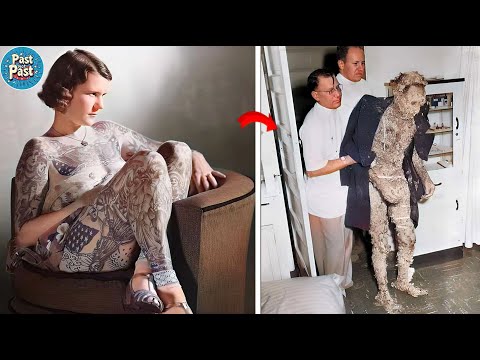
In this collection of over 100 old photos, you’ll meet a tattooed lady from 1938, her skin a canvas of stories long before ink became mainstream. You’ll witness the devastating toll of syphilis before penicillin, a haunting reminder of how fragile life once was. You’ll stand beside Albina Malihoir, a 16-year-old freedom fighter who took two bullets for her country, and you’ll feel the weight of a German soldier’s decade-long separation from the son he barely knew. These images don’t just show history—they drag you into it, forcing you to confront the humanity behind every headline.
But it’s the unexpected details that truly jolt your senses. A farmer painting white stripes on her cow during blackout conditions, a gas-attack resistance stroller from 1938, a coal miner waiting for a shower after a shift in 1958—each frame captures the ingenuity and absurdity of survival. “A woman tests a gas attack resistance stroller in England, 1938, reflecting fears of chemical warfare.” The image sears into your mind: a mother’s desperate hope cocooned in rubber and steel, a baby carriage turned into a fortress against an invisible enemy. It’s a reminder that even in the darkest times, love finds a way to improvise.
Then there are the moments of pure, unscripted defiance. “August Landmasser refuses to salute Hitler, 1936. Facing persecution for marrying a Jewish woman.” In a sea of raised arms, his crossed arms are a silent thunderclap—a single act of courage that echoes through the decades. You’ll see a guerrilla fighter smiling moments before execution at age 24, a mother embracing her son after he escaped a North Korean prison camp, and a blind Muslim carrying his paralyzed Christian friend through the streets of Damascus in 1889. These aren’t just photos; they’re love letters to the human spirit, written in the face of annihilation.
The collection swings from the sublime to the ridiculous. A llama in Times Square, a man testing a one-wheeled motorcycle in 1933, Albert Einstein wearing fuzzy slippers—these are the quirks that make history feel like a friend rather than a professor. “Gino Francesini tried to stretch to 5’7\” to become a fireman, missed by just 1/8 inch.” You can almost feel his disappointment, a tiny, human failure that somehow makes the past more real than any grand monument. And then, the gut-punch: a German soldier returning from Soviet captivity in 1956, his son now a decade older, the embrace captured in a single frame that says everything about loss and resilience.
As you turn each page, the boundaries between then and now blur. You’ll see yourself in the teenagers from the 1950s, in the child workers striking for better conditions in 1902, in the couple posing with their BMW Isetta microcar—a symbol of postwar hope. The photos don’t just change your perspective; they rearrange your DNA. You’ll laugh at the absurdity of a horsedrawn carriage sharing a street with a streetcar in 1917 Manhattan, and you’ll weep at the graves of a Catholic woman and her Protestant husband separated by a wall in 1888. Each image is a heartbeat, a breath, a whisper from the void.
And this is only the beginning. The box is still open, the images still flickering. What you’ve seen so far is just a crack in the door—a tease of the wonders and horrors that await. The past isn’t dead; it’s not even past. It’s waiting for you to look closer, to feel deeper, to let these frozen moments thaw the ice of assumption. Turn the page, and prepare to have your world tilted on its axis. The next photo might just be the one that changes everything.
But the box holds darker treasures too—the ones that don’t just tilt your world but shatter it. “Fall the German guillotine. Executioner France prepares for Matias Connibal Agsburg, 1902.” The blade hangs mid-air, polished and patient, while the executioner’s hands move with the calm efficiency of a man who has done this a thousand times. You can almost hear the crowd’s held breath, the creak of the mechanism, the terrible silence that follows. It’s not violence for spectacle—it’s violence as routine, a grim choreography that once passed for justice.
And then there are the images that make you question what you thought you knew about progress. “X-ray technician’s damaged hand caused by repeated radiation exposure. London, 1900.” The fingers are gnarled, the skin mottled and raw—a sacrifice made in the name of science, long before anyone understood the cost. You think of the invisible rays that once seemed miraculous, and the quiet martyrs who stood in their path. Progress, these photos whisper, is never free.
Some frames stop you cold with their strange, uncomfortable beauty. “Dr. Fukushi Masai, 1878 to 1956, curated the only known collection of tattoos taken from the deceased.” Imagine the shelves: preserved skin, inked with dragons and flowers and names, each one a story that outlived its teller. It’s macabre and tender all at once—a man who saw the art beneath the flesh and refused to let it vanish. You wonder what drove him, what conversations he had with the dying, what promises were made.
Then the collection yanks you back to the raw edge of survival. “A wounded British soldier receives bandages from a Red Cross dog. 1915.” The dog’s tail is mid-wag, the soldier’s face a mask of pain and disbelief. In the mud and chaos of war, a creature with no politics and no hatred offers the simplest gift: a roll of gauze, carried in its teeth. It’s the kind of image that makes you believe, for just a second, that goodness might be instinctive after all.
And just when you think you’ve seen it all, the photos remind you that history is also deeply, gloriously weird. “A pearl diver uses a car’s gas tank as an improvised helmet in the Mississippi River, 1938.” The contraption is absurd—a rusty tank, a hose, a man’s stubborn refusal to give up. You laugh, then realize you’re looking at the ancestor of every DIY fix, every desperate hack that kept someone alive one more day. The past wasn’t just brave; it was resourceful in ways that border on the ridiculous.
The images keep coming, each one a fresh jolt. You see a samurai with a long bow in 1860 Japan, a woman doing the limbo in 1964 Los Angeles, a llama in Times Square in 1957. You see construction workers posing during the building of the Chase Manhattan Bank in 1964, their faces a mosaic of pride and exhaustion. You see the Hindenburg exploding in 1937, the flame a terrible flower against the sky, and you understand—truly understand—that the airship era ended in that instant, along with so much else.
And still, the box isn’t empty. There are more photos beneath these, more stories waiting to be unearthed. The past isn’t just a door you’ve cracked open—it’s a labyrinth, and every turn reveals another face, another secret, another reason to keep looking. What you’ve seen so far is only the surface. The next image might be the one that breaks you open completely.
You keep turning, and the faces blur into a river of strangers who somehow feel like family. “Alfred Eisenstaedt as a professor, 1944. Photo by Lucian Aner.” Wait—no, it’s Einstein, the wild hair unmistakable, the eyes carrying the weight of a world he helped unleash. You catch yourself smiling before the next image wipes it away.
A child practices social distancing during a coronation party in England, 1953. The little girl sits alone in her chair, a paper crown perched on her head, staring at a camera she doesn’t understand. You think of every child who has ever been told to wait, to stay back, to be patient for reasons beyond their grasp.
Then the box hands you something gentler. “A son chases his father marching to World War II. Canada, 1940.” The boy’s legs are mid-stride, his small hand reaching for a coat that’s already slipping away. You don’t need to see the father’s face to know what it holds. Some goodbyes are photographed so often they become part of the language of grief.
And here’s the whiplash again—history refuses to stay in one register. A llama in Times Square, 1957. Sheep on the streets of London in the 1920s. A horsedrawn carriage and a streetcar sharing Manhattan in 1917, as if the century couldn’t decide which way to face. You laugh, and the laugh catches in your throat because you’ve just seen the graves of a Catholic woman and her Protestant husband, separated by a wall in 1888, and the juxtaposition is almost unbearable.
“The first morning after Sweden changed from driving on the left side to driving on the right, 1967.” The streets are a ballet of confusion, cars nosing into each other like nervous animals. You can feel the collective held breath, the entire nation learning a new muscle at once. It’s absurd and magnificent, a reminder that even the most ordinary habits are choices we make together.
The photos keep pulling you deeper. A man holds a punt gun, a shotgun the size of a cannon, aimed at the sky over a marsh. A woman tests a gas-attack resistance stroller. A coal miner waits for a shower, his body a map of the earth he’s been digging. You realize you’re not just looking at history—you’re being asked to hold it, to carry it, to let it change the shape of your hands.
And still the box isn’t done with you. There are more images beneath these, more faces pressing up from the bottom of the pile. The past isn’t a story you finish—it’s a conversation you keep returning to, each time hearing something new in the silence between the words.
And then, near the bottom of the pile, you find the ones that feel like a hand on your shoulder. “A German immigrant family with eight children on Ellis Island, 1904, symbolizing hope for a better future.” Their clothes are worn, their faces tired, but their eyes hold a fire that no ocean could drown. You think of everyone who has ever left everything behind for a maybe.
A horse-drawn carriage passes through a Sequoia in California, 1879. Children care for a dog after its owner’s death in England, 1936. A couple poses with their BMW Isetta microcar, innovation born from rubble. These aren’t grand events—they’re the quiet stitches that hold a century together.
Finally, you reach the last photograph. “Pablo Picasso’s first self-portrait at 15, 1896, versus his last at 90, 1972, with 50,000 artworks in between.” The boy stares out with uncertain eyes; the old man stares back with the calm of someone who has emptied himself onto canvas and found peace in the emptying. Between those two faces lies an entire life—messy, brilliant, unfinished.
You close the box. The room is the same, but you are not. History isn’t a timeline after all; it’s a mirror, and you’ve just seen your own reflection in a hundred strangers’ eyes. So tell me—which of these frozen moments made you feel most alive, and what would you have done if you’d been the one holding the camera?
Report this article
Select a reason for reporting:






