Imagine walking into a general store in Ohio in the spring of 1865. You hand the shopkeeper a crisp $5 bill for a sack of flour and some coffee. He takes it, holds it up to the light, squints, flips it over, and pulls a thick, dog-eared booklet from under the counter. He is not being paranoid. He is being prudent. Because in that moment, there is roughly a one in three chance that the bill in his hand is completely fake.
That is not a conspiracy theory. It is the official estimate from the United States Treasury. By 1865, an estimated one-third of all paper currency circulating in America was counterfeit. Some historians argue the real number was closer to one in two. The money in your pocket, your neighbor’s pocket, the money financing farms and factories and funerals—roughly a third of it was bogus.
So the obvious question, the one nobody really wants to answer honestly, is this: If one-third of America’s money was fake, then who exactly was printing it? And more importantly, how did a nation ever let it get that far?
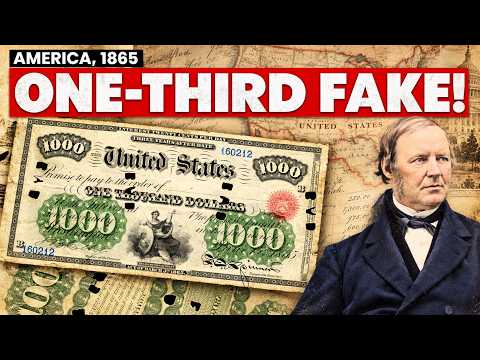
To understand how a third of a country’s money becomes counterfeit, you have to first understand something that will sound almost unbelievable to a modern listener. For most of the first 80 years of American history, the federal government did not actually print paper money. There was no uniform dollar bill. There was no face of George Washington on a green piece of paper. What there was instead was chaos. Beautiful, hand-engraved, wildly inventive, often fraudulent chaos.
The Constitution forbade individual states from issuing paper money, but the states found a workaround that was almost comical in its loopholes. They simply chartered private banks and let those banks print whatever they wanted. In 1800, there were only 29 banks in the entire United States. By 1860, there were an estimated 1,562 state-chartered banks, each one producing its own currency, each one with its own designs, denominations, colors, and vignettes.
Some of these notes were works of art. Vermont printed money in a pale orangey pink that looked more like a wedding invitation than a dollar bill. South Carolina issued a $50 note engraved with farm workers and an enslaved man hauling cotton. Nebraska printed a $3 bill showing an ox team pulling a wagon across the plains. There were bills with nude figures on them, bills with mermaids, bills with eagles clutching lightning bolts, bills with scenes of trains, factories, allegorical goddesses, children at play, and in one case, a bill from a Massachusetts bank that featured a portrait of Santa Claus.
By the 1850s, somewhere between 7,000 and 10,000 different varieties of legitimate bank notes were circulating in the country at the same time. Over the full span of the so-called obsolete bank note era, which ran roughly from 1782 to 1866, more than 30,000 unique designs were issued by over 2,500 different banks.
Think about what that means for a shopkeeper. Imagine trying to tell real from fake when there are tens of thousands of different real designs and new ones are being added every month. The sheer visual noise of American currency during this era was staggering. $3 bills, $7 bills, bills in strange denominations that would seem alien today. Bills printed in orange, red, green, blue, black, and every variation in between. The dollar was not a single thing. It was thousands of things pretending to be the same thing, and this is where the counterfeiters came in.
For a crook with a steady hand, an engraving tool, and even a modest print shop, this system was less a banking network and more an open invitation. All a counterfeiter had to do was pick an obscure bank in a far-off state, study a sample of its notes, carve a plate, print the fakes, travel somewhere where no one had ever seen a real version of that bank’s money, and spend. By the time anyone figured out something was wrong, the counterfeiter was three states away.
Even worse, the actual banks themselves were sometimes nearly as fraudulent as the forgers. The era between 1837 and 1863 is now known as the wildcat banking era, and the name is literal. Shady operators would open a bank deep in the backwoods of Michigan or Georgia or the wilderness of the frontier, in a place so remote that no one would ever realistically travel there to redeem their notes for actual gold or silver. The bank would print thousands of dollars in paper money, send it circulating hundreds of miles away where it looked legitimate, and when curious regulators finally wrote out to inspect the vault, they would find it empty or filled with a few barrels of nails topped with a thin layer of gold coins.
In some cases, the same gold coins were shuttled from bank to bank just ahead of the inspector in a traveling theater of fake reserves. Michigan state banking commissioners reporting back to the legislature in the late 1830s wrote that the state was flooded with paper currency issued by institutions that could not possibly make good on their obligations, and that by the time they could be investigated, the damage had already been done.
In certain regions, as much as half of all paper money in circulation was believed to be counterfeit or spurious, meaning it had been printed in the name of banks that did not even exist. There were notes from the Merchants Bank of Utica that had no parallel on Earth. There were bills issued by banks that had failed years ago and never been removed from circulation. Some shopkeepers simply refused to take any bill they did not personally recognize. Others, resigned to the madness, would accept any note at a steep discount, as low as 50 cents on the dollar, just to be rid of the risk.
Out of this disaster, an entire shadow industry was born. If you could not trust the money, somebody had to tell you which money to trust. Enter the counterfeit detector, a bizarre little publication that most Americans today have never heard of. The First Bank Note Reporter was published in 1826. By the 1840s and 1850s, every major American city had at least one. These were thick weekly or monthly booklets, usually printed in New York, Philadelphia, Boston, or Hartford, that listed every bank in the country, every denomination they issued, and every known counterfeit, altered, or spurious note associated with them.
The two most famous were Thompson’s Bank Note Reporter, founded by a New York banker named John Thompson in 1842, and Hodges’ Bank Note Safeguard, published by the Hodges family of New York. These publications would describe a bill in painstaking detail. The 1854 edition of Thompson’s might describe a counterfeit note from the Bank of Charleston as having a railroad and a mountain scene with a specific flaw in the vignette. Another entry might warn that notes from the Chesapeake Bank of Maryland had been found with Chesapeake misspelled, missing the final E. A note from a bank in Troy, New York was flagged because it was really a reissued and altered note from a Farmers Bank in Texas, with the location crudely scraped off and a new one engraved in its place.
Merchants and bankers paid real money for these guides because without them, running a business was effectively a form of gambling. The publishers themselves became accused of corruption, taking bribes to puff the ratings of suspicious banks, a practice that made the detectors themselves sometimes unreliable. And here is one of the strangest twists in the entire story. That same John Thompson, the man who built his fortune publishing a counterfeit detector, would go on to found two banks, including Chase National Bank, which eventually became J.P. Morgan Chase, one of the largest financial institutions in the world today. The chaos of fake money built real empires.
Now, you might be wondering how this situation could possibly have gotten so bad. The answer actually goes back decades before the Civil War, and it involves one of the oldest tricks in the book, which is weaponizing a nation’s own currency against it. During the Revolutionary War, the British had a devastating strategy against the colonists. They printed massive quantities of fake Continental currency, the paper money being issued by the fledgling American government, and smuggled it into the colonies. The flood of counterfeits became so overwhelming that the Continental dollar collapsed in value, which is where the old American phrase not worth a Continental comes from. It was not a metaphor. It was a monetary catastrophe caused by what we would today call economic warfare.
The British had figured out something the Americans would spend the next 100 years learning the hard way. If you cannot win a war on the battlefield, you can win it in the pockets of the enemy. That lesson would be revived with devastating effect during the Civil War, when both sides used counterfeiting as a weapon, both legally and illegally against each other.
The Continental dollar collapse had left a scar in the national psyche that lasted generations, and it is one of the reasons the Constitution was later written to forbid states from issuing their own paper money. But that constitutional prohibition did not stop private banks, chartered by those same states, from doing exactly the same thing in all but name. The loophole stayed open, and the counterfeiters, as always, walked right through it.
Which brings us to the single most important year in the story of American money: 1861. The Civil War breaks out, and almost immediately the federal government faces a terrifying financial problem. The war is going to be ruinously expensive. The existing revenue, mostly from tariffs and excise taxes, is nowhere near enough. There is no income tax yet. There is no national paper currency. The United States Treasury is essentially broke.
Secretary of the Treasury Salmon P. Chase, a tall, severe, deeply ambitious Ohio politician who had been Lincoln’s political rival and was now his finance chief, had to find a way to pay for armies, ships, rifles, uniforms, and payroll for hundreds of thousands of soldiers. Borrowing from private banks at crushing interest rates was not going to cut it. So, Chase did something that had almost no precedent in American history. He convinced Congress to let the federal government print its own paper money, backed not by gold or silver, but simply by the promise of the United States itself.
On February 25th, 1862, Congress passed the first legal tender act. The Treasury would print $150 million in paper notes. On the back, they were printed with a distinctive green ink, which is where the nickname greenback came from, and the name has stuck for over a century and a half. By the end of the war, through subsequent legal tender acts in July of 1862 and March of 1863, that number ballooned to roughly $450 million in greenbacks circulating across the country. Chase even put his own face on the $1 bill, which some historians argue was an early campaign stunt for a presidential run he would later launch unsuccessfully. The $10 note, meanwhile, carried the first portrait ever of Abraham Lincoln.
But here is where things get interesting, and where the counterfeiting problem exploded into a full-blown national emergency. The greenbacks were new. People did not know what they were supposed to look like. The federal printing processes were still being developed and refined. Counterfeiters took one look at this situation and licked their lips. The country was already drowning in fake state bank notes. Now, there was a whole new category of federal paper money being churned out in massive quantities by a government that had never done this before.
Within months, counterfeit greenbacks were appearing in cities from New York to Chicago to St. Louis. Confederate counterfeiters, Union counterfeiters, foreign counterfeiters, independent crooks, organized rings, all of them went to work. By some estimates, counterfeiting of federal notes became one of the fastest growing industries in America during the war years. And meanwhile, the Confederate government was dealing with the same disaster from the opposite direction. Confederate currency, printed by the breakaway Southern states, was being counterfeited so aggressively and so cheaply that the entire Southern economy was being quietly poisoned by its own money. In some cases, the counterfeit Confederate notes were actually printed on higher quality paper than the real ones. Southern soldiers would occasionally throw away genuine Confederate bills in favor of the northern printed fakes because the fakes were less likely to tear in the rain.
Nobody did this better or more openly than a man named Samuel Curtis Upham. Upham was a Philadelphia shopkeeper, a stationer, a former gold prospector, a part-time journalist, and above all, an opportunist with impeccable timing. In late February of 1862, he noticed something strange at his little shop at 403 Chestnut Street. Customers kept lining up to buy copies of the Philadelphia Inquirer. That particular issue happened to feature on its front page a reproduction of a Confederate $5 note printed as a curiosity for northern readers who had never seen rebel money. Upham, watching his customers hungrily study the image, had an idea that was both ingenious and legally bulletproof.
He paid for the printing plate the Inquirer had used, had thousands of copies made, and started selling his own mementos of the rebellion for a penny apiece. At the bottom of each note, in tiny print, he added a line that read, “Facsimile Confederate note, sold wholesale and retail by S. C. Upham, 403 Chestnut Street, Philadelphia.” Technically, legally, these were souvenirs. But almost immediately, Union soldiers heading south realized something delicious. If you took a pair of scissors and simply trimmed off the bottom line, the Upham note was practically indistinguishable from the real thing. Soldiers started buying stacks of Upham’s souvenirs, cutting off the identifying line, and using them to buy horses, sugar, tobacco, and supplies in the Confederate countryside. Southern merchants had no idea they were taking fake money.
One Southern journalist later wrote that Union troops were marching south carrying what he described as exhaustless quantities of Philadelphia Confederate notes. By May of 1862, Upham had expanded his operation to 12 different denominations of Confederate notes and postage stamps. By his own later claim, he printed over 1.5 million bogus notes between 1862 and 1863 with a face value of roughly 15 million dollars in Confederate currency.
The Confederate government lost its mind. Confederate President Jefferson Davis personally addressed the problem with the Confederate Congress. The Treasury Secretary of the Confederacy issued an official report on Upham’s operation to the House of Representatives. The Confederate Congress passed a law making counterfeiting of their currency punishable by death, and they allegedly placed a $10,000 bounty on Upham, dead or alive. One Southern senator would later claim that Upham had done more damage to the Confederate cause than Union General McClellan and his entire army.
And here is the part that is almost impossible to believe. When Union authorities finally investigated Upham, worried he might be counterfeiting Northern dollars, too, Secretary of War Edwin Stanton personally reviewed the case, concluded that Upham was only forging rebel money, and let him go. In the eyes of the United States government, Upham was effectively on their side. He kept printing until August of 1863, when the devaluation of Confederate currency finally made the business unprofitable. By the end of the war, Upham was offering $20,000 in counterfeit Confederate notes for just five real dollars, because at that point, Confederate money was worth less than the paper it was printed on. He walked away a wealthy man, went back to selling stationery and hair dye, and died in 1885 of stomach cancer, still bragging about how he had bankrupted the South from a shop on Chestnut Street.
But Upham was only the most famous of the Civil War counterfeiters. The real pros, the ones who threatened the northern economy from the inside, were a different breed entirely. The most notorious was a man named William Brockway, born in 1822, who built a counterfeiting career that spanned a mind-boggling 50 years. Brockway was not some back-alley hack with a cheap printing press. He was a self-educated engraver with the eye of an artist and the patience of a monk. His counterfeits of federal bonds and high-denomination National Bank notes were so technically perfect that even trained Treasury inspectors sometimes could not tell them from the originals.
Brockway worked with a network of engravers, printers, and professional passers, the men and women who actually spent the fake money in stores and banks. The Secret Service would later nickname him the king of counterfeiters, and he earned the title. He was arrested, convicted, served time, got out, and went right back to counterfeiting again and again well into his 70s. His final arrest came in 1895 at Rockaway Beach when he was in his 70s as part of a counterfeiting ring that had been quietly operating under the Secret Service’s nose for years.
Not far behind him in reputation was Pete McCartney, another man sometimes called the king of counterfeiters, who manufactured perhaps millions of dollars in bogus bills between the 1840s and 1880s. McCartney was famous not just for the quality of his fake money, but for his almost supernatural ability to escape from jail. On one occasion in the late 1860s, after being captured and locked in a St. Louis cell by federal officials, McCartney calmly asked where the Secret Service chief was staying for the night. At 10:00 that evening, the chief heard a knock on his hotel room door, opened it, and found McCartney standing there, having walked out of jail just to pay a social call before returning to his cell on his own.
There was something almost theatrical about the way these men operated, a sense that they viewed themselves not as criminals, but as competitors in a strange high-stakes game against an opponent that had been losing for decades. These were not isolated figures. By the Civil War years, counterfeiting had become something close to a legitimate industry in America. There were entire communities, particularly in rural Indiana, Illinois, and parts of Pennsylvania, where counterfeiters, engravers, and passers lived in open collaboration. There were counterfeit money wholesalers who would sell bulk quantities of fake notes to passers at a steep discount, $10 of fake currency for $1 of real currency, with the passers taking the risk of distribution. There were specialized print shops, specialized paper suppliers, specialized ink makers. Some counterfeiters became local celebrities, protected by sympathetic neighbors who viewed them as folk heroes battling the banks.
Historian Stephen Mihm, who wrote one of the definitive histories of this period, argued that counterfeiting was not so much a crime against American capitalism as it was a feature of it. In regions where real money was scarce, counterfeiters quietly filled the gap. Fake dollars oiled real markets. Farms were bought, debts were paid, wagons were loaded, and lives were lived on money that technically did not exist. The country ran, in part, on money that was not real. In some frontier towns, local merchants would privately admit they preferred certain counterfeit notes over genuine ones because the counterfeits came from a known forger whose work had never been detected, while the real notes came from banks that might collapse tomorrow and leave the paper worthless.
Which brings us back to the central question. If one-third of American money by 1865 was counterfeit, and nobody was really stopping it, who finally did something about it? The answer leads directly to one of the most consequential days in American history: April 14th, 1865.
That morning, Abraham Lincoln met with Treasury Secretary Hugh McCulloch, who had spent barely a month in office and had already concluded that counterfeiting threatened to strangle the fragile post-war economy. McCulloch argued for a dedicated federal agency to hunt forgers. Lincoln agreed, authorizing the commission that would become the Secret Service. That evening, he went to Ford’s Theatre.
The agency began operations on July 5th, 1865, under William P. Wood, a former prison superintendent who fought criminals like a street brawler with a badge. Within a year, his tiny team shut down over 200 counterfeiting operations. Wood personally captured William Brockway in 1868.
The other half of the solution was structural: the National Banking Acts and a prohibitive 10% tax on state bank notes killed the chaos of thousands of private currencies. The dollar became national, and it stayed national.
So the next time you pull a crumpled bill from your wallet, remember: that instant, universal trust is a historical anomaly, won by a dying president’s last official act and a quiet Treasury division that never stopped chasing ghosts. What would you trust more today—a government-printed dollar or a privately issued currency? Tell us in the comments below.
Report this article
Select a reason for reporting:






