Dr. Rebecca Torres had examined thousands of historical photographs, but none had ever made her blood run cold like this one. It was a typical Wednesday morning at the Louisiana Heritage Museum in New Orleans, and she was scanning a collection of early 20th-century images from the estate of a recently deceased socialite. The 23rd photograph showed a children’s birthday party in a formal garden, circa 1911. Most of the children smiled or held stiff poses for the camera, but in the left corner, partially hidden by an ornamental magnolia tree, stood a young boy whose face was frozen in unmistakable terror.
Rebecca zoomed in on the digital scan, her heart pounding. The boy, about eight years old, was dressed as formally as the others, but his skin was darker—he was the only non-white child in the image. His mouth was open, his eyes wide, fixed on something beyond the frame. His body was turned slightly away, one foot forward as if he’d been caught mid-motion, about to run. This wasn’t a child making a funny face; this was genuine fear.
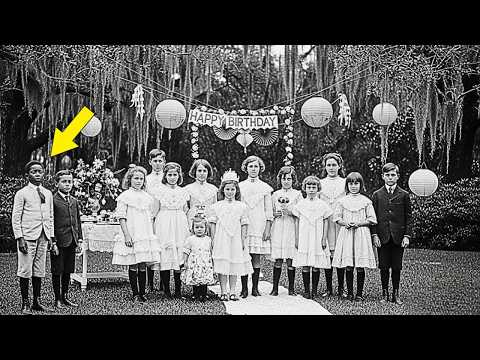
She checked the back of the original photograph. In faded ink, someone had written, “Eleanor’s 10th birthday, March 15th, 1911.” Rebecca’s fingers flew across her keyboard, searching newspaper archives for that date. What she found made her breath catch: a brief article from the Times-Picayune, dated the next day, reported a tragic accident at the Duchamp estate—a young neighbor boy had drowned in the ornamental lake during the party.
The boy was identified as Robert Beaumont, age eight, son of the Duchamp family cook. The coroner ruled it an accidental drowning. But the article’s evasions were glaring: why was a servant’s child playing during a formal party? And why did the photograph show him dressed as a guest, not a servant? Rebecca pulled up the image again, staring at Robert’s terrified expression. He hadn’t been playing. He had seen something—something that happened right before the photo was taken.
She dug deeper, uncovering a second newspaper account from a progressive publication called the New Orleans Lantern. This article told a different story: witnesses claimed Robert was attempting to rescue another child who had fallen into the lake—specifically, four-year-old Henry Duchamp, the birthday girl’s younger brother. Robert had succeeded in pushing Henry to safety, but drowned in the process. The Duchamp family had refused to comment, and the boy was buried quietly with only his mother present.
Rebecca’s mind raced. The photograph now made chilling sense: Robert’s terror was the moment he saw Henry fall. He hadn’t fallen in by accident; he had jumped in to save him. And he had been at the party as a guest—a black child at a white family’s celebration in 1911 New Orleans, where racial segregation was absolute. How was that possible?
She searched the Duchamp family papers and found letters from Vivian Duchamp, Eleanor’s mother, revealing a childhood friendship between Vivian and Robert’s mother, Mary. Vivian had hired Mary as a cook and allowed her son to play with Eleanor. In a letter from February 1911, Vivian wrote: “Eleanor has been pestering me about her birthday celebration. She wants Robert invited as a proper guest… Charles is furious at the suggestion, but Eleanor can be remarkably persistent.” Eleanor had fought to have her best friend at her party—and won.
But the official record had erased Robert’s heroism. Rebecca obtained the coroner’s inquest file, which included testimony from Eleanor herself. “Robert saved Henry. Robert saved my brother,” the ten-year-old had said. Yet the coroner dismissed her account as the confused testimony of a distressed child, and a note from Dr. Sullivan to Charles Duchamp revealed a deliberate cover-up: “The presence of a negro child as a guest, while unusual, need not become public knowledge. I have instructed the clerk to minimize details.” Robert’s sacrifice had been buried to protect the family’s reputation and the era’s racist social codes.
Rebecca sat back, stunned. The photograph was more than a historical curiosity—it was the key to a story of friendship, heroism, and a century of silence. And she knew she had to tell it.
Rebecca pulled up the city’s death certificate database and searched for Robert Beaumont, died March 15th, 1911. The record appeared, stark and clinical: name, Robert Beaumont; race, colored; age, eight years; cause of death, drowning; location, private residence, 2847 Prytania Street; informant, Charles Duchamp. He was buried two days later in Lafayette Cemetery No. 2, the historic burial ground for New Orleans’s black community. Rebecca made a note to visit.
She then found a longer, more skeptical article in the New Orleans Lantern, dated March 18th, 1911. It reported that multiple sources claimed Robert was not employed by the household but was the son of Mary Beaumont, the family’s longtime cook. Witnesses said he was dressed in formal attire and attending as a guest—a highly unusual circumstance the Duchamp family declined to explain. Most significantly, several children present stated that Robert was attempting to rescue another child who had fallen into the water: four-year-old Henry Duchamp, the birthday girl’s younger brother. Robert succeeded in pushing Henry to the edge, where adults pulled him to safety, but Robert himself was unable to escape. “If these accounts are accurate, Robert Beaumont died a hero,” the Lantern wrote, “yet no such acknowledgement appears in the official record.”
Rebecca sat back, her heart racing. The photograph now made complete sense. Robert hadn’t been playing; he had seen Henry falling. That expression of terror was the instant before he ran to save the younger boy’s life. And he had been at the party as a guest—which meant something even more extraordinary: Robert had somehow been friends with Eleanor Duchamp, close enough that she had invited him to her tenth birthday party in a city and era where such friendships were virtually unthinkable.
She spent the next two days searching for more about Robert and his mother, Mary. The 1910 census listed Mary Beaumont, age 32, as cook in the Duchamp household, living in servants’ quarters on the property. Under her name was one child, Robert, age 7. No father was mentioned. Robert had been born out of wedlock, a significant social stigma in 1903, particularly for a black woman working in a white household. Employment records showed Mary had begun working for the family in 1899, two years before Eleanor’s birth, hired on the recommendation of Vivian Duchamp, who had known Mary from childhood.
Rebecca dug deeper. A city directory from 1895 listed the Marchand family on Dauphine Street. Two houses down was the Beaumont family: Thomas Beaumont, a dock worker, his wife Alice, and their daughter Mary, age 17. Vivian and Mary had been neighbors, possibly friends. When Vivian married into the wealthy Duchamp family, she brought Mary with her as a trusted cook. And when Mary’s son Robert was born in 1903, he had grown up in the same household as Eleanor, born in 1901. The two children would have been playmates in their earliest years before the rigid social rules of segregated New Orleans forced them apart—except, somehow, they hadn’t been entirely separated.
Vivian’s personal correspondence, preserved in a small wooden box among the family papers, contained several letters from 1909 and 1910. One, to her sister Marguerite, mentioned the children: “Eleanor continues to be a spirited child… She has formed a close attachment to Mary’s boy Robert, who is clever and kind. They spend hours in the garden inventing elaborate games. Charles disapproves, of course… but I see no harm in it. They are children, and childhood friendships are innocent, whatever society’s rules might demand. I remember my own friendship with Mary at that age.”
Another letter, dated February 1911, revealed more: “Eleanor has been pestering me about her birthday celebration. She wants Robert invited as a proper guest, not hidden away in the kitchen. Charles is furious at the suggestion, but Eleanor can be remarkably persistent… She says Robert is her best friend, and that it would be cruel to exclude him. I find myself agreeing with her, though I know what scandal it might cause. Sometimes I think my daughter sees the world more clearly than any of us.”
Rebecca felt tears prickling her eyes. Eleanor had fought to have Robert at her party, despite knowing it would be controversial. And she had won. Robert had attended, dressed formally, welcomed as a guest—and then he had died saving Eleanor’s younger brother.
She needed to know what happened to Eleanor afterward. She found Eleanor’s obituary from October 1989: Eleanor Duchamp Morrison, age 88, passed away peacefully at her home in the Garden District. She was educated at Newcomb College and devoted her life to social causes. She was an early supporter of civil rights initiatives in Louisiana and worked tirelessly with the Urban League and the NAACP throughout the 1950s and 1960s. Memorial donations may be made to the Robert Beaumont Scholarship Fund at Xavier University.
The Robert Beaumont Scholarship Fund. Eleanor had created a scholarship in Robert’s name—78 years after his death, she had ensured his name would be remembered and honored.
Rebecca contacted Xavier University’s development office. The coordinator sent her the fund’s documentation. Eleanor had established it in 1969, providing a generous endowment that funded full scholarships for promising black students studying education or social work. The mission statement, written by Eleanor herself, read: “In memory of Robert Beaumont, who died at age eight performing an act of extraordinary courage and selflessness. His brief life embodied the best of human nature, transcending the artificial barriers that society erects between people. This scholarship honors his memory and supports young people who, like Robert, possess both moral courage and compassionate hearts.”
Rebecca printed the document and placed it beside the photograph of the birthday party. Eleanor had spent her entire adult life working for civil rights and had created a lasting tribute to her childhood friend. But the full story of Robert’s heroism and the friendship that had led to his presence at that party had remained buried—known only to Eleanor and perhaps a few others—until now.
Rebecca contacted the Louisiana State Archives and obtained the complete coroner’s inquest file. The testimony was brief, almost perfunctory. Charles and Vivian Duchamp both claimed Robert had been “playing near the lake despite warnings.” The groundskeeper offered nothing new. But then came Eleanor’s statement, and Rebecca’s hands trembled as she read it: “Robert was my friend. He came to my birthday party. I heard Robert yell. He ran past me toward the lake. Robert jumped in and pushed Henry toward the edge. Robert saved my brother.”
The coroner had scrawled a note beside her words: Child appears distressed and confused. Account differs from adult witnesses. A separate handwritten note from Dr. Sullivan to Charles Duchamp, dated the day after the inquest, removed all doubt. “Per our discussion, I have concluded the inquest and ruled the death accidental. The matter is closed. I trust this resolution will prevent any further scrutiny or scandal regarding the circumstances of your daughter’s party.”
Rebecca made copies of every page. This documentation would anchor the exhibit she was already imagining—one that would finally tell Robert’s true story and honor the friendship between him and Eleanor that had defied the brutal racial codes of their time.
She called Catherine Morrison, Eleanor’s daughter, who had donated the family papers. After a long pause, Catherine said, “My mother spoke about him toward the end of her life. I’m surprised to hear there’s a photograph.” They arranged to meet at Catherine’s Garden District home, where over tea Rebecca shared everything: the photograph, the newspaper articles, the inquest records, and Eleanor’s letter about establishing the scholarship.
Catherine listened, occasionally wiping her eyes. Then she stood and removed a leather-bound album from a bookshelf. “My mother gave this to me a few years before she died. She said I should understand the truth about our family, both the good and the shameful parts.” Inside were photographs Rebecca had never seen—Eleanor and Robert as young children, playing together in the Duchamp garden. Another showed Eleanor as a young woman in the 1920s, standing beside a gravestone.
“My mother visited Robert’s grave every year on the anniversary of his death,” Catherine said. “She never missed a year, not in 78 years. She would place flowers and sit there for hours.”
Rebecca asked what Eleanor would want done with the story now. Catherine smiled through her tears. “My mother would want everyone to know the truth. She would want Robert honored. She spent her entire life fighting to dismantle the conventions that buried him. Telling his story now would fulfill her life’s work.”
With the family’s blessing, Rebecca spent three months building the exhibit. She titled it Hidden in Plain Sight: The True Story Behind a Birthday Party Photograph. The entrance featured a large reproduction of the image with a simple question: “What do you see?” Visitors were then directed to the boy in the corner, to his expression of terror, and to the truth that followed.
The exhibit opened on March 15th, 2024, exactly 113 years after Robert’s death. Over 500 people attended. James Beaumont, Robert’s great-nephew, stood before Robert’s portrait for a long time. “For over a century, my family has told Robert’s story privately in our homes,” he said. “Today, the world knows the truth. Today, Robert gets the recognition he deserved in 1911.”
Two years later, a new granite monument was dedicated at Robert’s grave in Lafayette Cemetery No. 2. James Beaumont and Catherine Morrison unveiled it together, both crying. A children’s choir sang Amazing Grace. A seven-year-old girl left a note that read: “Thank you, Robert, for being brave. I will try to be brave like you.”
As Rebecca left the cemetery that day, she thought about the photograph that had started everything. Robert Beaumont had lived only eight years, but his story would now live forever. In an archive room somewhere, she knew another photograph was waiting. Another truth was ready to be discovered. And she would keep looking.
What forgotten hero in your own family’s history deserves to be remembered?
Report this article
Select a reason for reporting:






